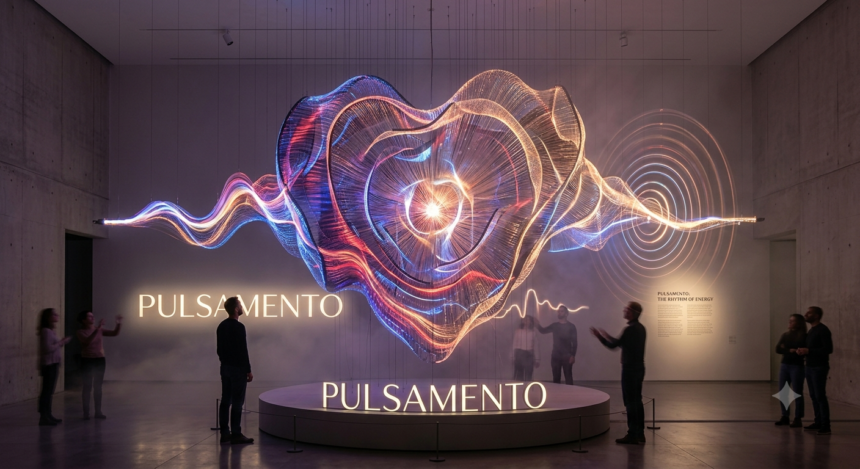
Pulsamento is an emerging term used online to describe a pulse, repeating beat, rhythmic movement, or recurring flow. It may refer to the heartbeat of music, the measurable rhythm of a biological process, a repeated signal in technology, or a metaphor for momentum and vitality. The important point is context: the word does not yet carry one universally standardized meaning in English.
That ambiguity explains both its appeal and the confusion surrounding it. Some pages present the term as a formal musical technique, others treat it as a wellness philosophy, and still others use it as a broad synonym for pulsation. A more accurate approach is to separate the established concepts behind the word from the newer interpretations being built around it.
What Does Pulsamento Mean?
In simple language, Pulsamento means a recurring pulse, beat, vibration, or pattern of movement. It is best understood as a flexible descriptive term rather than a tightly defined English technical term.
The closest established English word is pulsation, which Merriam-Webster defines as rhythmic throbbing or vibrating, as well as a recurring increase and decrease in a measurable quantity such as pressure, volume, or voltage. Cambridge similarly defines pulsation as movement with a strong, regular rhythm.
This gives the term a useful conceptual centre:
- Pulse: an individual beat or signal
- Rhythm: the organized pattern created by repeated events
- Frequency: how often the event repeats
- Amplitude: the strength or size of each variation
- Oscillation: repeated movement around an equilibrium point
- Tempo: the speed of a musical beat
These related ideas overlap, but they are not interchangeable. A pulse may happen once, while a rhythm requires a pattern. Frequency measures repetition, whereas amplitude describes intensity.
Is Pulsamento a Real Word?
The safest answer is: it is a real term in current online usage, but it is not a standard, widely defined English dictionary word. In the sources reviewed, major English dictionaries provide entries for pulse, pulsate, and pulsation, while recent web articles use the newer form in broader and sometimes conflicting ways.
That does not make the word meaningless. Language often develops through specialist use, borrowing, branding, artistic expression, and repeated public adoption. It does mean writers should define the term the first time they use it instead of assuming every reader understands the same thing.
A responsible definition might read:
Pulsamento is a descriptive term for a recurring pulse or rhythmic pattern expressed through sound, movement, biology, technology, or metaphor.
This definition is broad enough to reflect actual usage without pretending the term has an official scientific or medical status.
The Linguistic Roots Behind Pulsamento
The word belongs to the same semantic family as pulse, pulsate, and pulsation. Merriam-Webster traces pulsation through Medieval Latin to pulsare, associated with repeated striking, beating, or throbbing.
That root explains why the concept works naturally across several fields. A heart beats. A drum is struck. A speaker vibrates. An electrical signal rises and falls. Each involves repetition, variation, and movement through time.
Claims that the term has one precise origin in Italian, Spanish, or Portuguese should be treated cautiously unless a reliable language dictionary is cited. Its form sounds Romance-language-based, but its current English-language popularity appears to be shaped heavily by online publishing and creative usage rather than a single documented technical tradition.
The Concept in Music: The Underlying Sense of Motion
Music offers the clearest everyday example. Listeners often feel a steady underlying beat before they identify melody, harmony, or lyrical meaning. That perceived pulse helps them clap, tap a foot, dance, or predict when the next accented sound will arrive.
In formal music theory, more established terms are usually preferred:
- Beat is the basic recurring unit listeners follow.
- Tempo describes how fast the beat moves.
- Meter organizes beats into repeated groups.
- Rhythm describes the durations and timing of notes and rests.
- Groove refers to the performed rhythmic feel created by timing, accents, and interaction.
MusicTheory.net, for example, explains meter through the grouping and subdivision of beats rather than through the newer keyword.
How Musicians Could Use the Concept
For a musician, the term can describe the felt continuity that keeps a performance alive. It is not simply metronomic accuracy. A technically precise performance may still sound stiff if accents, phrasing, dynamics, and microtiming fail to create forward movement.
A practical rhythm exercise is to:
- Set a metronome at a comfortable speed.
- Clap only the main beats.
- Subdivide each beat into two, three, or four equal parts.
- Remove the metronome for several measures.
- Bring it back and check whether the internal pulse has drifted.
This turns an abstract idea into a measurable skill: maintaining timing while preserving expression.
Pulsamento in the Human Body
The body contains many repeating processes, but they operate on different timescales. Heartbeats occur many times per minute, breathing follows a slower cycle, and circadian rhythms organize changes across roughly 24 hours.
A pulse felt at the wrist is produced by pressure changes in the arteries associated with the cardiac cycle. The American Heart Association recommends checking it with the index and middle fingers and counting the beats over a measured period.
This is where careful wording matters. Pulsamento may be used informally to describe a bodily beat or throbbing sensation, but it is not a medical diagnosis. Clinicians use more specific terms such as:
- Heart rate
- Arterial pulse
- Palpitation
- Arrhythmia
- Pulsation
- Respiratory rate
- Heart-rate variability
When someone feels racing, skipped, irregular, or unusually forceful beats, describing the location, duration, triggers, and accompanying symptoms is more useful than relying on a broad keyword.
Rhythm Does Not Always Mean Regularity
A frequent myth is that any normal physiologic function operates perfectly regularly, like a metronome. There is often deviation, and the question is whether the observed pattern is normal for the situation, activity, and individual.
Openstax points out that in addition to rate and rhythm, the force of the pulse is evaluated, and that an irregular pulse may be a sign of atrial fibrillation
Seeking medical attention is advised for any sudden pain in the chest, fainting, shortness of breath, or an abnormal pulse. This is not a substitute for professional care. The article is conceptual – please consult with a physician regarding your particular health situation.
Circadian Pulsamento and Daily Biological Timing
The broad idea also fits daily biological cycles. The National Institute of General Medical Sciences explains that circadian rhythms include physical, mental, and behavioural changes occurring over a 24-hour cycle, with light and darkness exerting the strongest influence. Food intake, stress, activity, temperature, and social conditions can also affect these rhythms.
Calling this circadian Pulsamento may be poetically effective, but “circadian rhythm” remains the scientifically recognized phrase. The distinction protects accuracy while allowing creative language.
For daily planning, the useful lesson is not to chase a mysterious hidden energy. It is to observe repeatable patterns:
- When concentration feels strongest
- When sleepiness consistently appears
- How late caffeine affects sleep
- Whether exercise timing changes alertness
- How irregular schedules affect mood and performance
A two-week log usually reveals more than a single day of observation because rhythm becomes visible through repetition.
Pulsamento in Physics and Engineering
In science and engineering, related concepts are described with precise measurable terms. A repeating mechanical movement may be an oscillation. A changing electrical quantity may be represented as a waveform. A short burst may be called a pulse, while the number of cycles per second is frequency.
Merriam-Webster’s technical definition of pulsation includes periodically recurring increases and decreases in quantities such as pressure, volume, and voltage.
A useful engineering interpretation therefore has four components:
- Period: time required for one complete cycle
- Frequency: number of cycles per unit of time
- Amplitude: maximum variation from the reference level
- Phase: position within a repeating cycle
Using the term as an umbrella label may make a concept accessible to general readers. Technical documentation, however, should use the exact variable being measured.
Digital Technology, Interfaces and Signal Design
Digital products also rely on recurring visual and electronic patterns. A notification light may pulse. A loading icon repeats. Haptic feedback creates a timed vibration. Audio software displays waveforms, beats per minute, and transient peaks.
Here, Pulsamento can become a design principle: repetition should communicate state, urgency, progress, or interaction without overwhelming the user. A fast flashing signal may imply warning, while a slow expansion-and-contraction animation may suggest waiting or breathing.
Designers should test three factors:
- Meaning: Does the pattern communicate the intended status?
- Accessibility: Could flashing, vibration, or motion create discomfort or confusion?
- Consistency: Does the same pattern represent the same action throughout the product?
Rhythm in interface design is not decoration alone. Timing changes how users interpret feedback.
Pulsamento as a Metaphor for Work and Creativity
The term is often extended metaphorically to habits, productivity, and creative flow. That use can be helpful when it describes a real work-rest pattern rather than making unsupported health or performance promises.
Creative work rarely advances at a perfectly constant rate. Research, drafting, revision, recovery, and feedback form a repeating cycle. The most sustainable rhythm is often one that alternates focused effort with deliberate pauses.
A simple work cycle might include:
- A clearly defined task
- A protected concentration period
- A short recovery break
- A review of progress
- A decision about the next cycle
The value comes from the structure, not from the label. Pulsamento is useful here because it reminds people to design repeatable momentum instead of depending on motivation alone.
How to Identify Pulsamento in Any Context
When the word appears without explanation, use a five-question framework.
1. What Is Repeating?
Identify the event: a beat, movement, signal, sensation, behaviour, or visual change.
2. How Often Does It Repeat?
Look for tempo, frequency, period, or another measure of recurrence.
3. Is the Pattern Regular or Variable?
Some patterns are mechanically consistent. Others deliberately speed up, slow down, strengthen, or weaken.
4. What Carries the Pattern?
The carrier might be sound, light, pressure, electricity, muscle movement, data, or human behaviour.
5. What Function Does It Serve?
A recurring pattern may synchronize performers, transmit information, regulate a process, indicate a health signal, guide movement, or create emotional impact.
This framework prevents vague explanations. It converts a broad concept into observable components.
Common Misconceptions
“It Is a Recognized Medical Treatment”
No reliable evidence supports treating the keyword itself as a therapy. Slow, controlled breathing has been studied for physiological and psychological effects, but those findings belong to specific breathing methods and study conditions—not to an undefined branded concept.
Systematic reviews report potentially useful effects while also emphasizing differences among techniques and evidence quality.
“It Is Just Another Word for Heart Rate”
Heart rate is the number of heartbeats per minute. A pulse is the pressure wave felt in an artery, while rhythm describes the timing pattern. These ideas are connected but not identical.
“Every Repeating Pattern Is the Same”
A 120 BPM drum pattern, a 1-hertz signal, a breathing cycle, and a circadian rhythm all repeat, but their mechanisms, units, and purposes differ. The broad concept links them; technical language separates them.
“The Term Has One Official Definition”
Current usage is too varied for that claim. Readers should expect the intended meaning to change across music, health, technology, art, and branding.
How Content Creators Should Write About Pulsamento
Writers targeting this keyword have an opportunity to be more accurate than many existing pages. Start with a transparent definition, acknowledge the term’s nonstandard status, and then explain each established concept with the correct vocabulary.
For stronger E-E-A-T signals:
- Cite dictionaries for etymology and established meanings.
- Use medical organizations for health claims.
- Use scientific institutions for biological timing.
- Separate metaphor from measurable fact.
- Avoid claiming that the term cures stress, improves circulation, or changes brain function.
- Add expert review when publishing medical or therapeutic guidance.
- Include examples showing how meaning changes by context.
This approach satisfies curiosity without turning ambiguity into misinformation.
Practical Examples
The following sentences show responsible use:
- “The track’s Pulsamento comes from a steady kick pattern and syncopated bass line.”
- “The installation uses light Pulsamento to make the wall appear as if it is breathing.”
- “Engineers measured the pressure pulsation rather than relying on a visual impression.”
- “Her weekly creative routine developed a reliable rhythm of research, drafting, and revision.”
- “The patient reported palpitations, so the clinician recorded heart rate and rhythm.”
Notice the pattern: creative contexts allow broad language, while technical and medical contexts benefit from precise terminology.
Why the Concept Matters
Humans understand the world partly through pattern recognition. Repetition helps us anticipate music, coordinate movement, notice changes in the body, interpret signals, and structure time.
Pulsamento gives that family of experiences a memorable name. Its value is greatest when it acts as an entry point—not when it replaces established knowledge.
Used carefully, it connects art and measurement. It allows a reader to move from feeling a beat to asking better questions about tempo, frequency, physiology, or design.
Frequently Asked Questions
What Is Pulsamento in Simple Terms?
Pulsamento is a broad descriptive word for a recurring pulse, beat, vibration, or rhythmic pattern. Its exact meaning depends on whether the context is music, body rhythm, science, technology, art, or metaphor.
Is Pulsamento an English Dictionary Word?
It does not appear to be a widely standardized English dictionary entry in the sources reviewed. Established dictionaries instead define related terms such as pulse, pulsate, and pulsation. Writers should therefore explain what they mean when using it.
What Does Pulsamento Mean in Music?
In music, it can describe the felt underlying pulse that supports timing and movement. More precise music-theory terms include beat, tempo, meter, rhythm, subdivision, groove, and accent.
Is Pulsamento Connected to the Heartbeat?
Conceptually, yes, because the heartbeat and arterial pulse are recurring biological events. Medically, however, the preferred terms are heart rate, pulse, rhythm, palpitation, or arrhythmia, depending on what is being described.
Can Pulsamento Improve Focus or Reduce Stress?
The word itself has no proven therapeutic effect. Structured routines, rhythmic movement, music, or controlled breathing may influence attention or stress under particular conditions, but claims should be tied to the specific practice and credible evidence rather than the keyword alone.
Conclusion: Use the Word, but Define the Context
Pulsamento is best understood as a modern umbrella term for pulse-like repetition across music, biology, technology, art, and daily behaviour. It is memorable and flexible, yet that flexibility creates a responsibility to distinguish metaphor from scientific or medical fact.
The next step is simple: identify what is repeating, measure its timing where possible, and use the established technical term alongside the broader concept. That approach makes your writing clearer, your claims more trustworthy, and your explanation genuinely more useful than the vague definitions currently dominating the topic.