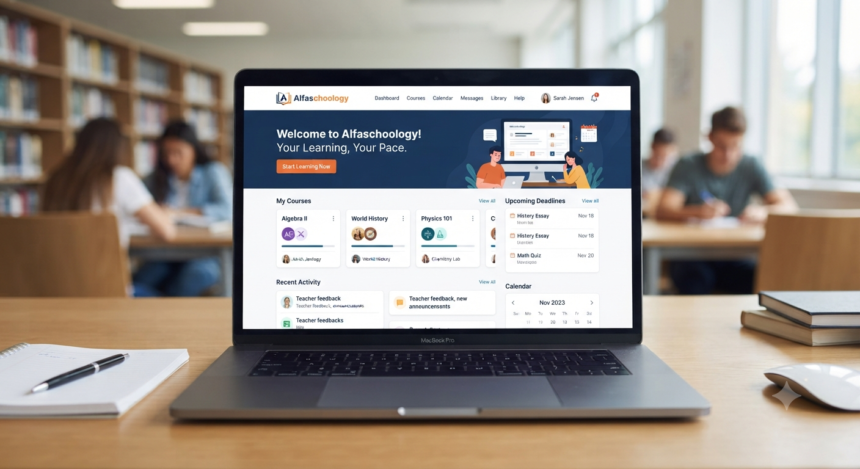
Alfaschoology is the term many students, parents, and educators use when searching for the Schoology learning portal associated with Alfa Fundación. It is not a clearly documented standalone software product; rather, the verified portal uses an Alfa Fundación Schoology subdomain and currently directs users to Microsoft authentication. 0turn312207view2
That distinction matters. Search results often describe the platform as though it were a unique learning management system, but the practical reality is simpler: users are accessing an institution-configured version of PowerSchool Schoology Learning, with the login method, course permissions, notifications, and available tools controlled by the school.
This guide explains what the portal is, how access works, what users can reasonably expect after signing in, and how to solve the most common problems without relying on guesswork. It also separates verified platform details from assumptions repeated by unofficial websites.
What Is Alfaschoology?
Alfaschoology is an unofficial term that refers to the learning platform used by the Alfa Fundación educational institution. The foundation runs an exclusive educational program for students in the Monterrey region, offering its learners high-caliber training, long-term academic improvement, and university preparation. al is hosted on Schoology, an online learning management system where students access courses, learning material, assignments, tests, and communication with educators. On PowerSchool’s website, the company’s product is described as online classrooms that allow students to engage in classes, connect with classmates, and communicate with teachers. way to understand the relationship between these terms is provided below.
Schoology is the online learning platform where the courses are hosted.
Alfa Fundación is the educational institution that offers the program. It is separate from the technology that hosts it but is deeply integrated with it.
Alfa Fundación Schoology is the learning portal that is specific to the organization.
Alfaschoology, in turn, is a shortened version of the last term. This term is frequently used by people searching for ways to access the system.
This information is critical for students who might have tried to create accounts using unrelated email addresses or searched for an unconnected portal. The practice is common among educational institutions because it prevents unauthorized access to the school’s information and ensures that only those who have to do so by right can use the learning management system.
Is Alfaschoology an Official Product Name?
There is no strong evidence that Alfaschoology is the formal name of a separate education product. The verified web address is the Alfa Fundación Schoology subdomain, while the underlying service is Schoology Learning.
That means users should be cautious when third-party articles promise special features, universal login credentials, or a separate Alfaschoology application. The exact tools visible inside an institution’s portal depend on administrator settings, user role, course design, integrations, and account permissions.
This is more than a branding detail. It helps students identify trustworthy login pages and makes troubleshooting easier because support questions can be directed to Alfa Fundación or the relevant Schoology administrator instead of an unknown third-party website.
How to Access the Alfaschoology Login Portal
The most reliable route is the institution’s Schoology subdomain. As verified on July 20, 2026, the Alfa Fundación portal redirected to Microsoft’s sign-in service, indicating that the organization currently uses a Microsoft-based single sign-on flow. schoology Sign-In Steps
- Open the official Alfa Fundación Schoology portal supplied by your school.
- Allow the page to redirect you to Microsoft.
- Enter the institutional Microsoft email address assigned to you.
- Enter your password and complete any security verification requested.
- Return to Schoology after successful authentication.
- Confirm that the correct courses and profile appear on the dashboard.
Microsoft single sign-on works by sending the user from Schoology to the organization’s login system, verifying the account, and then returning the authenticated user to Schoology. PowerSchool documents this type of Office 365 authentication as an institution-controlled login process. ssume that a personal Outlook, Hotmail, or Microsoft account will work. The portal may be configured to recognize only accounts provisioned by the institution.
What Users Can Expect Inside Alfaschoology
Once logged in, Alfaschoology should function like a school-managed Schoology environment. The exact layout may vary, but the core experience normally centers on a home page, courses, upcoming work, notifications, messages, learning materials, and performance information.
PowerSchool states that the student home page can display course materials, teacher comments, learning objectives, reports, and access to approved external applications. This central view helps users move from announcements to course-specific work without searching across unrelated services. se Dashboard and Learning Materials
Each course acts as a digital classroom. Teachers may organize folders by week, unit, subject, or learning objective, then add documents, links, pages, videos, discussions, assignments, and assessments.
Students should not rely only on the home feed. Opening each course directly can reveal instructions or materials that do not appear prominently in recent activity.
Assignments and Submission Tracking
A typical Schoology assignment page includes a due date, instructions, attachments, submission controls, and feedback after grading. Students should verify that an uploaded file has finished processing and that the assignment status shows as submitted.
A good submission routine is simple. Use the same checks for every assignment rather than trusting memory:
- Read the full instructions before starting.
- Check the required file type and naming format.
- Upload the correct version.
- Open the submitted file when possible.
- Capture the submission confirmation or timestamp.
- Review teacher feedback after grading.
This small process prevents many avoidable disputes involving blank documents, outdated drafts, unsupported file formats, or incomplete uploads. It also gives the student useful evidence when a genuine technical failure occurs.
Grades, Feedback, and Progress
The grade area can help students identify missing work, low-scoring skills, and patterns that require attention. However, the Schoology gradebook may not always be the institution’s final official academic record, especially when grades are also managed in another student information system.
Use grades as a feedback tool, not merely a score list. A low result paired with a detailed rubric or teacher comment is more useful than a number viewed without context.
Announcements and Communication
Teachers can use course updates, messages, comments, and discussion boards to communicate with students. Important information may appear in more than one location, so users should check notifications and the relevant course before assuming no announcement was posted.
Digital communication should remain clear and respectful. When asking for help, include the course name, assignment title, due date, device used, and a brief description of the problem.
How to Use Alfaschoology More Efficiently
Logging in is only the first step. Alfaschoology becomes genuinely useful when students develop a repeatable workflow for checking tasks, managing deadlines, and responding to feedback.
Build a Five-Minute Daily Check
At the beginning or end of each school day, complete the following check. Keep it brief enough to become an automatic habit:
- Review upcoming deadlines.
- Open new notifications.
- Check every active course.
- Identify one priority task.
- Confirm that recent submissions were received.
This routine reduces the risk of missing work hidden inside a course folder or update. It also makes larger workloads feel more manageable because students are making decisions before deadlines become emergencies.
Use the Calendar as a Planning Tool
Schoology can provide calendar information for courses and upcoming activities. PowerSchool also documents an iCal option that can share Schoology calendar data with another calendar service when the feature is enabled. should add personal preparation dates before the official deadline. For example, a project due Friday might have a research target on Monday, a draft target on Wednesday, and a final review on Thursday.
Turn Notifications Into a Filter
Too many alerts create noise; too few create blind spots. Prioritize notifications for assignment deadlines, teacher updates, direct messages, grades, and course changes.
Notification options can differ by account and administrator policy. Therefore, users should review account settings rather than assuming every course event will trigger an email or mobile alert automatically.
Create a Simple File System
Store schoolwork in folders that match course names and academic periods. Use filenames such as Biology_Cell_Report_Final_2026-07-20.docx instead of vague labels such as assignmentfinal2.docx.
This habit makes it easier to upload the right file and recover previous drafts. It is especially valuable when the same assignment is revised after teacher feedback.
Alfaschoology Mobile Access
Students may use the Schoology mobile app, but the login process must match the organization’s authentication setup. PowerSchool advises users to search for and select their school or organization in the app when single sign-on is required, rather than choosing a generic Schoology.com login. faschoology**, that likely means locating the Alfa Fundación organization and following the Microsoft sign-in redirect. If the app cannot complete the login, test the official portal in a current mobile browser before changing the password.
The mobile app is convenient for notifications, quick checks, messages, and basic coursework. PowerSchool also notes that some features or settings may be available only through a browser or computer, so a missing mobile option does not always mean the account is broken. n Alfaschoology Login Problems and Fixes
Access issues usually fall into one of four categories: the wrong portal, the wrong account, a browser or app problem, or an institution-side account issue. Identifying the category first is faster than trying random password resets.
1. The Page Keeps Returning to Microsoft Login
This can happen when the wrong Microsoft account is already active in the browser. Sign out of other Microsoft accounts, open a private browsing window, and try the official portal again.
If the institutional email is recognized but the loop continues, clear cookies for Microsoft and Schoology or test another supported browser. Avoid repeatedly resetting the password unless you have evidence that the password itself is incorrect.
2. “Account Not Found” or Unauthorized Access
The account may not yet be provisioned, the email may be typed incorrectly, or Schoology may not be matching the Microsoft identity to an existing user record. PowerSchool explains that Office 365 authentication depends on matching fields such as username, email address, or a unique identifier. the school and provide the exact error message, institutional email, date and time, and a screenshot that does not expose the password. The administrator may need to correct the user record or enrollment.
3. Courses Are Missing After Login
First, confirm that the profile name and institution are correct. Then check whether the course has started, whether enrollment has been completed, and whether the teacher has published the course or materials.
Some Schoology courses can be joined with a 13-digit access code, but this option depends on school policy and course settings. PowerSchool recommends obtaining the code from the instructor and notes that the join option may be unavailable for some students. he App Works Poorly but the Browser Works
Update the application, restart the device, and sign in by searching for the organization rather than using the generic login route. If the browser remains reliable, use it temporarily for submissions and settings that the app does not support.
Never delete an app before confirming that you know the correct institutional sign-in method. Reinstallation will not solve an account provisioning or course-enrollment problem.
5. An Assignment Will Not Upload
Check the file size, extension, internet connection, and whether the deadline has passed. Rename the file using standard letters and numbers, then retry from a browser if the mobile app fails.
Save evidence of the error and contact the teacher before the deadline when possible. Include the assignment name and attach the completed work to the message if school policy allows it.
Safety, Privacy, and Responsible Use
Because Alfaschoology is connected to an educational account, users should treat credentials, course files, grades, and messages as private. Use only the official portal or the official Schoology app, and never enter a school password into a blog, download page, or unofficial “login helper.”
PowerSchool’s privacy materials describe Schoology as part of its educational product environment and explain that data handling can include student records and integrations with services such as Google Drive. Local school policies and enabled integrations determine what an individual user encounters. abits include the following actions. They are simple, but they reduce both security risks and accidental disclosure:
- Keep institutional passwords unique.
- Use multi-factor authentication when required.
- Do not share screenshots containing grades or personal details.
- Sign out on shared computers.
- Review links before opening external resources.
- Report suspicious login prompts to school staff.
- Upload only files relevant to the course.
Students should also understand that activity inside a managed learning environment may be visible to authorized teachers or administrators. Write messages and discussion posts as part of the academic record, not as private social-media conversations.
How Alfaschoology Supports Alfa Fundación’s Educational Model
Alfa Fundación says its mission is to help students reach their potential through rigorous education, curricular opportunities, collaboration, responsibility, and commitment. It also describes a long-term program that supports learners across multiple educational levels and toward university completion. ured LMS supports that model by giving students a consistent place to find coursework, receive feedback, communicate with educators, and monitor responsibilities. The technology itself does not create academic success, but it can make expectations and progress more visible.
The strongest results come when teachers organize courses consistently, students check the platform daily, and families use available information to support—not micromanage—the learning process. Consistency matters more than the number of features enabled.
Best Practices for Students, Teachers, and Families
For Students
Treat Alfaschoology as a daily academic workspace. Check it at a fixed time, submit work early enough to recover from technical problems, and read feedback before starting the next related assignment.
For Teachers
Use predictable folder names, clear due dates, concise instructions, and consistent grading practices. A well-designed digital course reduces repetitive questions and allows students to focus on learning rather than navigation.
For Parents and Guardians
Ask the institution whether parent access is available and which information is considered official. Schoology parent access can depend on a school-provided code and local configuration, so families should follow the school’s instructions rather than attempting to create an unlinked account. ently Asked Questions About Alfaschoology
Is Alfaschoology the same as Schoology?
Alfaschoology appears to be a shorthand name for the Alfa Fundación Schoology portal, not a separate learning management system. Schoology provides the underlying technology, while Alfa Fundación controls its portal, users, courses, authentication, and institutional settings.
What is the official Alfaschoology login method?
The verified Alfa Fundación Schoology portal currently redirects users to Microsoft sign-in. Users should enter the institutional Microsoft account issued or approved by the school, not assume that a personal Microsoft account will provide access. I create my own Alfaschoology account?
Probably not for institution-managed access. Student and staff accounts are generally created, imported, or authorized by the organization, and a valid Microsoft login may still fail when no matching Schoology user record exists.
Why can’t I see my courses after signing in?
You may be using the wrong account, the enrollment may not be active, the course may be unpublished, or the academic term may not have started. Confirm your profile and contact the teacher or administrator with the course name and a screenshot of the dashboard.
Does Alfaschoology have a mobile app?
There does not appear to be a separate verified app named Alfaschoology. Users can access the institution through the official Schoology app or a browser, selecting the correct organization and completing the Microsoft single sign-on process when prompted. Takeaway
Alfaschoology is best understood as the Alfa Fundación community’s route into a customized Schoology learning environment. Use the verified institution portal, sign in with the correct Microsoft account, check courses consistently, protect your credentials, and document technical errors before contacting support.
Your next step is practical: bookmark the official portal, verify that the right courses appear, review notification settings, and create a five-minute daily dashboard routine. That simple system will help you catch deadlines earlier, submit work more reliably, and get more value from every course.