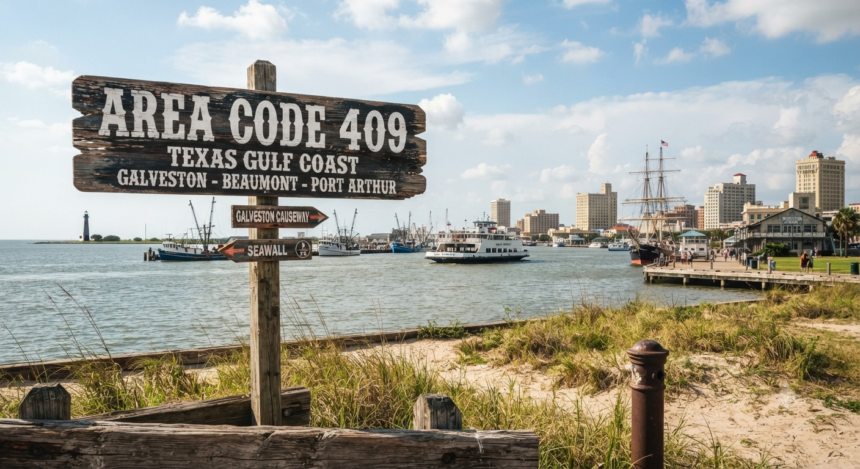
Areacode 409 belongs to southeastern Texas, covering communities along the Gulf Coast and near the Louisiana border. It is most closely associated with Beaumont, Port Arthur, Galveston, Texas City, and Orange, although the numbering area also reaches smaller cities and rural communities across the region.
For residents, the code is part of everyday regional identity. For businesses, it signals a local presence in an economically important corridor shaped by ports, energy, healthcare, tourism, manufacturing, and interstate commerce.
For anyone receiving an unfamiliar 409 call, however, the area code identifies only the number’s original numbering region. It does not confirm the caller’s identity, present location, or trustworthiness.
Areacode 409 Quick Facts
- State: Texas
- Primary region: Southeast Texas and the upper Gulf Coast
- Major cities: Beaumont, Port Arthur, Galveston, Texas City, and Orange
- Time zone: Central Time
- Standard-time offset: UTC−6
- Daylight-saving offset: UTC−5
- Established: March 19, 1983
- Created from: Area code 713
- Current local dialing format: Ten digits
- Country code when calling from abroad: +1
The Public Utility Commission of Texas lists 409 among the state’s active area codes, while the North American Numbering Plan Administrator identifies it as a ten-digit dialing area.
Where Is Areacode 409 Located?
Areacode 409 serves the southeastern edge of Texas. Its footprint stretches from the Beaumont–Port Arthur area toward Orange near the Louisiana state line and southwest along the Gulf Coast to Galveston and Texas City.
This is not the main Houston area code. Houston primarily uses the 713, 281, 832, 346, and 621 overlay complex, while 409 remains associated with communities farther east and southeast.
The distinction matters when identifying a business, estimating local calling context, or setting up geographically targeted marketing. A caller from Galveston or Beaumont may use 409, while a Houston-based caller is more likely to display one of the Houston overlay codes.
Major Cities Using the 409 Area Code
The best-known locations include:
- Beaumont
- Port Arthur
- Galveston
- Texas City
- Orange
- Nederland
- Groves
- Vidor
- Lumberton
- Jasper
- Santa Fe
- Crystal Beach
A phone number does not prove that a person currently lives or operates in one of these cities. Mobile number portability, business VoIP systems, and retained phone numbers allow people to keep a 409 number after moving elsewhere.
Counties and Communities in the Coverage Area
The numbering area reaches parts of several Southeast Texas counties, including Jefferson, Orange, Galveston, Hardin, Jasper, Newton, Chambers, and nearby rural areas. Coverage does not always follow county boundaries cleanly.
A city-specific prefix lookup is therefore more dependable than assuming every phone number in a county uses the same area code. Different communities within one county may occasionally be connected to different rate centers or numbering arrangements.
The Public Utility Commission directs users to numbering reports for prefix-level information because the three digits after the area code, known as the central office code or NXX, help identify the assigned rate center or provider. NANPA defines the NXX as the second group of three digits in a ten-digit number.
What Time Zone Does Areacode 409 Use?
Areacode 409 is in the Central Time Zone. During standard time, the region uses Central Standard Time, or UTC−6; during daylight saving time, it uses Central Daylight Time, or UTC−5.
This means the local time is generally:
- One hour behind Eastern Time
- The same as Chicago, Dallas, and most of Texas
- One hour ahead of Mountain Time
- Two hours ahead of Pacific Time
Because daylight-saving schedules can affect international or cross-border calls, confirm the current local time before contacting a business. Beaumont, for example, observes Central Daylight Time during the summer months.
Businesses running national customer-service teams should configure their call schedules around Central Time. Calling at 9:00 a.m. Eastern Time would reach a 409 customer at approximately 8:00 a.m. Central Time.
The History of Areacode 409
Areacode 409 entered service on March 19, 1983, after a geographic split from 713. Before the split, 713 covered a much larger portion of southeastern Texas, extending well beyond today’s Houston-focused numbering region.
The original 409 territory was significantly larger than it is now. It formed a broad, horseshoe-shaped region around Houston and included communities extending into East Texas and the Brazos Valley.
The split reflected growing demand for telephone numbers as the region’s population, commercial activity, and telecommunications use increased. At that time, geographic area-code splits were a common way to make additional number combinations available.
The 2000 Split That Created 936 and 979
Rapid population growth, added fax lines, early internet connections, pagers, mobile phones, and business demand increased pressure on available telephone numbers. NANPA’s planning records show that the 409 numbering plan area was eventually split to create 936 and 979.
Under the change:
- The eastern segment, including Beaumont and Galveston, retained 409.
- The central and northeastern segment, including Huntsville and Nacogdoches, moved to 936.
- The western segment, including Bryan and College Station, moved to 979.
Permissive dialing began in February 2000, allowing callers to use either the old or new code temporarily. This transition period gave residents, businesses, government offices, and organizations time to update signs, directories, stationery, advertising materials, databases, and telephone equipment.
After the transition ended, callers had to use the newly assigned area code for numbers moved into the 936 and 979 regions. Beaumont, Galveston, Port Arthur, and nearby communities continued using 409.
Why the Code Has Local Cultural Value
Area codes often become shorthand for regional identity, particularly when they represent a recognizable community rather than a large multi-code overlay zone. In Southeast Texas, 409 appears in business names, event branding, apparel, social media handles, and community promotions.
The code is also celebrated through 409 Day, held on April 9. The date uses the month and day to mirror the three-digit area code.
In 2026, the Greater Orange Chamber of Commerce used 409 Day to promote local businesses through events, discounts, and giveaways. That campaign demonstrates how a telephone prefix can develop meaning beyond telecommunications and become a recognizable regional brand marker.
How to Call a 409 Phone Number
Calling a number in Areacode 409 is straightforward, but the correct format depends on where you are calling from.
Calling From Within the United States or Canada
Dial the full ten-digit number:
409 + three-digit prefix + four-digit line number
For example:
409-555-0123
Entering only the seven-digit local number may not complete the call. Contacts, speed-dial entries, alarms, fax machines, medical-alert devices, and business telephone systems should therefore store the full ten-digit number.
The 409 region transitioned to ten-digit local dialing because 988 was already used as a central-office prefix in the area. The nationwide designation of 988 as a three-digit crisis line required affected areas to stop relying on seven-digit local dialing.
Calling From Outside the United States
Use the U.S. country code:
+1 409 XXX XXXX
The plus sign represents your country’s international access code. On most mobile phones, holding the zero key produces the plus symbol.
International calling rates depend on your telephone provider. Messaging apps and internet calling services may provide lower-cost alternatives, but the recipient’s number should still be saved with +1 and the full ten-digit telephone number.
Do You Dial 1 Before 409?
For many mobile calls, entering the ten-digit number is enough. Some landline providers or business phone systems may require:
1 + 409 + seven-digit number
The number 1 traditionally indicates a long-distance call within the North American Numbering Plan. Modern mobile networks often process the call with or without it.
Calling rules and charges depend on the provider and service plan. An area code alone does not determine whether a call is free, local, or long distance.
Is Areacode 409 Legitimate?
Yes. Areacode 409 is a legitimate geographic telephone code assigned to Texas under the North American Numbering Plan. A 409 number may belong to an individual, hospital, school, government office, contractor, tourism business, industrial company, or other organization.
Still, a legitimate area code does not make every incoming call legitimate. Caller ID can be spoofed, meaning a scammer can make a call appear to originate from a familiar or local number.
This practice is sometimes called neighbour spoofing. The caller displays an area code and prefix similar to the recipient’s number, hoping the local appearance will increase the likelihood that the call is answered.
Common Reasons You May Receive a 409 Call
A call may be connected to:
- A Southeast Texas business or customer
- A medical office or hospital
- A delivery, repair, or service appointment
- A school, university, or local authority
- A hotel, rental property, or tourism provider
- A person who kept the number after relocating
- A wrong number
- A robocall or telephone survey
- A debt collector
- A fraudulent or spoofed call
The safest approach is to judge the message and requested action rather than relying merely on the area code.
How to Check an Unknown 409 Number Safely
When an unfamiliar Areacode 409 number calls, avoid making an instant decision based on caller ID. Use a straightforward verification process.
- Let unexpected calls go to voicemail. Legitimate callers usually leave a name, organization, callback reason, or reference number.
- Search the complete number. Look for consistent listings on the organization’s official website, credible directories, or public records.
- Verify the organization independently. End the call and use the official number published on the organization’s website, statement, card, or account portal.
- Do not share verification codes. One-time passwords, account PINs, Social Security numbers, and card details should not be given to an unsolicited caller.
- Pause before making a payment. Gift cards, cryptocurrency, wire transfers, and urgent “pay now” demands are serious warning signs.
- Block persistent unwanted calls. Use the blocking and spam-reporting tools offered by your mobile carrier or phone.
- Document suspicious communication. Save voicemails, screenshots, phone numbers, payment instructions, and timestamps before reporting fraud.
Be especially cautious when a caller claims to represent a bank, utility company, hospital, police department, court, tax agency, or government office. Contact that organization through an independently verified number before taking action.
The FCC warns consumers about impersonation and payment scams that use urgent language, including fraudulent toll-payment messages.
Red Flags That Suggest a Scam
Warning signs include:
- Threats of immediate arrest or legal action
- Claims that your electricity or water will be disconnected within minutes
- Requests for gift cards or cryptocurrency
- Pressure to keep the call secret
- Requests for remote access to your computer or mobile phone
- Demands for a one-time verification code
- Refusal to provide written documentation
- A callback number that differs from the organization’s official contact information
- Poorly written text messages containing shortened or unfamiliar links
A genuine local number may still be spoofed. Never assume that a caller is trustworthy simply because the number begins with 409.
Can a 409 Number Reveal the Caller’s Exact Location?
No. Areacode 409 indicates the numbering region associated with the phone number, not a real-time GPS location. Even the prefix may reveal only the original rate center or carrier assignment.
Several factors weaken location assumptions:
- Number portability: Users may retain a number after switching carriers.
- Relocation: A person can move to another city or state and keep the same mobile number.
- VoIP service: Cloud telephone systems can issue a Texas number to a user working elsewhere.
- Call forwarding: A local number may route to a remote office or call centre.
- Business routing: One number can ring employees in several locations.
- Caller-ID spoofing: The displayed number may not belong to the actual caller.
Treat area-code data as a clue, not proof of identity or physical presence. A reverse-number database may show historical assignment details, but it cannot guarantee where the phone or caller is currently located.
Business Value of a 409 Phone Number
A local number can help a business appear accessible to customers in Southeast Texas. This is particularly relevant for companies serving Beaumont, Port Arthur, Orange, Galveston, Texas City, and surrounding communities.
A 409 number may support:
- Local search and advertising consistency
- Familiarity with regional customers
- Dedicated call tracking for Southeast Texas campaigns
- Separate lines for sales, support, or individual locations
- A recognizable local identity
- Easier attribution of regional marketing leads
However, businesses should not imply that they have a staffed local office unless that is true. A virtual number may improve call routing, but transparent address, service-area, and contact information remains important for customer trust and local SEO.
Choosing a Local Number Responsibly
Before purchasing Areacode 409 service from a VoIP provider, confirm:
- Whether the number supports voice calls and SMS
- Whether multimedia messaging is available
- Whether emergency calling is configured correctly
- Whether the number can be transferred to another provider
- How caller-ID name registration works
- Whether call recording complies with applicable laws
- Whether the provider offers spam-label remediation
- Which rate center the number is assigned to
- Whether voicemail transcription is included
- How missed calls are routed outside business hours
Businesses should also keep their name, phone number, and address consistent across their website, Google Business Profile, major directories, invoices, social accounts, and customer documents. Consistency helps users verify that the telephone number is genuinely connected to the organization.
Local SEO Considerations
Using a local number can strengthen regional relevance, but the phone number is only one part of a local SEO strategy. Search engines and customers also consider address information, service pages, customer reviews, local citations, business categories, and the accuracy of operating hours.
Businesses without a physical office in Southeast Texas should describe their service area honestly. Creating fake addresses or misleading location pages can damage trust and create platform-policy problems.
A good regional landing page should include:
- The specific communities served
- Locally relevant services
- Genuine customer testimonials
- Accurate operating hours
- Clear travel or response-time expectations
- A visible local or regional phone number
- Consistent business information
Areacode 409 and Nearby Texas Area Codes
Understanding nearby codes helps distinguish Southeast Texas calls from those originating in surrounding regions.
- 713, 281, 832, 346, and 621: Greater Houston
- 936: Huntsville, Conroe, Lufkin, and parts of East Texas
- 979: Bryan–College Station and portions of the Brazos Valley and Gulf Coast
- 337: Southwestern Louisiana
- 361: Corpus Christi and parts of the Texas Coastal Bend
The boundaries reflect telephone-number administration, not cultural or economic borders. Someone working across the Houston–Beaumont corridor may regularly communicate with contacts using several different area codes.
A business near a boundary may also serve customers in both 409 and a neighbouring numbering region. For that reason, local service areas should be confirmed through an address or ZIP code rather than an area code alone.
Frequently Asked Questions About Areacode 409
1. What city is Areacode 409 associated with?
Areacode 409 is most strongly associated with Beaumont, but it also serves Port Arthur, Galveston, Texas City, Orange, and surrounding Southeast Texas communities. It is a regional code rather than a code for one city only.
Beaumont is frequently identified as the major city for the numbering area because it is one of the largest and most recognizable communities within the region.
2. Is 409 a Texas area code?
Yes. It is an active Texas area code serving the southeastern part of the state, including the upper Gulf Coast and the Beaumont–Port Arthur region.
The Public Utility Commission of Texas includes 409 in its official area-code resources.
3. What time is it in the 409 area code?
The region follows Central Time. It normally uses UTC−6 during standard time and UTC−5 during daylight saving time.
Check the current daylight-saving status when scheduling a call from another country. The local time can shift by one hour relative to regions that do not change their clocks.
4. Why must I dial all ten digits for a local 409 call?
Ten-digit dialing became necessary because some 409 numbers used 988 as a prefix, while 988 was designated as a nationwide three-digit crisis line. Requiring the area code prevents dialing conflicts between local numbers and the three-digit service.
Update saved contacts, alarm systems, fax machines, call-forwarding rules, security systems, and automatic diallers with the complete ten-digit number.
5. Is a call from 409 automatically a scam?
No. Many legitimate residents, companies, healthcare providers, schools, tourism businesses, government departments, and public organizations use 409 numbers.
However, scammers can spoof local caller ID. Verify unexpected payment requests, account warnings, legal threats, or demands for personal information through an independently sourced official number.
Conclusion: What to Do When You See a 409 Number
Areacode 409 points to Southeast Texas, especially Beaumont, Port Arthur, Galveston, Texas City, and Orange. It operates in Central Time, requires ten-digit dialing, and has served the region since its 1983 split from area code 713.
When you receive a 409 call, use the location as context rather than proof. Listen to the voicemail, search the complete number, verify organizations through official contact channels, and never respond to pressure with sensitive information or immediate payment.
For business use, choose a 409 number only when it genuinely matches your service area or customer base. Keep your contact information consistent, configure the line securely, and make it easy for customers to confirm who is calling.