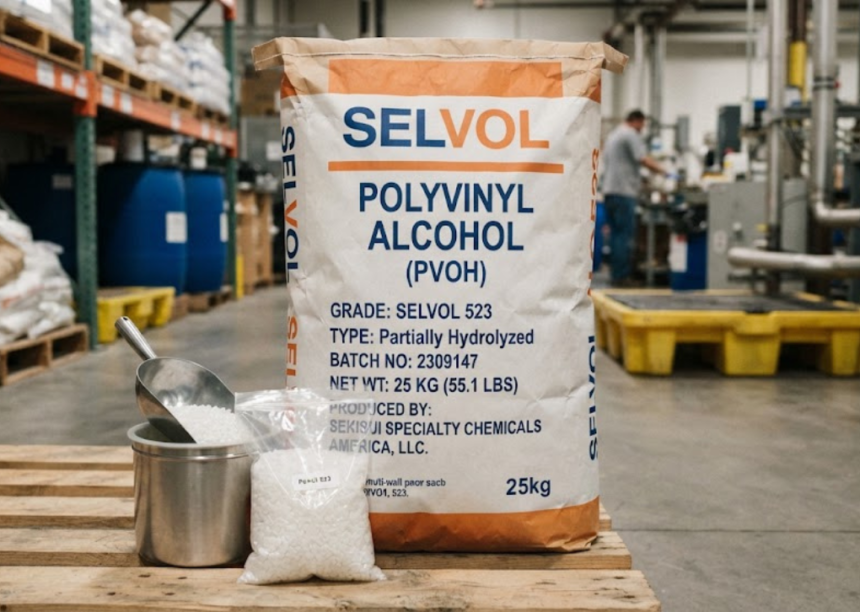
Selvol polyvinyl alcohol is a family of water-soluble PVOH/PVA polymers supplied by SEKISUI Specialty Chemicals for applications ranging from adhesives and paper coatings to textiles, emulsion polymerization, ceramics and water-soluble films. What makes the product family useful is not simply “PVA” as a chemistry. Performance changes materially with degree of hydrolysis, molecular weight, viscosity, particle size and formulation conditions, so choosing the correct grade can determine whether a process runs smoothly or creates problems with dissolution, coating rheology, adhesion or final-film resistance.
This guide explains how Selvol polyvinyl alcohol is made, how its grade structure works, what the major performance variables mean in practice and how manufacturers can narrow the options before laboratory validation.
What Is Selvol Polyvinyl Alcohol?
Selvol polyvinyl alcohol is SEKISUI Specialty Chemicals’ commercial PVOH product family. The manufacturer describes the resin as being produced from vinyl acetate monomer (VAM): VAM is first polymerized to polyvinyl acetate and then converted to polyvinyl alcohol through hydrolysis. That route matters because PVOH is not normally produced by directly polymerizing vinyl alcohol.
The resulting polymer contains hydroxyl-rich segments that give PVOH its characteristic affinity for water, strong film formation and adhesion to many hydrophilic surfaces. Residual acetate groups vary with hydrolysis level, and that difference changes solubility, hydrophobic-surface adhesion, water resistance and several processing characteristics.
SEKISUI currently groups the broader line into standard and specialty grades, including polymerization grades, fine-particle S-grades and tackified PVOH. It also offers premade solutions of selected grades in the United States, which can remove the cooking step for users that want ready-to-use material.
Why Degree of Hydrolysis Matters So Much
If you compare two grades of Selvol polyvinyl alcohol, hydrolysis is one of the first specifications to examine. It indicates how extensively acetate groups have been converted to hydroxyl groups.
As hydrolysis increases, hydrogen bonding generally becomes stronger. SEKISUI notes that water resistance and humidity resistance rise with increasing hydrolysis, while partially hydrolyzed grades tend to show better adhesion to hydrophobic surfaces.
In practical terms:
- Super-hydrolyzed grades are suited to applications demanding the highest water and humidity resistance.
- Fully hydrolyzed grades provide strong film strength, water resistance and adhesion to cellulosic materials.
- Intermediate grades can balance water resistance, adhesion and processability.
- Partially hydrolyzed grades are often easier to dissolve and can offer stronger affinity for less-polar or synthetic surfaces.
This is why “PVOH is water soluble” is too broad to guide formulation work. Water response depends on grade chemistry, temperature, film history, thickness, crystallinity and any crosslinking or plasticization used in the system.
How Viscosity and Molecular Weight Change Performance
The second major selection lever is molecular weight, which SEKISUI commonly expresses through solution viscosity. Its published ranges associate roughly 3–4 cP with ultra-low viscosity, 5–6 cP with low viscosity, 22–30 cP with medium viscosity and 45–72 cP with high viscosity; the corresponding average molecular-weight ranges rise as viscosity increases.
Higher molecular weight can improve cohesive and mechanical strength, but it also raises solution viscosity. That trade-off matters on high-speed coaters, pumps, spray systems and processes where high solids are desirable.
Lower-viscosity Selvol polyvinyl alcohol may be attractive when formulators need easier pumping, higher solids or lower application viscosity. Higher-viscosity grades can be valuable when film integrity, binding strength or rheology development has priority.
A useful rule is simple: do not select viscosity in isolation. Evaluate it together with solids level, shear conditions, coating weight, drying profile and substrate.
Key Physical and Functional Properties
Selvol polyvinyl alcohol is used across very different industries because the same polymer family can deliver several functions at once. SEKISUI lists high tensile strength, film formation, adhesive performance and resistance to greases, petroleum hydrocarbons, and animal or vegetable oils among its relevant properties. Resistance to organic solvents also tends to increase with hydrolysis.
Important functional attributes include:
- Film formation: useful for coatings, binders, protective layers and soluble films.
- Adhesion: particularly valuable in paper, wood, packaging and emulsion-based adhesive systems.
- Oil and grease resistance: relevant to paper and barrier-coating development.
- Water solubility or controlled water sensitivity: adjustable through grade selection and formulation.
- Tensile and cohesive strength: valuable in yarn sizing, films and temporary binders.
- Crosslinkability: hydroxyl functionality allows performance to be modified chemically.
- Rheology control: molecular weight and concentration strongly affect solution viscosity.
The dry resin is described by SEKISUI as a white-to-cream granular powder. The company also notes that solid product has indefinite storage stability when protected from moisture, emphasizing the importance of dry storage and sealed handling.
Common Selvol Polyvinyl Alcohol Grades
There is no single “best” grade of Selvol polyvinyl alcohol. The correct option depends on the target balance of solubility, adhesion, strength, water resistance and processing viscosity.
Selvol 205: Low-Viscosity, Partially Hydrolyzed
Selvol 205 is a useful example of how a partially hydrolyzed grade behaves. SEKISUI describes it as a low-viscosity product at approximately 88 mol% hydrolysis, with applications spanning multiple industrial systems. The retained acetate groups help increase surface activity and compatibility with PVAc and related vinyl-ester emulsions.
For a formulator, that combination can be useful where strong emulsion stabilization, adhesion and manageable viscosity are more important than maximizing water resistance.
Selvol 325: Medium-Viscosity, Fully Hydrolyzed
Selvol 325 sits at the other end of the decision spectrum. SEKISUI identifies it as a fully hydrolyzed, medium-viscosity grade with 98.0–98.8% hydrolysis and a typical viscosity range around 28–32 cP in the company’s product data. Its higher hydrolysis supports stronger water resistance and adhesion to cellulosic substrates.
That profile helps explain why grades in this range are considered for paper sizing, board laminating, winding and other applications where cohesive strength and film integrity matter.
Selvol E Grades
The Selvol E line is manufactured in Tarragona, Spain and includes fully hydrolyzed, partially hydrolyzed and fine-particle grades. Current published examples range from low-viscosity E103 and E203 through medium-viscosity E325 and E523.
Importantly, regional counterparts should not be assumed to be automatically interchangeable. SEKISUI advises comparing viscosity, hydrolysis, solution behavior and availability when switching between standard and Selvol E products.
Where Selvol Polyvinyl Alcohol Is Used
The value of Selvol polyvinyl alcohol becomes clearer when it is viewed by function rather than by industry name alone.
Adhesives and Emulsion Polymerization
In PVAc and related emulsions, PVOH can act as a protective colloid and contribute to adhesive performance. Grade selection affects emulsion viscosity, particle behavior, wet tack and final bonding characteristics.
SEKISUI also offers specialized polymerization grades such as 805, 823 and 840, which it positions as improved versions of standard grades for emulsion polymerization, including benefits such as better water solubility and lower foaming.
Paper and Paperboard
For paper, Selvol polyvinyl alcohol can serve in surface sizing, pigment coating, anti-grease treatment, thermal-paper systems and specialty coatings. Fully hydrolyzed grades are particularly relevant where film strength, cellulosic adhesion or improved water resistance is required.
The real formulation challenge is balancing barrier performance with coatability. A resin that provides excellent dry-film properties but drives viscosity beyond the coater’s operating window may not be the best production choice.
Textiles
PVOH is widely associated with warp and yarn sizing because it can reinforce yarn, improve abrasion resistance during weaving and later be removed under controlled conditions. Hydrolysis level changes both adhesion to fiber types and ease of desizing.
For synthetic yarns, partially hydrolyzed grades can offer an advantage because residual acetate groups improve adhesion to less hydrophilic fibers. For cotton-rich systems, more highly hydrolyzed grades may provide a stronger balance of film strength and cellulose affinity.
Ceramics, Construction and Specialty Binders
Selvol polyvinyl alcohol also functions as a temporary binder in ceramic and mineral systems. Fine-particle S-grades are designed for applications where particle size and dispersion behavior matter; SEKISUI states that more than 99% of these products pass a U.S.S. 80-mesh screen.
Other published application areas include seed coatings, PVC production, oil-field cementing, building products, microencapsulation and specialty coatings.
Water-Soluble Films and Packaging
Selvol polyvinyl alcohol is attractive for soluble-film concepts because its water response can be tuned through hydrolysis, molecular weight and formulation. But “water soluble” should never be treated as a single performance specification.
A film intended to remain intact during humid storage but dissolve during a defined wash cycle needs different chemistry and testing from a temporary industrial release film. Thickness, additives, humidity conditioning and dissolution temperature all matter.
How to Prepare Selvol Polyvinyl Alcohol Solutions Correctly
Poor dissolution can make a suitable polymer look like the wrong polymer. This is one of the most actionable points for production teams working with Selvol polyvinyl alcohol.
SEKISUI recommends a dispersion-first, dissolution-second process for most grades. Powder should be added to cold or room-temperature water under enough agitation to wet and separate the particles before heat is applied. Most non-S grades then require cooking, generally in the 85–96°C (185–205°F) range, followed by a hold of about 30 minutes at the specified temperature.
Key operating practices include:
- Add resin gradually rather than dumping it into hot water.
- Create good bulk movement without whipping excessive air into the solution.
- Reach the grade-specific minimum cook temperature.
- Avoid dead zones where swollen particles can agglomerate.
- Keep tanks and lines free from unintended borax contamination because borate chemistry can trigger rapid gelation.
- Follow the current technical data sheet for maximum recommended solids.
For Selvol polyvinyl alcohol, incomplete cooking may leave transparent gel-like particles that are easy to miss visually but can reduce performance. That can show up later as coating defects, filters plugging, viscosity inconsistency or weak final films.
How to Choose the Right Selvol Polyvinyl Alcohol Grade
A purchasing decision based only on price per kilogram is risky. For engineers evaluating Selvol polyvinyl alcohol, a better approach is to work backward from the process and end-use requirements.
Ask these questions before requesting samples:
- What must the final film do? Define strength, flexibility, water sensitivity, grease resistance, adhesion and removability.
- What substrate is involved? Cellulose, mineral, polyester, PVC and other surfaces interact differently with PVOH.
- What solution viscosity can the equipment tolerate? Include the real application solids, temperature and shear rate.
- How will the material be dissolved? Check tank heating, mixing capacity, batch time and foam control.
- Does the process need fast dissolution or fine-particle dry blending? An S-grade may deserve evaluation.
- Will the film be crosslinked or plasticized? Additives can fundamentally change water response and flexibility.
- What regulatory or regional requirements apply? Use the current TDS, SDS and applicable compliance documentation for the exact grade and market.
The best Selvol polyvinyl alcohol grade is therefore the one that meets both end-use performance and plant-process constraints. Lab testing should reproduce actual water quality, solids level, substrate, drying conditions and use environment as closely as possible.
Common Mistakes to Avoid
Several formulation failures blamed on Selvol polyvinyl alcohol are actually selection or processing failures.
- Choosing by viscosity alone: hydrolysis can change adhesion and water response even when viscosities look similar.
- Adding powder directly to hot water: rapid surface swelling encourages clumps and incomplete dissolution.
- Ignoring actual solids: a viscosity measured at one standard concentration does not predict every production formulation.
- Assuming all PVOH films dissolve the same way: temperature and hydrolysis can produce very different behavior.
- Substituting regional grades by name only: confirm specification ranges and solution behavior before changing supply.
- Making broad sustainability claims: water solubility is not the same property as biodegradation, and environmental fate depends on polymer grade and treatment conditions.
That last point deserves care. A 2024 wastewater-treatment study reported extensive biodegradation and low acute ecotoxicity for a specific nonmodified PVOH 18-88 test material, while earlier literature has reported more variable environmental degradation behavior. Sustainability statements should therefore identify the specific material, test method and disposal pathway rather than treating every PVOH formulation as environmentally identical.
Selvol Polyvinyl Alcohol vs. Generic PVA: What Buyers Should Compare
“PVA” on a purchase specification is not enough. Buyers considering Selvol polyvinyl alcohol or an alternative should compare hydrolysis range, solution viscosity, ash or purity limits, particle form, solids handling, regional availability and technical documentation.
This is where a branded grade family can simplify qualification. Current SEKISUI data publishes defined grade ranges and application guidance, while technical and safety documentation can be checked for the exact product.
For critical manufacturing, request a representative sample and validate it in the actual formulation. A paper coating, ceramic binder or adhesive emulsion may respond to small differences that do not appear obvious from a generic polymer name.
Frequently Asked Questions
Is Selvol polyvinyl alcohol the same as PVA or PVOH?
Selvol polyvinyl alcohol is a branded family of polyvinyl alcohol products. PVOH is the clearer abbreviation for polyvinyl alcohol, although PVA is also commonly used in industry.
The grade name is important because different products can have different molecular weights, hydrolysis levels and processing behavior. Two materials described simply as “PVA” may therefore perform differently in the same formulation.
Is Selvol polyvinyl alcohol soluble in cold water?
It depends on the grade and physical form. Some grades are more cold-water processable than others, but SEKISUI states that most non-S grades should be properly cooked after dispersion.
For standard Selvol polyvinyl alcohol preparation, the manufacturer recommends wetting the particles in cold or room-temperature water first, then heating to the grade-specific cook-out temperature.
What is the difference between fully and partially hydrolyzed Selvol grades?
Fully hydrolyzed products contain fewer residual acetate groups and generally provide stronger water resistance, cohesive strength and affinity for cellulosic surfaces. Partially hydrolyzed grades retain more acetate functionality, which can improve adhesion to hydrophobic substrates and make dissolution easier at lower temperatures.
The right choice depends on the substrate and whether the formulation prioritizes water resistance, adhesion, solubility or processing efficiency.
Which Selvol grade should be used for adhesives?
There is no universal adhesive grade. PVAc emulsion adhesives, remoistenable adhesives, paper converting and water-resistant laminating systems can require different hydrolysis and viscosity profiles.
When choosing Selvol polyvinyl alcohol, start with the substrate, solids content, required wet tack, water resistance and application viscosity. Shortlist suitable grades from those requirements, then confirm performance through controlled laboratory trials.
Is Selvol polyvinyl alcohol biodegradable?
The answer requires more precision than a simple yes-or-no label. Biodegradation depends on PVOH structure, test conditions, microbial environment and the treatment pathway.
Recent standardized work on a specific PVOH 18-88 material reported high biodegradation during simulated wastewater treatment, while other reviews have documented variability in environmental persistence. Any biodegradability claim for Selvol polyvinyl alcohol or another PVOH should therefore be tied to a defined material and recognized test method.
Conclusion: Match Selvol Polyvinyl Alcohol Chemistry to the Process
Selvol polyvinyl alcohol is not one polymer with one fixed performance profile. It is a configurable PVOH platform in which hydrolysis, molecular weight, viscosity, particle size and formulation choices determine how the material dissolves, coats, bonds and performs after drying.
This is why Selvol polyvinyl alcohol should be qualified against the actual manufacturing process rather than selected from a generic resin description. Define the required end-use properties first, shortlist grades by hydrolysis and viscosity, review the current TDS and SDS, and then run application-specific trials under realistic plant conditions.
That workflow is far more reliable than purchasing material based solely on a generic “PVA” label. It also gives formulators, procurement teams and production engineers the best chance of achieving stable processing, predictable film properties and repeatable commercial performance.