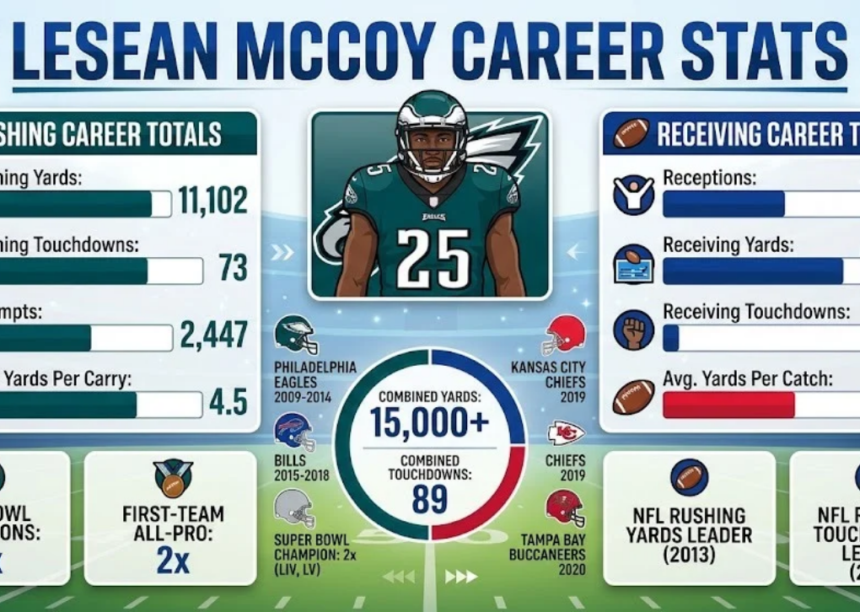
LeSean McCoy Career Stats tell the story of one of the most electrifying running backs of his generation. Known for his extraordinary footwork, unpredictable cuts, and remarkable open-field vision, McCoy spent 12 NFL seasons turning ordinary rushing attempts into memorable plays, ultimately finishing with 11,102 rushing yards, 3,898 receiving yards, and 89 total touchdowns.
Nicknamed “Shady,” LeSean McCoy became a cornerstone of the Philadelphia Eagles before extending his success with the Buffalo Bills. His later appearances with the Kansas City Chiefs and Tampa Bay Buccaneers added two Super Bowl championships to a résumé that already included six Pro Bowl selections, two first-team All-Pro honors, and recognition on the NFL’s 2010s All-Decade Team.
What makes his career especially interesting is the combination of production, longevity, and versatility. McCoy wasn’t simply a high-volume runner; he was an elite offensive weapon who could make defenders miss, create yards after contact, catch passes, and deliver spectacular performances when his team needed them most.
LeSean McCoy Career Stats: Quick Overview
Before examining individual seasons, here is a complete statistical snapshot of McCoy’s professional career.
| Career category | Official total |
|---|---|
| NFL seasons | 12 (2009–2020) |
| Games played | 170 |
| Games started | 141 |
| Rushing attempts | 2,457 |
| Rushing yards | 11,102 |
| Rushing touchdowns | 73 |
| Yards per rushing attempt | 4.5 |
| Receptions | 518 |
| Receiving yards | 3,898 |
| Receiving touchdowns | 16 |
| Total yards from scrimmage | 15,000 |
| Total rushing and receiving touchdowns | 89 |
| Pro Bowl selections | 6 |
| First-team All-Pro selections | 2 |
| Super Bowl championships | 2 |
Source: NFL official player statistics and Pro-Football-Reference. All career totals in this table refer to regular-season games unless otherwise stated.
These numbers place McCoy among the most productive running backs of the 2010s. His 15,000 yards from scrimmage are particularly impressive because they capture both his rushing output and his contribution as a receiver.
His career also demonstrates consistency across different offensive systems. Whether carrying the ball in Philadelphia’s fast-paced attack or working behind Buffalo’s offensive line, McCoy remained a dangerous player capable of producing explosive gains.
Complete LeSean McCoy Career Stats by Season (2009–2020)
A year-by-year breakdown reveals how McCoy developed from a promising rookie into an established NFL superstar before transitioning into a veteran supporting role.
| Season | Team | Games | Rush yards | Rush TD | Receptions | Rec. yards | Rec. TD |
|---|---|---|---|---|---|---|---|
| 2009 | Eagles | 16 | 637 | 4 | 40 | 308 | 0 |
| 2010 | Eagles | 15 | 1,080 | 7 | 78 | 592 | 2 |
| 2011 | Eagles | 15 | 1,309 | 17 | 48 | 315 | 3 |
| 2012 | Eagles | 12 | 840 | 2 | 54 | 373 | 3 |
| 2013 | Eagles | 16 | 1,607 | 9 | 52 | 539 | 2 |
| 2014 | Eagles | 16 | 1,319 | 5 | 28 | 155 | 0 |
| 2015 | Bills | 12 | 895 | 3 | 32 | 292 | 2 |
| 2016 | Bills | 15 | 1,267 | 13 | 50 | 356 | 1 |
| 2017 | Bills | 16 | 1,138 | 6 | 59 | 448 | 2 |
| 2018 | Bills | 14 | 514 | 3 | 34 | 238 | 0 |
| 2019 | Chiefs | 13 | 465 | 4 | 28 | 181 | 1 |
| 2020 | Buccaneers | 10 | 31 | 0 | 15 | 101 | 0 |
| Career | Four teams | 170 | 11,102 | 73 | 518 | 3,898 | 16 |
Verified against the NFL’s season-by-season rushing and receiving records. Playoff games are excluded.
The most important takeaway from these LeSean McCoy Career Stats is that his peak lasted longer than many casual football fans remember. He exceeded 1,000 rushing yards in six different seasons, with standout performances in both Philadelphia and Buffalo.
His production also highlights three especially significant years: 2011, 2013, and 2016. Each represents a different strength—touchdown scoring, total offensive dominance, and rushing efficiency.
LeSean McCoy Career Stats: Rushing Performance and Peak Seasons
McCoy’s rushing ability was built around more than straight-line speed. His patience behind the line of scrimmage, exceptional balance, and ability to change direction without losing momentum made him extraordinarily difficult to tackle.
Across 2,457 career carries, he maintained an average of 4.5 yards per attempt. That figure becomes even more impressive when considering the substantial workload he handled during his prime.
2011: A Record-Breaking Touchdown Season
The 2011 season established McCoy as one of the NFL’s premier offensive players. Playing for the Philadelphia Eagles, he recorded 1,309 rushing yards and an NFL-leading 17 rushing touchdowns.
He also added 315 receiving yards and three touchdown catches, giving him 20 touchdowns from scrimmage. At the time, that was a Philadelphia Eagles single-season franchise record, surpassing Steve Van Buren’s previous mark of 18.
McCoy’s performance earned him first-team All-Pro recognition and a Pro Bowl selection. His ability to finish drives was just as valuable as his explosiveness between the 20-yard lines.
2013: The Best All-Around Season of His Career
Among all LeSean McCoy Career Stats, the 2013 campaign stands out as his most complete offensive performance.
Under head coach Chip Kelly, McCoy produced the following remarkable numbers:
| Statistical category | 2013 result |
|---|---|
| Games played | 16 |
| Rushing attempts | 314 |
| Rushing yards | 1,607 |
| Rushing touchdowns | 9 |
| Average rushing yards | 5.1 |
| Receptions | 52 |
| Receiving yards | 539 |
| Receiving touchdowns | 2 |
| Total scrimmage yards | 2,146 |
| Total touchdowns | 11 |
His 1,607 rushing yards led the NFL, while his 2,146 combined rushing and receiving yards also ranked first in the league. He finished the season with another first-team All-Pro selection, cementing his reputation as one of football’s most complete running backs.
What separates this season from a typical high-volume performance is efficiency. McCoy averaged more than five yards per carry despite receiving 314 rushing attempts, demonstrating that his productivity wasn’t simply the result of additional opportunities.
2016: A Remarkable Comeback in Buffalo
Another fascinating chapter in LeSean McCoy Career Stats is his 2016 resurgence with the Buffalo Bills.
After an injury-affected 2015 campaign, McCoy rebounded with 1,267 rushing yards on 234 attempts. His 5.4 yards per carry marked his highest single-season rushing average of any NFL season.
He added 13 rushing touchdowns, 356 receiving yards, and another receiving touchdown. His combined production reached 1,623 scrimmage yards, proving that his explosive ability had survived the transition from Philadelphia to Buffalo.
Unlike his 2013 season, when he relied on a particularly large workload, the 2016 performance delivered elite efficiency with fewer carries. It is an excellent example of why evaluating running backs requires looking beyond rushing yards alone.
LeSean McCoy Career Stats: Receiving Yards and Dual-Threat Ability
Modern football increasingly demands running backs who can contribute as pass catchers, and McCoy was ahead of that trend.
He finished his career with 518 receptions for 3,898 yards and 16 receiving touchdowns. Those receiving yards accounted for approximately 26% of his total yards from scrimmage.
That versatility gave offensive coordinators several options. McCoy could run traditional routes from the backfield, catch short passes in space, or turn screen plays into substantial gains using his exceptional change-of-direction ability.
His Most Productive Receiving Seasons
The receiving portion of LeSean McCoy Career Stats includes several performances that deserve more attention.
| Season | Receptions | Receiving yards | Touchdowns |
|---|---|---|---|
| 2010 | 78 | 592 | 2 |
| 2012 | 54 | 373 | 3 |
| 2013 | 52 | 539 | 2 |
| 2016 | 50 | 356 | 1 |
| 2017 | 59 | 448 | 2 |
His 2010 season produced career highs in both receptions and receiving yards. Catching 78 passes for 592 yards showed that he could be an important part of a passing offense even before reaching his peak as a runner.
In 2013, his receiving average reached an impressive 10.4 yards per catch. This suggested a different kind of threat: fewer receptions than in 2010, but more yardage per opportunity.
The numbers reveal a player who could succeed in different offensive roles rather than depending on one specific style of play.
Philadelphia Eagles Career Stats: Where Shady Became a Superstar
McCoy entered the NFL when Philadelphia selected him in the second round, 53rd overall, of the 2009 NFL Draft. After playing college football at the University of Pittsburgh, he joined an Eagles backfield that had previously featured the highly productive Brian Westbrook.
His first season provided glimpses of his potential, with 637 rushing yards and 308 receiving yards. By 2010, he had emerged as a major contributor, recording his first 1,000-yard rushing season.
During his six seasons with Philadelphia, McCoy accumulated:
| Category | Eagles total |
|---|---|
| Games played | 90 |
| Rushing yards | 6,792 |
| Rushing touchdowns | 44 |
| Receiving yards | 2,282 |
| Receiving touchdowns | 10 |
| Total scrimmage yards | 9,074 |
| Total touchdowns | 54 |
These LeSean McCoy Career Stats explain why Philadelphia remains so closely associated with his football legacy. He established himself as the franchise’s all-time leading rusher and became one of the most recognizable offensive players in Eagles history.
The Famous 2013 Snow Bowl Performance
One game perfectly captures McCoy’s ability to perform under challenging conditions.
On December 8, 2013, the Eagles faced the Detroit Lions in a snow-covered contest at Lincoln Financial Field. McCoy rushed for 217 yards, including 148 in the fourth quarter, helping Philadelphia secure a 34–20 victory.
His two long fourth-quarter touchdown runs measured 40 and 57 yards. The performance broke Steve Van Buren’s longstanding Eagles single-game rushing record of 205 yards.
It wasn’t just an impressive statistical achievement. McCoy demonstrated extraordinary footwork and control in conditions that made basic movement difficult for many players.
His 2013 performance remains one of the most memorable rushing displays in Philadelphia franchise history.
Buffalo Bills Career Stats: Proving His Success Wasn’t Team-Dependent
Philadelphia traded McCoy to the Buffalo Bills in March 2015 in exchange for linebacker Kiko Alonso. The move surprised many observers because McCoy had been such an important part of the Eagles’ offense.
However, the next four seasons showed that his success extended beyond Philadelphia’s system.
His LeSean McCoy Career Stats with Buffalo include 3,814 rushing yards, 1,334 receiving yards, and 30 total touchdowns between 2015 and 2018.
The 2016 season was his finest in a Bills uniform, but his 2017 production was also significant. McCoy rushed for 1,138 yards, recorded 448 receiving yards, and played all 16 regular-season games.
He also contributed to Buffalo’s return to the playoffs following the 2017 season, ending a postseason absence that had stretched back to the 1999 campaign. Although the Bills lost their Wild Card matchup against Jacksonville, McCoy remained a central figure in that team’s offensive identity.
His final Buffalo season in 2018 was less productive, as he recorded 514 rushing yards and averaged 3.2 yards per carry. This represented a notable decline from his earlier peak, although team context and offensive circumstances also influence running-back performance.
Kansas City Chiefs and Tampa Bay Buccaneers: The Championship Years
The final stages of McCoy’s NFL journey were very different from his prime years in Philadelphia and Buffalo.
The Kansas City Chiefs signed him in 2019, reuniting him with Andy Reid, who had coached him earlier in Philadelphia. McCoy contributed 465 rushing yards, 181 receiving yards, and five total touchdowns during the regular season.
Kansas City went on to win Super Bowl LIV, giving McCoy his first championship. Although he was part of the winning team, he was inactive for the Super Bowl itself and did not record offensive production in that game.
In 2020, he joined the Tampa Bay Buccaneers and became part of another championship-winning roster. His on-field role was limited to 31 rushing yards and 101 receiving yards during the regular season.
Tampa Bay defeated Kansas City in Super Bowl LV, giving McCoy a second consecutive championship. He was listed as having not played in that game, a distinction worth remembering when interpreting his postseason statistics.

These LeSean McCoy Career Stats reveal an important difference between individual production and team success. His best statistical seasons came earlier, while his championship victories arrived during the final two years of his career.
LeSean McCoy Career Stats and His Dominance During the 2010s
One of the strongest arguments for McCoy’s historical significance comes from his production throughout an entire decade.
Between the 2010 and 2019 regular seasons, McCoy accumulated 10,434 rushing yards, the most by any NFL player during that period. He also produced 3,489 receiving yards and scored 85 touchdowns from scrimmage across those ten seasons.
McCoy’s regular-season rushing yards across the decade
04509001,3501,8002010201120122013201420152016201720182019
Source: NFL seasonal statistics. Covers 2010–2019 only.
This decade-long consistency earned McCoy a place on the NFL 2010s All-Decade Team, an honor recognizing players who defined that era of professional football.
The distinction matters because single-season rushing titles do not always translate into sustained excellence. McCoy combined both: spectacular peak performances and enough durability to remain productive across much of the decade.
His 10,434 rushing yards from 2010–2019 also represented approximately 94% of his final career rushing total. This clearly identifies the decade in which almost all of his NFL production occurred.
LeSean McCoy Career Stats in the Playoffs and Super Bowl
Regular-season performance tells most of McCoy’s statistical story, but postseason numbers provide additional context.
Across seven postseason appearances, McCoy recorded 222 rushing yards on 57 carries, along with 15 receptions for 104 receiving yards. He scored one rushing touchdown in those games.
| Playoff category | Career total |
|---|---|
| Games played | 7 |
| Rushing attempts | 57 |
| Rushing yards | 222 |
| Rushing touchdowns | 1 |
| Receptions | 15 |
| Receiving yards | 104 |
| Receiving touchdowns | 0 |
| Total scrimmage yards | 326 |
These totals are much smaller than his regular-season production partly because his teams did not regularly make deep playoff runs during his most productive years.
In the four postseason games where he recorded rushing attempts—2009, 2010, 2013, and 2017—he accumulated all 222 of his career playoff rushing yards.
His final championship years contributed no additional postseason rushing or receiving yards. The important distinction is that McCoy earned two Super Bowl championship rings without recording a play in either Super Bowl game.
What LeSean McCoy Career Stats Reveal Beyond the Headlines
Traditional statistics provide a strong starting point, but a closer examination offers several additional insights into his career.
1. His Career Production Was Remarkably Balanced
McCoy produced exactly 15,000 yards from scrimmage, averaging approximately 88.2 scrimmage yards per regular-season game across 170 appearances.
That figure includes the less productive final seasons, when he was no longer receiving the same workload. His prime years were therefore substantially more productive than his overall per-game average suggests.
2. Receiving Added Substantial Value
Approximately 26% of McCoy’s scrimmage yards came through receptions rather than rushing attempts.
This is important when comparing him with traditional power runners. His contribution was not limited to designed running plays, and defenders also had to account for his movement as a receiver.
3. His Peak Was Not Defined by One Statistic
The LeSean McCoy Career Stats from 2011, 2013, and 2016 demonstrate three different versions of excellence.
The 2011 season highlights scoring dominance, 2013 represents maximum total offensive production, and 2016 emphasizes efficiency. Choosing his best season depends on whether touchdown creation, accumulated yardage, or yards per carry receives the greatest weight.
4. Philadelphia Accounted for Most of His Career Production
McCoy recorded 9,074 of his 15,000 scrimmage yards with Philadelphia, approximately 60.5% of his entire NFL total.
Buffalo accounted for another 5,148 scrimmage yards, confirming that McCoy enjoyed substantial production in both organizations.
Kansas City and Tampa Bay combined for only 778 scrimmage yards. This reinforces why evaluating his legacy should focus primarily on his Eagles and Bills performances, rather than solely on his two championship seasons.
5. Longevity Matters, but Context Matters More
McCoy was a highly productive starter over multiple seasons, but not every stage of his career involved similar playing time or offensive responsibilities.
His declining rushing totals toward retirement do not erase the quality of his peak years. Likewise, his two championships should be credited accurately without overstating his individual contributions during those particular Super Bowl games.
LeSean McCoy’s Awards, Records, and NFL Legacy
The following achievements help explain why McCoy remains an important name in discussions about the best running backs of his era.
-
Six Pro Bowl selections: 2011 and 2013–2017.
-
Two first-team All-Pro selections: 2011 and 2013.
-
NFL rushing yards leader: 1,607 yards in 2013.
-
NFL rushing touchdowns leader: 17 in 2011.
-
NFL yards-from-scrimmage leader: 2,146 in 2013.
-
Most rushing yards during the 2010s: 10,434.
-
Philadelphia Eagles all-time rushing leader: 6,792 yards.
-
NFL 2010s All-Decade Team: Recognized among the decade’s outstanding running backs.
-
Two Super Bowl championships: LIV with Kansas City and LV with Tampa Bay.
-
Philadelphia Eagles Hall of Fame: Inducted in November 2024.
McCoy officially retired as an Eagle on October 1, 2021, after signing a one-day contract with Philadelphia. His Eagles Hall of Fame induction followed on November 3, 2024, reinforcing his lasting connection with the franchise.
LeSean McCoy Career Stats Compared With Other Running Backs
When evaluating McCoy against other prominent running backs, it is important to consider the specific timeframe being compared.
For the 2010s, McCoy’s 10,434 rushing yards ranked first, ahead of players such as Frank Gore and Adrian Peterson during that exact ten-season period. That is a different comparison from all-time career rushing yardage, where players with significantly longer careers may have higher totals.
McCoy also offered an unusual blend of rushing production and receiving ability. While several contemporaries excelled primarily through physical running or accumulated yardage over long careers, McCoy’s exceptional lateral movement and pass-catching production helped distinguish his playing style.
The strongest interpretation of LeSean McCoy Career Stats is not that he dominated every statistical category. Instead, he combined elite rushing production, strong receiving numbers, scoring ability, and sustained performance across several seasons.
That combination explains his All-Decade selection and provides a strong foundation for comparing him with the best running backs of his generation.
Frequently Asked Questions About LeSean McCoy Career Stats
1. How many rushing yards did LeSean McCoy finish with?
LeSean McCoy finished his NFL career with 11,102 rushing yards on 2,457 carries, averaging 4.5 yards per attempt. He accumulated those yards across 170 regular-season games between 2009 and 2020.
His most productive rushing season came in 2013, when he gained 1,607 yards with the Philadelphia Eagles. He also surpassed 1,000 rushing yards in six different seasons, demonstrating sustained success rather than a brief period of dominance.
2. How many total touchdowns did LeSean McCoy score?
McCoy scored 89 regular-season touchdowns, consisting of 73 rushing touchdowns and 16 receiving touchdowns.
His finest touchdown-scoring season was 2011, when he scored 17 times on the ground and three times as a receiver. That 20-touchdown campaign established a Philadelphia Eagles single-season record at the time and played a significant role in his first-team All-Pro recognition.
His postseason statistics include one additional rushing touchdown, which is not part of his 89 regular-season total.
3. What was LeSean McCoy’s best NFL season?
The 2013 season is generally the strongest choice when considering total offensive performance. McCoy led the NFL with 1,607 rushing yards and 2,146 yards from scrimmage while earning first-team All-Pro honors.
However, 2011 was arguably his best scoring season because he accumulated 20 total touchdowns. His 2016 campaign with Buffalo also deserves recognition for its impressive 5.4 rushing yards per attempt.
These different measures explain why LeSean McCoy Career Stats cannot be reduced to a single standout number.
4. How many Super Bowl rings does LeSean McCoy have?
McCoy has two Super Bowl championship rings. He was a member of the Kansas City Chiefs team that won Super Bowl LIV following the 2019 season and the Tampa Bay Buccaneers team that won Super Bowl LV following the 2020 season.
He was inactive for Super Bowl LIV and did not play in Super Bowl LV. Although he did not make on-field contributions during either championship game, he was part of both winning organizations.
His Super Bowl success came near the end of a career whose greatest individual statistical achievements had occurred several years earlier.
5. Is LeSean McCoy in the Pro Football Hall of Fame?
As of October 2026, McCoy has not been inducted into the Pro Football Hall of Fame in Canton. He was among the modern-era nominees considered for the Class of 2026 but was not among the players ultimately elected that year.
He is, however, a member of the Philadelphia Eagles Hall of Fame and the NFL’s 2010s All-Decade Team.
His 11,102 rushing yards, 15,000 yards from scrimmage, six Pro Bowl selections, and two first-team All-Pro honors all form part of his case for future consideration. Whether he eventually receives induction is determined by the Hall of Fame’s selection process, not by a single statistical threshold.
Conclusion: Why LeSean McCoy’s NFL Career Still Matters
LeSean McCoy Career Stats reflect far more than an impressive collection of rushing yards and touchdowns. They capture the achievements of a versatile, elusive, and exceptionally productive running back who helped define NFL offense during the 2010s.
His 11,102 rushing yards, 3,898 receiving yards, 89 touchdowns, and two championship rings represent a career built on individual excellence and sustained contributions to multiple franchises. His 2011 scoring dominance, 2013 rushing title, and 2016 resurgence remain especially valuable reference points.
For anyone evaluating McCoy’s place in NFL history, the most useful next step is to compare his 2011, 2013, and 2016 seasons using rushing efficiency, yards from scrimmage, and touchdown production rather than relying on rushing yards alone.