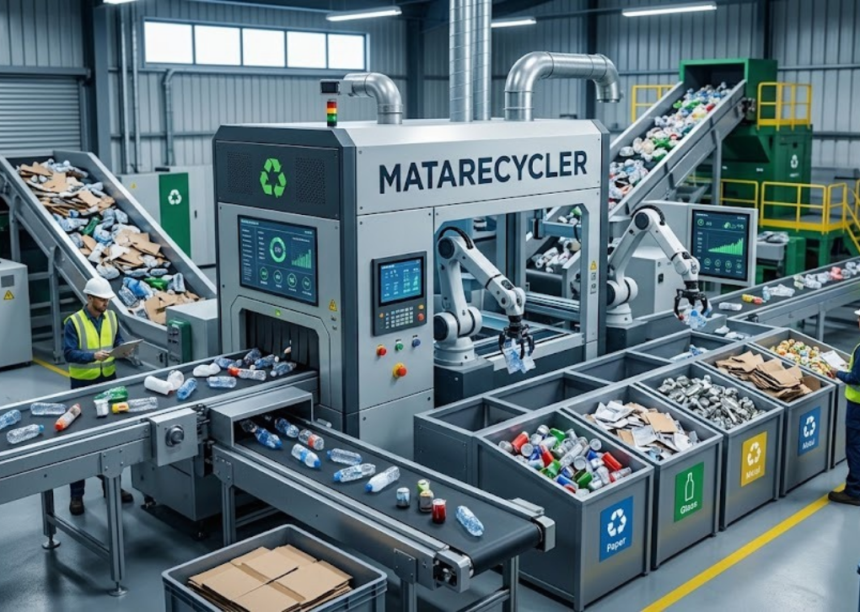
MataRecycler is a name that has started appearing in online discussions about recycling, sustainability, and modern waste-management technology. Some websites present it as an educational platform that helps people understand responsible recycling, while others describe it as an advanced system that uses artificial intelligence (AI), sensors, and automated sorting to process waste. The important question is whether these descriptions refer to one established product or several different interpretations of the same term.
Understanding the distinction matters. Recycling technology is a genuine and rapidly developing field, but not every name associated with environmental innovation represents a verified commercial product. Research into the available websites reveals a clearer picture of the name, its stated purpose, and the technologies that can genuinely improve recycling efficiency.
MataRecycler+2
This guide examines the available evidence, explains how smart recycling works in practice, and provides practical advice for readers who want to make informed environmental or business decisions.
What Is MataRecycler?
MataRecycler is a name associated with online information about recycling, waste reduction, sustainability, and, in some publications, smart waste-management technology. The most direct information comes from websites using the name themselves.
The website MataRecycler.com describes its purpose as making recycling information accessible to individuals, businesses, and communities. Its stated content includes educational articles about recycling processes, waste management, reuse, sustainable practices, and environmental awareness.
MataRecycler
That description establishes the website’s stated editorial purpose. It does not, by itself, establish that the operator manufactures recycling machinery, provides commercial recycling software, or manages physical waste-processing facilities.
What does the name MataRecycler represent?
The name suggests a connection with recycling and the recovery of useful materials. However, the websites reviewed do not provide a consistently documented, authoritative explanation of the name’s origin or a single technical definition accepted across the industry.
Depending on the source, readers may encounter three interpretations:
-
Recycling education: An online resource sharing information about waste management, environmental responsibility, and sustainable living.
-
Smart recycling: A proposed approach involving sensors, computer vision, automated sorting, and data analysis.
-
A broader sustainability concept: A general label for ideas intended to reduce waste and improve resource efficiency.
These interpretations overlap in their environmental objectives, but they are not interchangeable. An educational website can explain AI recycling without owning the technology it describes.
MataRecycler.com vs. MataRecycler.org
One detail worth checking is the web address. Both MataRecycler.com and MataRecycler.org publish information under similar names, but they are separate domains.
The .com website describes itself primarily as a recycling and sustainability information platform. The .org website also presents itself as an informational resource, while its visible categories include technology, entertainment, fashion, sports, and business. The available pages do not establish that the two domains share the same ownership or operate as one organization.
MataRecycler+1
For readers, the practical lesson is straightforward: always examine the exact website, its authors, its contact information, and its published evidence instead of assuming that similar names indicate the same organization.
Is MataRecycler a Real Product or Company?
The answer depends on what is meant by a real product.
The websites using the name are accessible online, and their published descriptions establish that they operate as information platforms. However, the material reviewed for this article does not independently establish a specific commercial recycling machine, a named manufacturer, a documented software product, or a verified installation operating under that name.
Some third-party articles describe an AI-powered recycling system involving cameras, sensors, automated sorting, and analytics. Those descriptions are technically plausible because similar capabilities already exist in the recycling industry. Nevertheless, the existence of comparable technology does not prove that a particular product using this name exists.
Tell Magazine+2
It is useful to distinguish three levels of evidence:
| Claim | What the available evidence establishes |
|---|---|
| An informational website uses the name | Supported by its published About page |
| The name is associated online with smart recycling | Supported by third-party articles |
| A commercial AI recycling product operates under the name | Not independently verified in the sources reviewed |
| The product has proven performance figures or confirmed customers | No independently verifiable evidence established here |
This is not proof that no related project exists. It means the stronger commercial and technical claims require additional documentation.
Is MataRecycler legitimate? As an informational website, it has a published description of its purpose. As a claimed technology product or commercial recycling service, its identity and capabilities remain insufficiently documented in the sources reviewed. There is also insufficient evidence here to label the name a scam.
That distinction is important for anyone considering a purchase, partnership, investment, or technical recommendation.
How Does MataRecycler Relate to AI-Powered Recycling?
Artificial intelligence is becoming an important part of modern waste management. In conventional recycling facilities, mixed materials must be separated into useful categories before they can be processed and sold to manufacturers. Manual sorting and conventional mechanical systems can struggle when waste contains overlapping objects, mixed materials, unfamiliar packaging, or items that look similar but require different treatment.
AI-assisted sorting can help address some of these challenges. It combines image recognition, machine learning, sensors, and automated equipment to identify objects and direct materials toward the appropriate processing stream.
However, it is important to separate the general capabilities of AI recycling from unverified claims about any specific product.
How an AI recycling system typically works
A modern automated sorting system may follow this sequence:
-
Waste enters the sorting line. Collected materials move along a conveyor after initial preparation.
-
Sensors inspect the material. Cameras and other sensing equipment collect information about objects, including their appearance and material characteristics.
-
Software classifies objects. Computer vision or machine-learning models compare the observed features with patterns learned from training data.
-
Sorting equipment separates the waste. Mechanical diverters, air jets, robotic mechanisms, or other equipment direct selected items into different streams.
-
Performance data is recorded. Some systems track material composition, recovery rates, and sorting quality to help operators improve their processes.
The precise setup depends on the facility, the materials being processed, and the intended output. Not every recycling system includes every component.
TOMRA, for example, documents the use of deep-learning models trained on labeled images to recognize objects and improve sorting performance. This provides a concrete example of established AI-assisted recycling technology, rather than evidence of a specific MataRecycler product.
TOMRA+1
What technologies might be associated with smart recycling?
The following are established technology categories, not verified features of MataRecycler.
-
Computer vision: Identifies visible features such as shape, color, and packaging design.
-
Machine learning: Uses training data to classify objects and improve recognition.
-
Optical and material sensors: Help distinguish materials that cannot reliably be identified by appearance alone.
-
Robotic sorting: Uses mechanical systems to pick or redirect selected objects.
-
Data analytics: Helps operators understand waste composition, material recovery, and process efficiency.
-
Smart collection systems: May use fill-level sensors or operational data to improve collection schedules.
These technologies can work together, but a product should only be credited with specific capabilities when its technical documentation confirms them.
Potential Benefits of Smart Recycling Technology
Even though a particular MataRecycler system has not been independently verified, the benefits of well-designed recycling technology are worth understanding.
1. More efficient material separation
Contaminated or incorrectly sorted waste can reduce the quality of recovered materials. Automated identification may help separate valuable materials more consistently, especially in high-volume facilities.
For manufacturers, better-sorted feedstock can be more useful because material quality affects how reliably it can be incorporated into new products.
2. Improved recovery of valuable materials
Recycling facilities process materials such as aluminium, steel, paper, cardboard, and different types of plastic. When these materials are recovered successfully, they can become inputs for new manufacturing processes rather than being discarded.
The U.S. Environmental Protection Agency (EPA) explains that recycling can conserve natural resources, save energy, and divert waste from landfills and incinerators.
US EPA
3. Better operational information
A sorting facility can benefit from knowing which materials enter its system, how much usable material it recovers, and where losses occur.
Digital monitoring and analytics can help managers identify recurring contamination problems, evaluate equipment performance, and make decisions based on recorded data rather than visual estimates alone.
4. Potential reductions in repetitive manual work
Automation can take over certain repetitive sorting tasks and allow workers to focus on inspection, maintenance, quality control, and other responsibilities. However, the actual effect on staffing, costs, and productivity depends on the equipment, facility design, and operating conditions.
5. Support for a circular economy
A circular economy aims to keep products and materials in use for longer, reducing the need to extract new resources and minimizing waste. Recycling supports this goal, although product durability, repair, reuse, and waste prevention are also essential.
Technology is most useful when it improves the complete material-recovery process rather than simply making a single sorting operation faster.
What Are the Limitations of AI Recycling?
Smart recycling is not a complete solution to waste management. It has technical, financial, and operational limitations that businesses and municipalities must consider.
Contamination and material complexity
Food residue, liquids, dirt, damaged packaging, and mixed-material products can complicate sorting. An object may also be difficult to classify when it is crushed, covered, or hidden beneath another item.
AI models can make classification errors, particularly when they encounter materials or packaging that differ from their training data.
Equipment and maintenance costs
Industrial sorting systems can require specialized machinery, software, installation, technical support, and ongoing maintenance. Organizations must compare these costs with the value of the additional material recovered and the operational improvements achieved.
A system that performs well in a demonstration may produce different results in a facility with different waste streams, conveyor speeds, or maintenance conditions.
Local recycling infrastructure
Not every community has facilities capable of processing every recyclable material. Even a correctly sorted item may not be recycled if there is no suitable collection service, processing capacity, or market for the recovered material.
The EPA identifies gaps in recycling infrastructure, public confusion about accepted materials, and weaknesses in recycled-material markets as ongoing challenges. These observations illustrate why technology alone cannot solve the entire problem.
US EPA
Environmental claims need measurable evidence
A system should not be described as environmentally superior simply because it uses AI or carries a sustainability label. Its real impact depends on factors such as energy consumption, material recovery, contamination, transportation, equipment lifespan, and the products made from recovered materials.
A credible environmental assessment should examine the full process and compare it with a realistic alternative.
How to Evaluate MataRecycler Before Trusting Its Claims
If you are researching MataRecycler for educational purposes, its articles may provide a starting point for understanding recycling-related topics. For a purchase, investment, business partnership, or technical assessment, a more rigorous approach is necessary.
Use the following verification checklist.
1. Confirm the identity of the organization
Look for a legal business name, identifiable leadership, a verifiable business address, and contact information that can be independently checked.
A website’s About page explains how its operator describes the platform. It does not automatically verify a manufacturer’s identity or a company’s commercial operations.
2. Request technical documentation
If the name is presented as a machine or software system, request documentation describing its design, capabilities, supported materials, installation requirements, and limitations.
For industrial equipment, specifications should explain the operating conditions under which performance figures were measured.
3. Check performance claims
Be cautious about statements such as “95% sorting accuracy,” “40% higher recycling rates,” or similar numerical promises unless they are accompanied by credible evidence.
Ask the provider:
-
What exactly does the percentage measure?
-
Was the result independently tested?
-
Which waste streams were included?
-
How large was the test sample?
-
What were the contamination and rejection rates?
-
Can the results be reproduced in an independent facility?
A high classification accuracy figure does not necessarily mean that the same percentage of all incoming waste becomes reusable material. These are different measurements.
4. Look for independently confirmed installations
A credible industrial technology provider should ideally be able to identify customer facilities, published case studies, or independently verifiable demonstrations.
Ask for results from an installation processing waste similar to yours. A system tested on clean, uniform packaging may behave differently when handling mixed municipal waste.
5. Review privacy, safety, and support
If a proposed system uses connected sensors, cameras, or cloud dashboards, examine what information it collects, how long it retains the data, who can access it, and how the information is secured.
For physical equipment, also investigate operator safety, maintenance requirements, spare-parts availability, warranty terms, and service response times.
6. Avoid committing money based on a name alone
Before paying a deposit or signing a contract, verify the supplier independently, obtain written commercial terms, and check whether the promised product or service can actually be delivered.
The central rule is simple: evaluate the evidence behind a product, not the confidence of the language used to describe it.
How to Recycle More Effectively Without Special Technology
You do not need an advanced machine to improve your recycling habits. Correct sorting, waste prevention, and consistent participation can make a practical difference at home, school, or work.
The EPA recommends checking local recycling requirements, keeping recyclable items clean and dry, excluding food and liquids, and keeping plastic bags and wraps out of recycling bins unless the local program specifically accepts them. It also advises emptying and flattening cardboard boxes.
US EPA
Here are five useful steps:
-
Check local rules first. Confirm which plastics, metals, paper products, glass, and electronic items are accepted by your local collection service or recycling facility.
-
Separate materials correctly. Follow the required sorting system rather than assuming every recyclable symbol means an item belongs in the same bin.
-
Keep recyclable materials clean enough for processing. Remove leftover food and liquid when appropriate, following local instructions.
-
Reuse products whenever practical. Repairing, donating, refilling, or reusing an item may avoid waste more effectively than recycling it immediately.
-
Handle specialist waste separately. Batteries, electronic waste, chemicals, and other potentially hazardous materials may require dedicated collection arrangements.
For readers in Pakistan, local arrangements matter particularly because collection and processing options can differ between cities, neighborhoods, and individual service providers. Verify accepted materials with your municipal authority or a reputable local recycler rather than applying another country’s rules automatically.
Could Smart Recycling Become More Important in the Future?
The outlook for automated sorting and data-driven waste management is promising. Recycling facilities face pressure to recover more usable materials, improve quality, and understand their waste streams more accurately.
Commercial technology demonstrates that these capabilities are already being developed and deployed. For example, TOMRA’s documented deep-learning systems are designed to recognize difficult-to-classify objects, automate sorting tasks, and improve material recovery.
TOMRA+1
Future improvements may combine better sensors, more capable machine-learning models, robotics, and real-time operational analytics. However, the success of these systems will still depend on collection infrastructure, reliable maintenance, responsible system design, and viable markets for recovered materials.
For now, readers should treat MataRecycler as a name associated with recycling information and differing online descriptions of smart recycling, rather than assuming it represents one confirmed commercial technology.
The opportunity lies in the broader field: using verifiable technology to recover materials more effectively while measuring environmental and economic outcomes honestly.
Frequently Asked Questions About MataRecycler
1. What is MataRecycler used for?
MataRecycler is associated with online information about recycling, waste management, sustainability, and environmental awareness. Some third-party articles also use the name when discussing AI-assisted sorting systems, but the available evidence does not independently establish a specific commercial product operating under that name. Readers should check the exact website and verify technical claims before relying on them.
2. Is MataRecycler an AI-powered recycling machine?
An AI-powered recycling machine is a technically plausible concept, and comparable systems exist in the recycling industry. However, the sources reviewed for this article do not establish that a particular machine branded MataRecycler has verified specifications, independent performance testing, or confirmed commercial installations. Claims about its hardware and capabilities should therefore be treated as unverified.
3. Is MataRecycler.com a legitimate website?
MataRecycler.com publishes an About page describing its educational focus on recycling, waste management, reuse, and sustainability. That confirms the site’s stated purpose, but it does not independently validate every article or any commercial technology claims associated with the name. Evaluate individual claims against authoritative sources and independently check any organization offering products or services.
4. What are the benefits of AI-powered recycling?
AI-assisted recycling can help identify materials, improve sorting consistency, recover valuable resources, and provide useful operational data. Its performance depends on the waste stream, sensors, software, equipment, and maintenance. It cannot eliminate every contamination problem or guarantee that all collected materials will be recycled successfully.
5. How can I verify whether a recycling technology is genuine?
Start by checking the manufacturer’s identity, official product documentation, technical specifications, independently verified installations, and published performance measurements. Request evidence explaining how accuracy, recovery rate, contamination, and cost savings were calculated. Before making a financial commitment, verify the supplier, installation conditions, maintenance obligations, and warranty in writing.
Conclusion: What Should You Do Next?
MataRecycler highlights an important distinction in sustainability research: a genuine environmental goal is not the same as a verified commercial solution. Recycling education and smart waste-management technology can both support better resource use, but each claim must be assessed according to the evidence available.
If your goal is to learn about recycling, begin with clear educational resources and the rules issued by your local recycling provider. If you are evaluating a smart recycling product for a business or community, request technical documentation, independently tested performance results, and evidence of real-world installations before investing.
Ultimately, effective recycling depends on more than a promising name or advanced technology. It requires correct sorting, reliable infrastructure, measurable results, and responsible decisions at every stage of the waste-management process.