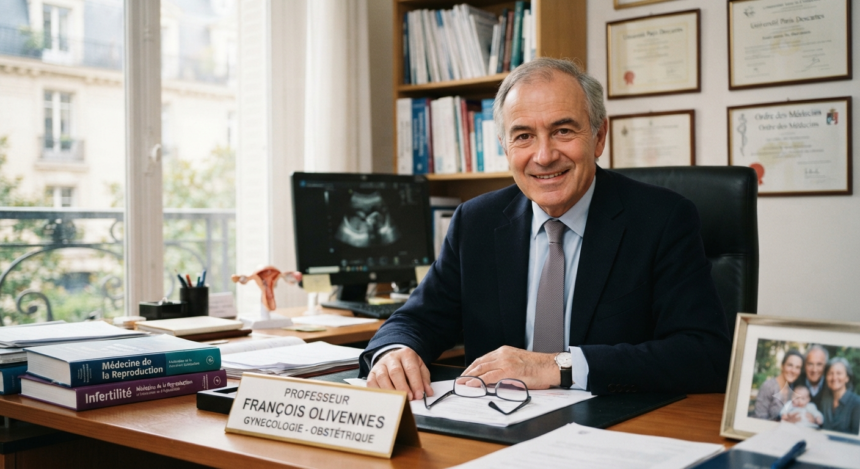
François Olivennes is a French obstetrician-gynaecologist best known for his work in infertility treatment, in vitro fertilisation, reproductive medicine, and public debate around assisted reproduction. His profile is unusual because it spans several worlds at once: hospital medicine, scientific research, private clinical practice, publishing, media commentary, and bioethics.
That breadth explains why searches for François Olivennes often produce fragmented answers. One page focuses on his medical career, another discusses his books, while celebrity-oriented profiles concentrate on his former marriage to actress Kristin Scott Thomas.
A fuller account reveals something more significant: a physician whose career mirrors the transformation of fertility care in France over the last four decades.
Who Is François Olivennes?
François Olivennes was born on January 4, 1959, in Boulogne-Billancourt, France. He became an obstetrician-gynaecologist and developed a specialist career in infertility, assisted reproductive technology, and IVF.
His professional identity is closely tied to procréation médicalement assistée, commonly shortened in French to PMA. In English, the nearest umbrella term is medically assisted reproduction, covering treatments such as ovarian stimulation, intrauterine insemination, IVF, ICSI, embryo transfer, and fertility preservation.
François Olivennes Quick Facts
| Detail | Verified information |
|---|---|
| Full name | François Olivennes |
| Born | January 4, 1959 |
| Birthplace | Boulogne-Billancourt, France |
| Profession | Obstetrician-gynaecologist and reproductive-medicine specialist |
| Core expertise | Infertility, IVF, assisted reproduction, fertility preservation |
| Major hospitals | Antoine-Béclère Hospital and Cochin Hospital |
| Later practice | Private reproductive-medicine and IVF centres in the Paris region |
| Known for | Clinical work, research publications, books, and public bioethics commentary |
The most useful way to understand him is not simply as a doctor who performs fertility treatment. He has also acted as an interpreter between technical medicine and the public, explaining what reproductive science can do, where it can fail, and how law or policy can restrict access.
Early Life and Family Background
He grew up in an intellectually prominent French family. His father, Armand Olivennes, was a psychiatrist and poet, while his mother, Maria Landau, worked in psychiatry and psychoanalysis.
His brothers Denis and Frédéric later became well known in French media and business circles. François was the eldest of the three brothers.
The family’s history was also marked by the Holocaust and migration from Germany to France. Reporting on the Olivennes family notes that the surname was changed from Olievenstein and that much of the wider family was murdered during the Shoah.
That background does not automatically explain his medical opinions. It does, however, provide context for a public career frequently concerned with autonomy, dignity, discrimination, family formation, and the limits of state power over personal life.
Medical Education and Entry Into Reproductive Medicine
Olivennes completed his medical training in France and moved into obstetrics, gynaecology, and reproductive biology. His career developed during a period when IVF was shifting from an experimental breakthrough into a structured clinical discipline.
He worked at Antoine-Béclère Hospital in Clamart in the department associated with Professor René Frydman, one of the central figures in the history of French reproductive medicine. Publisher biographies state that Olivennes later took charge of the reproductive-medicine unit at Cochin Hospital in Paris in 2002.
This progression matters. Antoine-Béclère and Cochin were not peripheral settings; they placed François Olivennes near the institutional centre of French fertility treatment.
These were environments where clinicians were actively developing approaches to ovarian stimulation, embryo transfer, patient selection, reproductive safety, and the ethical questions created by rapidly advancing fertility technology.
François Olivennes and the Evolution of IVF Care
IVF is sometimes described as a single procedure, but treatment actually involves a chain of closely connected decisions. Clinicians must assess ovarian reserve, select an appropriate stimulation protocol, monitor follicular development, retrieve oocytes, choose a fertilisation method, manage embryos, prepare the endometrium, and determine when an embryo should be transferred.
His research touched several of these pressure points. Published studies associated with his career have examined ovarian stimulation, GnRH agonist and antagonist protocols, frozen embryo-transfer preparation, IVF twin pregnancies, outcomes for children conceived through assisted reproduction, and strategies for reducing ovarian hyperstimulation syndrome.
One recurring theme is individualisation. Fertility treatment cannot safely be reduced to giving every patient the same drug dose, transfer schedule, or stimulation protocol.
In a review concerning the prevention of ovarian hyperstimulation syndrome, Olivennes explained that merely lowering the initial gonadotropin dose is not always sufficient. Effective prevention requires a broader, patient-specific assessment of risk and treatment response.
That principle remains highly relevant to modern fertility care. Ovarian stimulation aims to produce enough mature oocytes to create viable embryos, yet an excessive response can cause avoidable complications.
The physician must therefore balance effectiveness with safety, taking account of age, ovarian reserve, previous treatment response, hormone levels, medical history, and the objectives of the individual patient.
Research Contributions and Scientific Visibility
Olivennes has authored or co-authored a substantial body of peer-reviewed work in reproductive medicine. Bibliographic databases connect him with research ranging from the 1990s to publications released in 2025, indicating a long scientific career rather than a brief period of academic activity.
Earlier research examined perinatal outcomes in IVF twin pregnancies and followed children conceived through IVF or cryopreserved embryos. These studies addressed a central question in assisted reproduction: treatment success cannot be measured only by whether pregnancy occurs.
A responsible assessment must also consider:
- Maternal health and treatment complications
- Premature delivery and neonatal outcomes
- Risks associated with multiple pregnancy
- The health and development of children
- Live-birth outcomes rather than laboratory results alone
His work also appeared in discussions about avoiding multiple pregnancies in assisted reproductive technology. That subject helped move fertility medicine towards a healthier definition of success: not the highest possible pregnancy rate per embryo transfer, but the best chance of delivering one healthy child with the lowest avoidable risk.
More recent co-authored research has examined luteal-phase support in frozen embryo-transfer cycles and expert consensus on the role of luteinising hormone in infertility management. This continued publication record shows that François Olivennes remained connected to practical questions in fertility care well beyond his early hospital appointments.
From Public Hospitals to Private Practice
After working in major public hospitals, he moved into private practice. Publisher records state that he began practising privately in 2006 at the Eylau-La Muette IVF centre, while more recent affiliations connect him with the Ambroise Paré–Cherest reproductive-medicine centre in Neuilly-sur-Seine.
The transition from public hospital leadership to private treatment reflects a wider tension in French reproductive medicine. Public systems provide essential access, specialist training, and academic depth, but they can also face staff shortages, limited funding, long waiting lists, and uneven regional capacity.
Private centres may offer different organisational models and potentially shorter treatment pathways. However, affordability, regulation, transparency, and equitable access remain important considerations.
François Olivennes has publicly criticised weaknesses in France’s assisted-reproduction system. During a 2009 parliamentary hearing, he argued that French PMA results compared poorly with those of several other European countries.
In 2024, he also criticised the implementation of elective egg freezing in France. Although the law had expanded access, he argued that treatment capacity and practical resources had not increased sufficiently, resulting in abnormally long waiting periods.
Public Positions on PMA, Egg Freezing and Reproductive Rights
François Olivennes is not only a clinician; he is a visible participant in French bioethics debates. His public interventions generally combine support for wider access with an insistence that reproductive medicine still requires rules, evidence, responsible counselling, and recognition of biological limitations.
He supported extending PMA access to single women and female couples. He argued that there was no adequate medical, psychological, or ethical reason to exclude them solely because they did not belong to a heterosexual couple.
He also criticised political resistance that treated the traditional family structure as the decisive standard for receiving fertility care. His position places individual autonomy and equal treatment above assumptions that reproductive medicine must reproduce one particular family model.
Donor Conception and the Right to Know One’s Origins
On donor conception, he joined public calls to protect the right of donor-conceived people to obtain information about their origins. That debate represents a significant shift away from systems built around permanent donor anonymity.
The ethical focus is no longer limited to intended parents and donors. It also includes the future identity, medical history, psychological interests, and personal rights of the child born through donation.
His Conditional Position on Surrogacy
His stance on gestational surrogacy has been more conditional than absolutist. In a 2015 commentary, he argued that surrogacy could be ethically legitimate in narrowly defined medical circumstances when it was based on freely given, non-commercial consent.
He distinguished such an arrangement from commercial systems that may exploit financially vulnerable women. This remains a highly contested position because critics question whether consent can ever be separated completely from social, emotional, or economic pressure.
Why François Olivennes Warns About Fertility Timing
One of the strongest themes in his public education work is the gap between social timelines and reproductive biology. Many people understandably delay parenthood because of education, career development, housing costs, relationship uncertainty, financial pressure, or the absence of a suitable partner.
Biology, however, does not pause. Female fertility changes with age, and assisted reproductive treatment cannot always overcome declining egg quantity or quality.
In N’attendez pas trop longtemps pour avoir un enfant, François Olivennes addressed women considering pregnancy after their early thirties. The book discusses the most favourable fertility period, the potential benefits of infertility treatment, and the medical limits patients may encounter after delaying pregnancy.
This message can easily be misinterpreted as pressure on women to have children earlier. A more accurate reading is that genuine reproductive choice requires honest information about time, probabilities, uncertainty, and the limits of medical intervention.
IVF can help many patients, but it does not guarantee pregnancy. It also cannot reverse every age-related change in egg quality or eliminate miscarriage, chromosomal abnormalities, pregnancy complications, and failed implantation.
Books and Work as a Public Educator
François Olivennes has written or co-written books for professional and general audiences. His subjects include fertility timing, pregnancy preparation, sexuality, assisted reproduction, and the social effects of new reproductive technologies.
Notable titles associated with him include:
- N’attendez pas trop longtemps pour avoir un enfant, examining age, fertility, and infertility treatment.
- Tout ce qu’il faut savoir avant une grossesse, a practical guide to preparing for pregnancy.
- Tout ce que les femmes ont toujours voulu savoir sur le sexe… et enfin osé demander, written with Sophie Bramly.
- Faire un enfant au XXIe siècle, exploring modern routes to parenthood.
- Pour la PMA, an examination and defence of medically assisted reproduction.
His accessible writing strengthens his E-E-A-T profile because it demonstrates more than credentials or publication totals. It reflects sustained, first-hand engagement with patients’ fears, questions, failed treatments, physical burdens, uncertainty, and emotionally difficult choices.
He also avoids presenting reproductive medicine as effortless technological progress. His public work frequently acknowledges that treatment creates hope while simultaneously exposing patients to limits, waiting, disappointment, ethical conflict, and imperfect probabilities.
Personal Life and Connection to Kristin Scott Thomas
Public interest in François Olivennes is partly driven by his former marriage to British-French actress Kristin Scott Thomas. Biographical sources report that they married in 1987, had three children, and later divorced.
One of their children, Joseph Olivennes, became an actor after studying philosophy and performing arts. His family connection has occasionally brought additional media attention to the physician’s personal life.
The marriage is relevant to a complete biography, but it should not overshadow his professional record. Celebrity-focused pages often reverse the balance and present him primarily as the former husband of a famous actress.
The available evidence supports the opposite emphasis. His independent public importance comes from reproductive medicine, scientific research, patient education, healthcare criticism, and bioethics.
What Makes His Career Distinctive?
The clearest information gain comes from viewing François Olivennes through four connected roles rather than reducing his career to a single professional label.
- Clinician: He treated infertility and worked in IVF programmes across major Paris institutions.
- Researcher: He contributed to studies concerning stimulation protocols, embryo transfer, multiple pregnancy, and child outcomes.
- Policy critic: He publicly challenged treatment delays, unequal access, and under-resourced reproductive services.
- Communicator: He translated complex fertility science into books, interviews, essays, and public arguments.
These roles reinforce one another. Clinical experience gives weight to his policy arguments, while research supports his medical recommendations.
His communication work then makes specialised knowledge usable outside fertility clinics. That combination explains why his influence extends beyond the patients he has personally treated.
Controversies and Areas of Debate
Reproductive medicine is ethically contested by nature. Questions about embryo selection, donor identity, access for non-traditional families, elective egg freezing, gestational surrogacy, and preimplantation testing involve competing values rather than purely technical answers.
François Olivennes has adopted positions that some religious and socially conservative audiences reject, particularly his support for broader PMA access. His conditional acceptance of tightly regulated, altruistic surrogacy has also attracted disagreement.
He has additionally supported debate over preimplantation genetic testing for chromosomal abnormalities in embryos. Supporters argue that such testing may reduce some failed transfers and identify embryos with chromosomal problems, while critics raise questions about evidence, embryo selection, medicalisation, cost, and accessibility.
A trustworthy profile should not present his positions as universally accepted. His influence comes partly from his willingness to enter disputed territory and argue that reproductive rules should be assessed through medical evidence, patient welfare, child interests, and real-world consequences.
Frequently Asked Questions About François Olivennes
What is François Olivennes famous for?
He is best known as a French obstetrician-gynaecologist specialising in infertility, IVF, and medically assisted reproduction. He is also recognised for fertility research, books, and public advocacy concerning PMA access and reproductive policy.
His reputation therefore comes from more than clinical practice. He has combined patient treatment with research, public education, ethical commentary, and criticism of weaknesses in the French fertility-care system.
Where did François Olivennes work?
He worked at Antoine-Béclère Hospital in Clamart and later directed the reproductive-medicine unit at Cochin Hospital in Paris. From 2006, he practised in the private IVF sector, including at Eylau-La Muette.
More recent scientific affiliations have connected him with the Ambroise Paré–Cherest Centre for Reproductive Medicine in Neuilly-sur-Seine.
Is François Olivennes still involved in fertility research?
Recent PubMed records list him as a co-author on 2025 research concerning frozen embryo-transfer support and a French consensus on luteinising hormone in infertility care. This indicates continued participation in contemporary reproductive-medicine research.
His publication history extends back several decades. That continuity makes it possible to trace changes in fertility care from early concerns about IVF outcomes and multiple births to modern questions about personalised treatment.
Was François Olivennes married to Kristin Scott Thomas?
Yes. Public biographical sources state that he married Kristin Scott Thomas in 1987, that they had three children, and that the marriage ended in divorce.
Their son Joseph later pursued an acting career. However, François Olivennes had already established an independent professional identity through medicine and research.
What does François Olivennes believe about PMA?
He has argued for broader access to PMA, including access for single women and female couples. At the same time, he stresses the need for ethical rules, medical evidence, responsible patient counselling, and realistic expectations.
He has also criticised France when legal promises were not supported by adequate staffing or treatment capacity. His 2024 comments on elective egg freezing focused on the gap between granting a theoretical right and making timely treatment practically available.
Conclusion: How to Evaluate François Olivennes’s Legacy
François Olivennes should be understood as more than a prominent fertility doctor or a person connected to a famous actress. His real significance lies at the intersection of clinical IVF practice, reproductive research, patient education, healthcare policy, and French bioethics.
His career also demonstrates why fertility medicine cannot be evaluated through pregnancy rates alone. Safety, access, informed consent, treatment capacity, child welfare, emotional burden, and long-term outcomes all matter.
Readers researching his work should go beyond short celebrity biographies. Start with his peer-reviewed studies, then compare his public arguments with French law, clinical resources, patient experiences, and opposing ethical perspectives.
That approach provides the clearest picture of a physician who helped move assisted reproduction from a narrowly technical specialty into a wider public conversation about time, choice, family, fairness, and the responsible use of reproductive science.