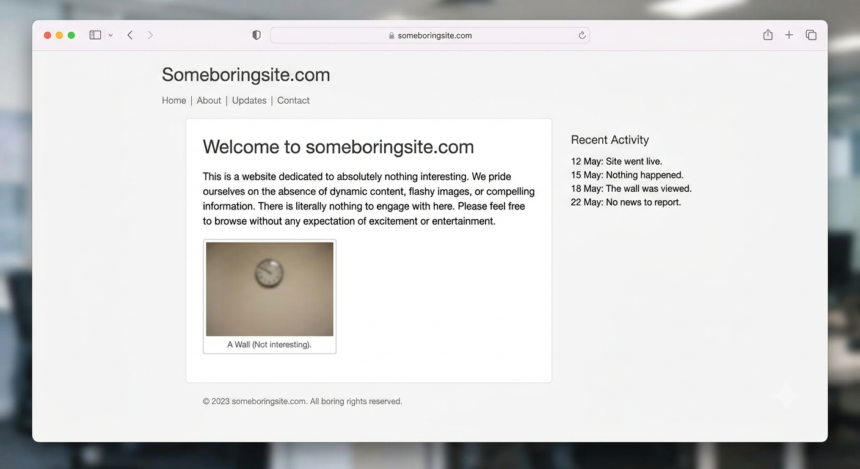
Someboringsite.com has a deliberately understated name, but the live website is not an empty joke page or a single-purpose utility. It is a broad, WordPress-based publishing platform covering puzzles, creativity, art, quantum topics, technology, online safety and several loosely connected lifestyle subjects. The important question is not whether the name is amusing. It is whether the content is useful, navigable and trustworthy enough for the reason you are visiting.
For first-time visitors, Someboringsite.com is best understood through the actual site rather than promotional claims found elsewhere. This guide examines its visible categories, content model, privacy language, editorial strengths, warning signs and the practical checks readers should make before relying on an article.
What Is Someboringsite.com?
Someboringsite.com describes itself as a platform for exploration, learning and inspiration. Its About page says the editorial concept is built around three principal categories: Mind Benders, Quantum Quandaries and Artistic Adventures. The stated goal is to encourage curiosity, critical thinking, scientific exploration, creativity and lifelong learning.
That description is only part of the current picture. The homepage still highlights those three pillars, yet its latest-post area also contains material about generative AI, IT services, social media, online dating, casino platforms and sports betting. In other words, the site now functions more like a general-interest content blog than a tightly controlled publication devoted only to puzzles, physics and art.
Someboringsite.com at a Glance
- Website type: General-interest editorial blog
- Main visible pillars: Brain teasers, quantum-related topics and art
- Additional subjects: Technology, AI, digital culture, online safety and gambling-related content
- Platform: WordPress using the Newsup theme
- Access model: Articles can be read without an account
- Contact options: A published email address and web form
- Policy pages: Privacy Policy and Terms and Conditions are available
The site does not currently present itself as a software platform, calculator library or members-only community. Some third-party articles claim it offers APIs, batch processing, forums, webinars and advanced utility tools, but those features were not visible in the live navigation or core pages reviewed for this guide.
The Main Content Areas on Someboringsite.com
1. Mind Benders and Learning Activities
Within Mind Benders, Someboringsite.com is intended to challenge perception and encourage cognitive engagement. On the homepage, it is introduced as a collection of puzzles, brain teasers and philosophical dilemmas. The category archive, however, stretches beyond classic riddles into self-help books, sensory activities, children’s games and other personal-development themes.
A representative article about riddles for young children explains different riddle formats, age appropriateness, language development and ways to use puzzles in games or storytelling. It is easy to scan, includes a table of contents and breaks the subject into practical sections for parents and educators.
This area is most useful when readers want:
- Simple activity ideas for children
- Introductory explanations of puzzles and wordplay
- Classroom or family discussion prompts
- Light personal-development reading
- Accessible content rather than academic analysis
The strongest pages translate a broad topic into usable suggestions. The weaker ones may use vague titles or drift away from the category’s original “brain teaser” purpose, so checking the article itself matters more than trusting the category label.
2. Quantum Quandaries and Science-Themed Content
In Quantum Quandaries, Someboringsite.com presents its science-focused material. Its homepage description promises explanations of quantum theories, experiments and unusual phenomena. The archive and homepage include topics such as quantum computing, quantum radar, quantum storage, the quantum realm and the cost or availability of quantum computers.
One live article discusses when practical quantum computers may become available. It covers qubits, error correction, industry players, deployment barriers and possible applications in finance and healthcare. The page is written for general readers, not physicists, and gives a broad overview rather than a sourced technical review.
Readers should separate established quantum computing concepts from speculative or wellness-oriented phrases that borrow the word “quantum.” Titles involving “quantum jumping meditation” or “quantum therapy” should not automatically be treated as evidence-based physics or medical guidance. That distinction is essential because scientific terminology can sound authoritative even when it is being used metaphorically.
There is also a maintenance concern. During this review, several links promoted from the homepage—including pages for quantum storage and quantum jumping meditation—returned 404 errors. A missing page does not make the entire domain unsafe, but it does show that the content index and live URLs are not always synchronized.
3. Artistic Adventures
The Artistic Adventures section is the clearest match between the site’s stated mission and its visible content. It includes articles about composition, hand art, Japanese art, coaching, religious art, dorm décor, pixel art, art supplies and concept art.
The Japanese art article, for example, discusses historical periods, traditional and contemporary forms, notable artists, techniques and international influence. Its structure is useful for newcomers because it moves from historical context to media, artists and cultural significance.
Still, readers should notice the difference between a convenient overview and a scholarly source. The article provides broad historical statements but does not display a bibliography, museum references or expert credentials beside the text. For inspiration or orientation, that may be enough. For coursework, publication or professional research, primary museum, university and academic sources should be consulted as well.
How the Website Is Organized
From the perspective of usability, it is worth noting that Someboringsite.com utilizes the standard magazine-style layout. The top menu offers the option to navigate to the homepage, three popular categories, About page, and Contact page. Most posts contain a table of contents, show the author’s name, date of publishing, related articles, and post navigation. Thus, the website’s structure allows skimming through the content in a search of interesting material.
However, as could be seen from the Homepage, the Latest Posts section combines various categories, and some recent articles do not follow the three main categories. Hence, a user who gets interested in one post about children riddles may stumble upon content about online dating, casino guides, and IT technical support in the next post.
Therefore, when browsing the website, it is necessary to pay attention to the category in the address field or the name of the column. Although the latest posts suggest a variety of topics, they still present articles for different categories. In other words, each post falls under a specific category, and the Homepage combines them randomly. Therefore, it would be a good practice for Search Engine Optimization to check the address field/category name before opening the desired post to ensure that there is no mistake in the address field, and the post actually belongs to the selected category.
What Someboringsite.com Does Well
Accessible, Low-Barrier Reading
Most pages use short sections, descriptive headings and direct language. Readers do not need an account to open the articles reviewed, and the familiar blog layout reduces the learning curve.
Broad Idea Discovery
The site can be useful as a starting point. A parent may find a riddle activity, an art student may discover a movement to research, and a technology reader may encounter an introductory explanation of quantum computing.
Visible Basic Transparency Pages
Someboringsite.com publishes an About page, a Contact page, a Privacy Policy and Terms and Conditions. The About page names a founder, co-founder, editor, developer, designer and support manager, while the Contact page displays an email address, mailing address and form.
Clear Privacy Disclosures at a Basic Level
The Privacy Policy says the site may collect names and email addresses submitted through forms or newsletter registration, along with device and browsing information collected through cookies or similar technologies. It also says personal information is used to answer inquiries, send opted-in updates and improve the website.
These pages are positive trust signals, but they should be interpreted carefully. A published team list or address is not the same as independently verified ownership, and a privacy statement does not prove every technical practice behind the website.
Limitations Readers Should Know
Editorial Focus Has Become Blurred
The core brand promises curiosity, quantum science and creativity, while the current feed includes promotional and gambling-adjacent topics. This wider scope may increase publishing volume, but it weakens topical consistency and makes authoritativeness harder to judge.
Some Claims Lack Visible Citations
Several informational articles make historical, scientific or developmental claims without showing references. That does not automatically make the statements wrong, but it limits traceability. High-stakes subjects deserve stronger sourcing than general entertainment or craft ideas.
Author Expertise Is Not Always Clear
Article pages show bylines, yet detailed author biographies, qualifications and editorial review methods are not consistently visible. For E-E-A-T, a name alone is weaker than a profile explaining relevant education, professional experience, sourcing standards and corrections policy.
Broken or Removed Pages Create Friction
Some homepage-linked articles returned 404 errors during review, including a generative AI page in addition to quantum-themed pages. Broken internal links can frustrate visitors, waste crawl paths and reduce confidence in site maintenance.
The Site Disclaims Content Accuracy
The Terms and Conditions state that the website is provided “as is” and makes no warranties about the accuracy, reliability, completeness or timeliness of its content. This is common legal language, but readers should take it seriously when evaluating health, finance, safety, science or gambling-related material.
Is Someboringsite.com Legit and Safe to Use?
The live domain has the basic structure expected from an operating content website: accessible articles, navigation, policy pages, contact details and identifiable bylines. Nothing in those visible elements alone proves malicious intent. At the same time, “legit” should not be confused with “authoritative on every subject.”
For ordinary reading, the main risk on Someboringsite.com is likely information quality, not the act of opening a general article. The site’s broad subject range, missing citations, unclear author qualifications and occasional broken pages mean readers should verify important claims elsewhere.
Use these precautions:
- Do not submit sensitive personal, financial or medical information through a general contact form.
- Check the publication date because fast-moving technology topics can become outdated.
- Confirm scientific claims through universities, peer-reviewed journals or recognized research institutions.
- Confirm health advice through qualified clinicians and authoritative health bodies.
- Treat gambling-related articles as commercial or entertainment content, not a reliable method of making money.
- Review destination domains before clicking promotional or recommended external links.
- Avoid assuming that an article is expert-reviewed unless the page explicitly explains the reviewer’s credentials.
The privacy policy also acknowledges that no internet transmission or electronic storage method is completely secure. That is a sensible reminder to share only the information necessary for an inquiry.
How to Get Better Value From Someboringsite.com
A disciplined reading process makes the website more useful.
Step 1: Identify Your Intent
Decide whether you need entertainment, a creative idea, a beginner’s explanation or a source suitable for formal research. Someboringsite.com is generally better positioned for the first three than the fourth.
Step 2: Check the Page Signals
Look at the author, publication date, category, headings and whether supporting sources are provided. A detailed structure improves readability, but it does not replace evidence.
Step 3: Separate Ideas From Proof
Use an article to generate questions, keywords or project ideas. Then verify factual claims through stronger primary sources before making a decision, submitting schoolwork or publishing your own material.
Step 4: Watch for Topic Mismatch
A page filed near quantum science may still discuss speculative wellness concepts. A “latest” article may be sponsored, promotional or unrelated to the original categories. Read the actual claim, not just the label.
Step 5: Report Problems
The Contact page invites questions and suggestions through email or a form. Reporting a broken link or unclear statement is more constructive than assuming it will be noticed automatically.
Who Is the Website Best For?
Overall, Someboringsite.com is most suitable for casual learners, parents seeking activity ideas, readers exploring art topics and people who enjoy broad introductory articles. It may also help content researchers discover related terms, questions and angles for deeper investigation.
For researchers, Someboringsite.com is less suitable as a sole authority for academic science, medical decisions, financial choices, cybersecurity guidance or historical research. In those settings, use it only as a discovery layer and move quickly to primary or expert-reviewed material.
Final Verdict
Someboringsite.com is a real, active general-interest publication with a playful brand and three recognizable editorial roots: mind challenges, quantum-themed explanations and artistic exploration. Its strongest value lies in accessibility, idea discovery and beginner-friendly formatting. Its main weaknesses are inconsistent topical focus, limited visible sourcing, unclear specialist credentials and several broken links.
The best next step is simple: open the category that matches your interest, choose one article, check its author and date, and verify any decision-relevant claim through an authoritative source. Enjoy the site for discovery—but do not outsource your judgment to it.
Frequently Asked Questions
What kind of website is Someboringsite.com?
It is a WordPress-based editorial blog. Its stated focus is puzzles and cognitive challenges, quantum-related subjects and artistic creativity, although the current feed also includes technology, online safety, IT, dating and gambling-related material.
Is Someboringsite.com actually boring?
The name is intentionally self-deprecating. The site covers a wide range of subjects and uses magazine-style headlines, images and category pages, so whether it feels boring depends on the reader’s interests rather than the branding.
Does the Website Offer Tools, APIs or Community Forums?
No such features were visible in the primary navigation, About page or homepage during this review. Claims on third-party blogs about APIs, batch tools, forums or webinars should therefore be treated as unverified unless the live site adds or documents them.
Can I Trust Its Quantum Physics and Health-Related Articles?
Use them as introductory reading, not as your only evidence. Check whether a page cites reputable research, distinguish real quantum computing from metaphorical “quantum” wellness language, and verify medical or scientific claims through qualified experts and primary sources.
Does Someboringsite.com Collect Personal Data?
Its Privacy Policy says it may collect information voluntarily submitted through contact or newsletter forms, plus device and browsing data through cookies or similar tracking technologies. The policy says this information may be used for responses, opted-in updates and website improvement.