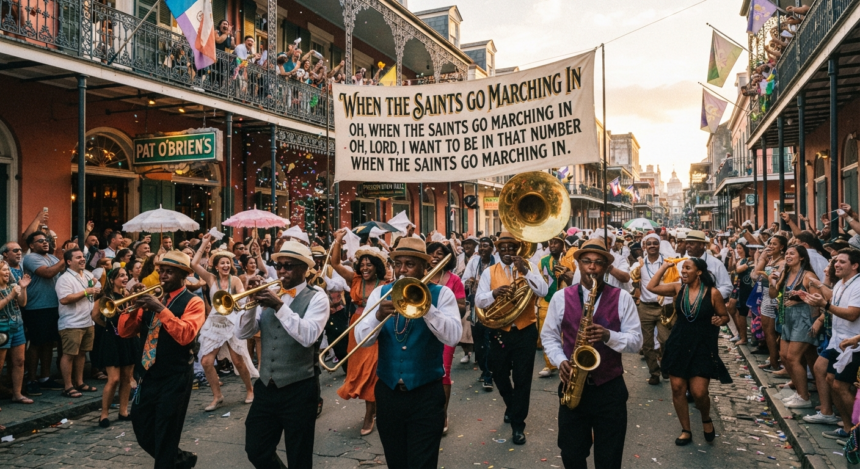
People searching for song when the saints go marching in lyrics are usually looking for more than a few familiar lines. This enduring spiritual carries layers of religious imagery, African American musical history, New Orleans culture, jazz improvisation, funeral tradition, and community celebration.
The song sounds simple because its melody is memorable and its refrain repeats easily. Yet its history is surprisingly complex. There is no universally accepted single author, no one definitive set of verses, and no single performance that represents every way the song has been sung over the last century.
That is exactly why song when the saints go marching in lyrics remains such a rich search topic. Understanding the words means understanding where the song came from, why the verses change, how Louis Armstrong reshaped its public identity, and why the same tune can feel solemn in one setting and explosively joyful in another.
What Is “When the Saints Go Marching In”?
“When the Saints Go Marching In”, frequently shortened to “The Saints”, is a traditional American hymn that was adopted by the New Orleans jazz culture and became one of the most popular standards of the city’s music. It has since crossed over into mainstream popular culture, being performed in jazz club, parade, and brass-band repertoires, as well as in schools, sports, film, and recordings. “When the Saints Go Marching In” has been linked to both religious and secular occasions, ranging from funerals to festive parades and theatrical performances. The United States National Park Service refers to it as a traditional American hymn that was embraced by New Orleanians as their unofficial anthem. Apart from that, the park service notes its connection to traditional jazz funerals and the role played by Louis Armstrong’s 1938 Decca recording in promoting the song beyond the local community. However, for the purposes of the song when the saints go marching in lyrics research, it is important to remember that “The Saints” has never been a modern standard. It belongs to the folk and spiritual song tradition, meaning that it was constantly adapted and rearranged to fit the needs of the performers and community members who embraced it.
Song When the Saints Go Marching In Lyrics: What Do the Words Mean?
At its core, the song expresses a desire to join the righteous at a moment of divine fulfillment. The famous image of saints “marching in” presents salvation not as a private event but as a communal procession.
The title phrase itself works both literally and symbolically. The saints may be understood as the faithful entering heaven, while the act of marching creates the image of a united body moving toward a promised destination.
The repeated desire to be included among that group gives song when the saints go marching in lyrics their emotional center. The speaker is not merely observing a sacred event but expressing a personal hope of participating in it.
The Meaning of Being Counted Among the Saints
One of the best-known ideas in the song is the wish to be counted among the redeemed. Methodist hymn-history scholarship connects this imagery with biblical passages in Revelation that describe enormous gathered multitudes around the divine throne.
That makes the concept more than a catchy response line. It communicates hope, belonging, spiritual readiness, and the desire for salvation.
For someone studying song when the saints go marching in lyrics, this is a useful interpretive key: the song is fundamentally about inclusion in a future sacred community. Its emotional power comes from turning theology into a personal wish for belonging.
Why Are There Different Versions of the Lyrics?
Many listeners expect a song to have an official lyric sheet. This one does not fit that model.
Traditional spirituals often circulate orally before or alongside printed versions. Communities remember a refrain, add verses, replace images, alter wording, change rhythm, or adapt the song to a funeral, worship service, parade, classroom, concert, or sporting event.
Research published by Discipleship Ministries notes several early printed and recorded variants. It identifies a 1923 Paramount Jubilee Singers recording titled “When All the Saints Come Marching In,” while also documenting later printed forms with different apocalyptic and family-centered verses.
That history explains why websites presenting song when the saints go marching in lyrics may not all show identical words. Differences are not automatically errors. They may reflect distinct branches of a long oral and printed tradition.
The Earliest Known Recordings and Printed Traditions
The exact origin of the modern song is difficult to pin down. Similar titles appeared before the version most listeners recognize today, but similarity of title does not necessarily mean the earlier composition had the same melody or text.
Discipleship Ministries points to an 1896 song titled “When the Saints Are Marching In,” with words by Katharine E. Purvis and music by James Milton Black. It also notes a 1908 work called “When the Saints March In for Crowning.” Neither is simply identical to the modern standard.
A major milestone came in 1923, when the Paramount Jubilee Singers made the earliest known commercial recording of the recognizable song tradition. Later gospel recordings helped stabilize elements of the melody and refrain while still allowing verse variation.
So when evaluating song when the saints go marching in lyrics, it is better to think in terms of a developing tradition than a single moment of composition. That approach also explains why dates, titles, and verse sets can differ across reputable historical sources.
Louis Armstrong and the Version That Changed Everything
The name most strongly associated with the song is Louis Armstrong. His 1938 recording with his orchestra did not create the spiritual, but it helped redefine how the wider public heard it.
The Library of Congress describes Armstrong’s performance as the first jazz recording of the famous hymn. It highlights the recording’s vocal presentation, trombone preaching effects, and Armstrong’s soaring trumpet work, while noting that he remembered the song from his New Orleans childhood.
Armstrong’s approach blurred boundaries between church music and entertainment. At the time, that mixture could be controversial. The Library of Congress notes that some clergy and listeners objected to the sacred material being treated within a jazz setting.
Today, that performance is recognized as historically important. Armstrong’s 1938 recording was selected for the 2020 National Recording Registry, with the selections publicly announced by the Library of Congress in March 2021.
For anyone researching song when the saints go marching in lyrics, Armstrong matters because he helped shift the song from primarily religious repertoire into a globally recognizable jazz standard. His recording became a reference point that later musicians could imitate, reinterpret, or deliberately depart from.
From Spiritual Hymn to New Orleans Anthem
The transformation did not erase the song’s sacred roots. Instead, New Orleans culture allowed sacred feeling, public celebration, memory, improvisation, and communal movement to overlap.
The National Park Service describes “The Saints” as one of the quintessential New Orleans tunes and notes its connection with early traditional jazz funerals. In those traditions, music can move between mourning and celebration, reflecting grief for the dead as well as affirmation of life.
This dual emotional character helps explain why song when the saints go marching in lyrics can sound solemn when sung slowly but triumphant when played by a brass band. The words stay spiritually focused while tempo, instrumentation, dynamics, and improvisation dramatically change the listener’s experience.
Why the Song Works So Well in Jazz
The tune is structurally friendly to improvisation. Its recognizable melodic shape gives listeners a stable reference point while musicians can vary rhythm, phrasing, harmony, call-and-response patterns, solos, and instrumental texture.
That balance is crucial. A jazz band can stretch the performance without losing the audience because people quickly recognize the refrain.
This is another reason song when the saints go marching in lyrics has survived across generations. Simple words and a strong melodic framework leave room for performers to contribute personality.
Religious Symbolism Inside the Song
The spiritual imagery is often brighter and more dramatic than casual listeners realize. Historical versions have included references to cosmic signs, judgment, heavenly gathering, coronation, family reunion, and the end of earthly suffering.
Discipleship Ministries connects several traditional verse themes with biblical imagery from Revelation and Matthew, including the gathering of the faithful and apocalyptic signs involving the sun and moon. Those scriptural echoes help explain why some older versions feel more dramatic than the best-known singalong form.
That background changes the way song when the saints go marching in lyrics can be interpreted. The upbeat jazz treatment may sound like pure celebration, but the spiritual tradition beneath it deals with mortality, redemption, hope, judgment, and reunion.
Why Joy and Death Appear Together
That combination may initially feel contradictory. It is not.
Many religious musical traditions treat death as both loss and transition. A funeral can contain grief for separation while also expressing hope for eternal life.
“The Saints” works especially well in that emotional space. Its central image turns entry into the afterlife into a procession rather than a disappearance.
Why the Lyrics Are Easy to Remember
The song’s durability is partly musical and partly linguistic. For readers studying song when the saints go marching in lyrics, the repeated language is part of the design rather than a sign of simplicity without depth.
Those characteristics make song when the saints go marching in lyrics accessible to children, congregations, amateur musicians, marching bands, and large crowds. People can join after hearing only a small portion of the song.
The structure also supports call and response, a musical practice with deep importance in African American sacred and secular traditions. A leader can introduce a musical idea, while the larger group responds with the recognizable refrain.
Famous Performers and Interpretations
Louis Armstrong may be the defining jazz interpreter, but the song has traveled through gospel, blues, rock and roll, folk, country, traditional jazz, brass-band music, and popular entertainment. That breadth is unusual even for a standard with deep roots.
Discipleship Ministries notes recorded interpretations associated with Mahalia Jackson, Elvis Presley, Johnny Cash, Bruce Springsteen, and the Gaithers, among many others. The variety shows how easily the song can cross genre boundaries without losing its recognizable core.
Each version can change the emotional emphasis. A gospel singer may foreground faith. A jazz trumpeter may foreground improvisation. A rock performer may turn it into a communal singalong.
That versatility is a major reason song when the saints go marching in lyrics continues to generate interest rather than surviving only as a historical artifact. Every new setting gives listeners another way to hear the same central spiritual idea.
The Song in Sports and Popular Culture
A melody built for group participation naturally works in stadiums. Supporters can adapt the central phrase to a team name, nickname, color, or player while preserving the tune.
The song is especially easy to transform because its refrain has a strong rhythmic skeleton. That adaptability helps explain why song when the saints go marching in lyrics appears in searches connected not only with hymns and jazz but also with fan chants and public celebrations.
The cultural reach of song when the saints go marching in lyrics also extends into film, television, festivals, schools, street performances, and civic celebrations. Its New Orleans identity remains especially strong, even though the song is now recognized around the world.
Song When the Saints Go Marching In Lyrics for Beginners and Musicians
Beginning musicians frequently encounter the song because it offers a rare combination: instant recognition and manageable melodic material. A student can learn the basic tune quickly, then use it to practice timing, articulation, ensemble listening, variation, and improvisation.
For singers, the repetitive refrain makes breathing and phrasing easier to plan. For instrumentalists, the melody can be moved into different keys and treated in straight, swing, marching, gospel, or Dixieland styles.
If you are learning song when the saints go marching in lyrics for performance, start by mastering the melody and refrain before adding decorative runs. Once the tune is secure, experiment with dynamics, call-and-response phrases, rhythmic displacement, and short improvised fills.
How to Choose the Right Lyric Version
Because multiple variants exist, the “right” words depend on context. A church service may favor devotional or biblical verses, while a jazz ensemble may perform only a familiar refrain plus instrumental solos.
Before publishing or performing song when the saints go marching in lyrics, identify the source of the version you plan to use. This is especially useful for educational, historical, or commercial projects where attribution and arrangement details matter.
Use this quick checklist:
- Identify the tradition: gospel, hymn, jazz, funeral, classroom, sports, or popular arrangement.
- Check the source date: older printed and recorded versions may use different wording.
- Separate the traditional song from a modern arrangement: an arrangement can have its own creative elements.
- Match the verse selection to the setting: religious and secular performances may emphasize different themes.
- Verify credits before commercial use: do not assume every recording, transcription, or arrangement has the same rights status.
What Makes This Song So Enduring?
Many songs become famous. Fewer become cultural tools that communities repeatedly reshape.
“When the Saints Go Marching In” survives because it is simultaneously specific and flexible. Its imagery is rooted in Christian spiritual hope, yet its rhythm and repetition allow the song to function as worship music, funeral music, jazz repertoire, parade music, a teaching piece, and a crowd chant.
That flexibility is the real story behind song when the saints go marching in lyrics. The song remains recognizable even while performers alter tempo, instrumentation, verses, emotional tone, and social setting.
Its history also demonstrates how music can move between sacred and secular worlds without losing its identity. Armstrong’s jazz interpretation did not remove the spiritual foundation; it introduced another way for the same material to live.
Common Misunderstandings About the Song
One misconception is that Louis Armstrong wrote the song. He did not. His contribution was an enormously influential interpretation that helped establish the piece as a jazz standard.
Another misconception is that every online version of song when the saints go marching in lyrics should be identical. The surviving tradition includes multiple textual variants, and historical sources document changes in verses and presentation over time.
A third misconception is that the upbeat sound means the song is only cheerful entertainment. Its deeper themes include mortality, salvation, judgment, reunion, and the hope of belonging among the redeemed.
FAQ About Song When the Saints Go Marching In Lyrics
1. Who wrote “When the Saints Go Marching In”?
No single author is universally accepted for the traditional version known today. Earlier songs with similar titles existed, but historical research shows that they were not necessarily the same song in melody or text.
The modern standard developed through spiritual, gospel, printed, and recorded traditions. That is why song when the saints go marching in lyrics is more accurately discussed as an evolving traditional work than as a conventional song written by one clearly identified songwriter.
2. What is the main meaning of the lyrics?
The central idea is the singer’s desire to be among the faithful when the saints gather or enter the heavenly kingdom. The language expresses spiritual hope, belonging, salvation, and anticipation of a final sacred gathering.
Some historical verses add apocalyptic imagery, family reunion, or references to Christ. Those additions broaden the emotional range without changing the central longing.
3. Why are there so many different verses?
The song developed within a tradition where material was transmitted through singing, performance, printed hymn collections, and recordings. Different communities preserved the refrain while adding or changing verses.
For that reason, finding different song when the saints go marching in lyrics on two reputable sources does not necessarily mean one is incorrect. They may represent different historical or performance traditions.
4. Why is Louis Armstrong’s version so important?
Armstrong’s 1938 recording helped establish the hymn as a major jazz standard. The Library of Congress describes it as the first jazz recording of the famous hymn and selected it for the 2020 National Recording Registry.
His performance also demonstrated how sacred repertoire could be transformed through jazz phrasing, ensemble interaction, vocal personality, and trumpet improvisation. That transformation is central to the song’s modern identity.
5. Is “When the Saints Go Marching In” a gospel song or a jazz song?
It is best understood as both, depending on context. Its roots are in spiritual and religious music, while twentieth-century performers—especially in New Orleans—made it a foundational traditional-jazz standard.
That double identity is precisely why song when the saints go marching in lyrics remains culturally powerful. The same core song can support worship, remembrance, celebration, improvisation, education, and mass participation.
Conclusion
The enduring appeal of song when the saints go marching in lyrics comes from much more than a memorable refrain. The song carries spiritual hope, African American musical heritage, New Orleans tradition, biblical imagery, communal memory, and one of the most famous transformations from hymn to jazz standard in American music.
If you are publishing content about the song, do not stop at reproducing a lyric sheet. Give readers the history, explain the symbolism, distinguish early variants from later arrangements, highlight Armstrong’s role, and clarify why different versions exist.
That is the next step: treat song when the saints go marching in lyrics as a living musical tradition rather than a static block of words. Readers searching for the lyrics will leave with something far more useful—the story of why those words have continued to march through churches, streets, stages, stadiums, and generations.