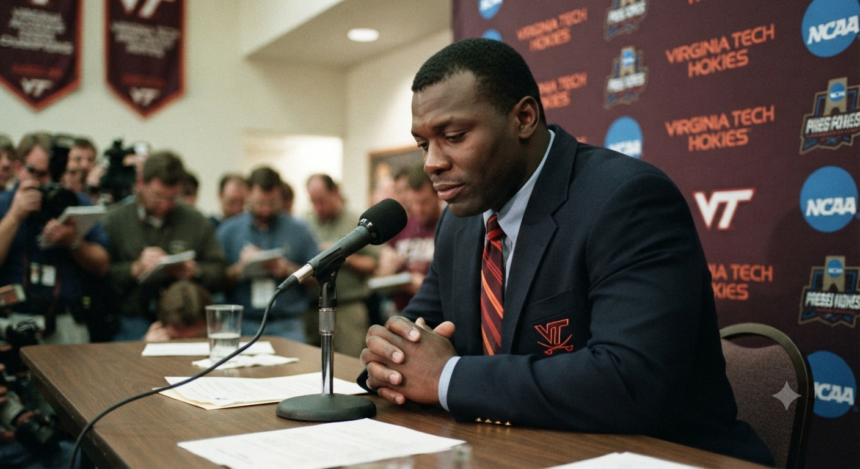
The Bruce Smith Virginia Tech confession has become a surprisingly confusing search topic. Some pages describe an emotional 2025 revelation involving self-doubt, tears, and a dramatic campus speech, while the earliest traceable reporting points to something much simpler: Smith speaking about why Virginia Tech mattered to him, why he remained connected to Virginia, and why young athletes should think about the relationships and opportunities they want to build in the state.
That distinction matters. Bruce Smith is a living person, so an attention-grabbing word such as “confession” should not automatically be interpreted as an admission of wrongdoing. The documented story is compelling without embellishment: one of football’s greatest defensive players explained his attachment to Virginia and encouraged the next generation to think beyond the next game or contract.
Bruce Smith Virginia Tech Confession: The Quick Answer
The clearest contemporaneous published account connected to the Bruce Smith Virginia Tech confession is a May 27, 2025 EssentiallySports article. It embedded a Triumph NIL social post and quoted Smith explaining that choosing Virginia Tech had been relatively straightforward because he felt there was something special about Virginia and believed Tech was “the place for me.”
Smith also encouraged young Hokies to ask practical questions about their future: whether they planned to live in Virginia, develop relationships there, and conduct business there. In that context, the so-called “confession” was not a scandalous disclosure; it was a personal statement about loyalty, place, relationships, and long-term opportunity.
A later December 2025 article expanded the narrative dramatically, describing hidden anxiety, thoughts of transferring, tears at Cassell Coliseum, a lengthy standing ovation, viral hashtags, and national television coverage. Those added details are not present in the earlier May account and should not be presented as established fact without independent corroboration.
What Did Bruce Smith Actually Say?
The published 2025 remarks show Smith telling younger athletes to consider where they want to live and establish their professional relationships after football. His message was essentially that choosing a university can influence much more than an athletic career.
That idea fits Smith’s public life after retirement. Rather than severing his Virginia connections after becoming an NFL superstar, he remained involved in business and development projects in the state and continued to maintain strong ties with Virginia Tech and Hampton Roads.
Why the Bruce Smith Virginia Tech Confession Became a Search Trend
The phrase Bruce Smith Virginia Tech confession demonstrates how an attention-grabbing headline can become a search query in its own right. Once a publication characterizes ordinary remarks as a “confession,” subsequent pages can optimize around that wording even when the original comments were considerably less dramatic.
That creates a problem for readers. Search results may make it seem as though there was a disciplinary admission, secret controversy, or newly uncovered scandal when the quoted material actually concerns Smith’s connection to Virginia and his advice to younger athletes.
For anyone researching the story, these distinctions are useful:
- Verified: Smith publicly discussed why Virginia Tech was the right place for him.
- Verified: He encouraged younger athletes to think about where they want to live, form relationships, and do business.
- Verified: Smith was honored as Norfolk’s First Citizen in 2024, with coverage emphasizing his continuing community involvement.
- Not independently established by the stronger sources reviewed: claims about a dramatic confession involving hidden mental-health struggles, a tearful Cassell Coliseum appearance, or a massive nationwide media event.
- Separate historical fact: Smith was involved in a major NCAA eligibility dispute before the 1984 Independence Bowl. That controversy occurred more than four decades before the 2025 remarks.
This source-by-source distinction is the most accurate way to understand the Bruce Smith Virginia Tech confession without allowing search-engine wording to rewrite someone’s biography.
Bruce Smith’s Virginia Tech Career Explains Why His Words Carry Weight
To understand why even relatively brief Bruce Smith Virginia Tech confession remarks draw attention, it helps to understand his place in Hokies history. Smith played at Virginia Tech from 1981 through 1984 and developed into one of the most disruptive defensive linemen college football had seen.
The National Football Foundation credits Smith with 46 career sacks and 71 tackles for loss, accounting for an extraordinary 504 yards lost by opponents. He recorded 22 sacks during his junior season and followed with another 16 as a senior.
The 1984 Outland Trophy and a Program-Changing Legacy
Smith won the 1984 Outland Trophy, awarded to the nation’s outstanding interior lineman, and became a consensus All-American. Contemporary UPI reporting described him as a massive but unusually fast defensive player and noted that his 46 quarterback sacks were believed at the time to represent a national career record.
His impact lasted. Virginia Tech retired his No. 78, and Smith entered the College Football Hall of Fame in 2006; the National Football Foundation credits his performance with helping elevate the Hokies’ football profile.
That context gives the Bruce Smith Virginia Tech confession considerably more meaning. When Smith advises players to think about long-term relationships and roots, those comments come from an alumnus whose association with Virginia continued long after his final college football game.
The 1984 NCAA Dispute: What Happened and What It Was Not
Searchers investigating the Bruce Smith Virginia Tech confession may quickly encounter references to the 1984 Independence Bowl controversy. That was a genuine and extensively reported eligibility dispute, but it should not be retroactively transformed into a new 2025 confession.
Virginia Tech had faced NCAA sanctions involving recruiting violations. An NCAA publication subsequently stated that Smith lost eligibility after the Committee on Infractions determined that he had been improperly recruited by Virginia Tech.
Archival WDBJ coverage later described evidence involving firewood provided to Smith’s father by a Virginia Tech booster during his recruitment. Whatever judgment readers make about the significance of that benefit, it is important to describe the event using the historical record rather than modern viral retellings.
Smith Went to Court to Play in the Independence Bowl
The controversy intensified immediately before Virginia Tech’s December 15, 1984 Independence Bowl game against Air Force. Smith challenged his postseason ineligibility through the courts, ultimately receiving legal relief that enabled him to participate.
The legal battle consumed valuable preparation time and became a major storyline surrounding the game. Virginia Tech eventually lost 23–7, while archival reporting noted how disruptive the court proceedings had been during the days leading to kickoff.
The NCAA did not simply forget the matter afterward. In May 1985, The NCAA News reported that Virginia Tech was required to return the team trophy and Smith’s individual awards associated with participation in the Independence Bowl.
None of this turns the modern Bruce Smith Virginia Tech confession into an admission concerning that case. The eligibility battle was already public in 1984 and 1985, long before social media, NIL collectives, or today’s viral sports-news ecosystem existed.
The “Confession” Fits a Much Longer Story About Virginia Tech
Smith’s modern statements about Virginia did not emerge from nowhere. During his 2009 Pro Football Hall of Fame induction speech, he discussed being recruited by Virginia Tech and recalled coach Bill Dooley emphasizing both education and the idea that NFL scouts would find Smith if his performance deserved their attention.
That prediction proved correct. The Buffalo Bills used the first overall selection in the 1985 NFL Draft on Smith, beginning one of professional football’s most decorated defensive careers.
His NFL accomplishments eventually transformed Smith from an important Virginia Tech alumnus into a league-wide benchmark. He played 19 seasons, earned 11 Pro Bowl selections and completed his career with 200 official sacks, the NFL career record.
From Blacksburg to Canton
Smith spent his first 15 NFL seasons with Buffalo and became a centerpiece of a defense that helped the Bills reach four consecutive Super Bowls. Buffalo’s official profile credits him with NFL Defensive Player of the Year awards in 1990 and 1996 and 13 career seasons with at least 10 sacks.
He was inducted into the Pro Football Hall of Fame in 2009, completing a path that began at Booker T. Washington High School in Norfolk and ran through Blacksburg before reaching Buffalo and Canton.
Seen from that perspective, the Bruce Smith Virginia Tech confession is less mysterious. His comments about Virginia represent another chapter in a relationship he has discussed publicly for years.
Norfolk’s First Citizen Honor Adds Another Layer
Smith received Norfolk’s First Citizen recognition in 2024, an honor connected to his work beyond football. Coverage from the Virginia Sports Hall of Fame emphasized his activity in Norfolk and illustrated the importance local leaders placed on his willingness to continue investing in his home region.
His business career also makes the message clearer. Smith’s public development biography lists hospitality, residential, and mixed-use projects in Virginia, including projects connected to Blacksburg and Virginia Beach.
This adds substance to one of the key ideas behind the Bruce Smith Virginia Tech confession: athletes should ask where they intend to establish their lives after sports. Smith’s point was broader than “stay home”; he was highlighting how a college decision can create a durable network for business, relationships, reputation, and civic involvement.
What the Bruce Smith Virginia Tech Confession Means for Current Athletes
The most useful takeaway is not celebrity gossip. It is career planning, particularly for athletes making decisions that may shape where their professional network exists for decades.
College sports have changed radically since Smith arrived in Blacksburg in 1981. NIL arrangements, the transfer portal, personal branding, athlete revenue opportunities, social media, and increasingly professional recruitment decisions mean that players have more short-term options than previous generations ever experienced.
Think Beyond the Depth Chart
A football recruit naturally asks about coaching, facilities, championships, playing time, strength programs, scheme fit, exposure, and NFL development. Smith’s perspective suggests another layer of questions that may become even more important after a player’s eligibility expires.
Consider asking:
- Where do I want my strongest professional network to exist five or ten years from now?
- Which university gives me relationships that can survive after football ends?
- Can I imagine building a company or career in this region?
- Does the alumni community have value beyond athletics?
- Am I choosing entirely for short-term exposure, or am I building a longer-term platform?
Viewed this way, the Bruce Smith Virginia Tech confession becomes an alumni lesson about network effects, geography, social capital, personal reputation, and long-term optionality. Those concepts may not generate highlight reels, but they can influence the remaining 40 or 50 years of an athlete’s working life.
Why Readers Should Be Careful With Viral Retellings
There is another valuable lesson here, and it has nothing to do with defensive line technique. Search and social-media headlines reward drama, so “confession” is more clickable than “Hall of Fame alumnus explains why he chose Virginia Tech.”
Once the dramatic wording gains traction, details can accumulate. A later article about the Bruce Smith Virginia Tech confession described an emotional May 2025 scene, personal struggles, tears, a prolonged ovation, viral reactions, and other specifics that go substantially beyond the earlier account containing Smith’s documented remarks.
For E-E-A-T-sensitive publishing, that difference matters. Direct quotations should be separated from interpretation, contemporaneous sources should be favored over later rewrites, and unsupported claims concerning living people should be labeled clearly rather than repeated as fact.
That approach also produces better SEO content. Google does not need another page paraphrasing the same sensational headline; readers benefit far more from a page that explains what is documented, what is historical context, and what remains unverified.
Bruce Smith Virginia Tech Confession and the Meaning of “Home”
The best-supported version of the story is also the most coherent. Smith grew up in Norfolk, became an accomplished athlete at Booker T. Washington High School, attended Virginia Tech, became the first selection of the NFL Draft, built a Hall of Fame career, and eventually developed substantial business interests in Virginia.
His message to younger athletes follows that same path. A university can become much more than the place where somebody spends four seasons playing football; it can become the foundation of friendships, business relationships, professional credibility, and community identity.
That is why Bruce Smith Virginia Tech confession is best understood as a description of Smith’s enduring connection to Virginia rather than shorthand for a newly verified scandal.
Frequently Asked Questions About Bruce Smith Virginia Tech Confession
What was the Bruce Smith Virginia Tech confession?
The Bruce Smith Virginia Tech confession refers to 2025 remarks in which Smith discussed why Virginia Tech was the right choice for him and encouraged younger athletes to consider whether they wanted to live, develop relationships, and pursue business opportunities in Virginia. The contemporaneous account does not establish that Smith confessed to a crime or disclosed a new NCAA offense.
Did Bruce Smith confess to wrongdoing at Virginia Tech?
There is no reliable evidence in the reviewed 2025 reporting supporting that interpretation. Smith did have a documented NCAA eligibility dispute in 1984, but that controversy concerned findings about his recruitment and was publicly litigated before the Independence Bowl more than 40 years ago.
Was there a tearful Bruce Smith speech at Cassell Coliseum in May 2025?
A later web article describes such an event and adds claims involving personal anxiety, tears, a long standing ovation, and extensive viral reaction. Those specific details are not contained in the earlier May 27 report of Smith’s remarks, so they should be treated as unverified unless supported by a primary video or independent reputable reporting.
What did Bruce Smith accomplish at Virginia Tech?
Smith accumulated 46 sacks and 71 tackles for loss, including 22 sacks during his junior season. He won the 1984 Outland Trophy, became a consensus All-American, had his No. 78 retired by Virginia Tech, and entered the College Football Hall of Fame in 2006.
What is Bruce Smith best known for in the NFL?
Smith remains the NFL’s official career leader with 200 sacks. He was selected first overall in 1985, earned 11 Pro Bowl selections, won two NFL Defensive Player of the Year awards, played on Buffalo’s four consecutive AFC championship teams, and entered the Pro Football Hall of Fame in 2009.
Conclusion: Read the Headline, Then Verify the Story
The Bruce Smith Virginia Tech confession is a useful case study in why readers should look beyond viral terminology. The strongest verifiable story is not a shocking new admission; it is a legendary Virginia Tech player explaining his lasting connection to the state and encouraging younger athletes to think carefully about where they want to build their lives after football.
If you publish or share this topic, keep the 2025 remarks separate from the 1984 NCAA dispute, use primary or institutional sources for Smith’s career record, and clearly label later claims that cannot be independently verified. That approach delivers stronger E-E-A-T, greater information gain, and a far more trustworthy resource than simply repeating a sensational headline.