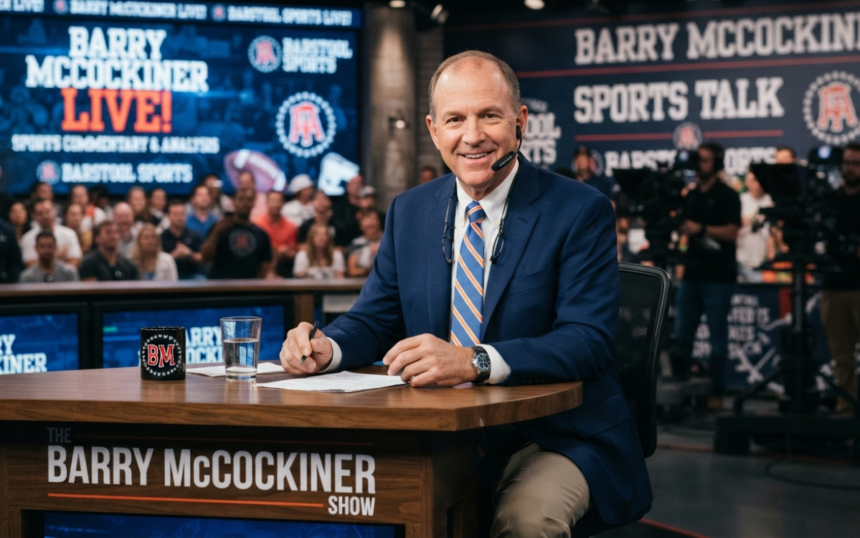
Barry McCockiner is the pseudonymous sports-comedy creator best known for blending legitimate NFL and NBA knowledge with satire, deliberately outrageous takes, and fake-breaking-news posts designed to expose how quickly people share claims they have not verified. What began as an abrasive social-media character eventually grew into a recognizable sports-content brand spanning viral Twitter/X trolling, podcast appearances, a long-running YouTube channel, and a series of incidents in which journalists or commentators treated parody as real reporting.
That distinction matters. Search results for Barry McCockiner are full of recycled biographies, joke profiles, invented personal details, and pages that blur the fictional persona with the creator behind it. A more useful profile separates what is documented from what is simply part of the bit.
Who Is Barry McCockiner?
Barry McCockiner is an online sports persona rather than a conventional public biography. The creator built an audience by combining sports analysis with trolling, sarcasm, impersonation-style parody, and intentionally provocative arguments about major athletes, especially NFL quarterbacks and NBA stars. In a 2020 Talking Buffalo interview, the host described him as a social-media “lightning rod” and emphasized that he was also highly knowledgeable about football and basketball.
The name itself is a deliberately crude phonetic joke, which should be an immediate clue that the brand is not presenting itself like a traditional credentialed reporter. Historically, the account has used changing display names and handles, including the widely documented @SportsTalkBarry identity, making old screenshots easy to misunderstand when stripped of context.
Is Barry McCockiner a real person?
A real creator obviously operates the accounts and produces the videos, but “Barry” functions as a character and pseudonym. No reliable source reviewed for this article establishes a verified legal name, date of birth, education history, spouse, hometown, or other standard biographical details, so pages that confidently supply those facts should be treated cautiously.
That is an important E-E-A-T point. When a creator is intentionally pseudonymous, the absence of a verified private biography is not a gap that should be filled with guesses. It is better to say “not publicly established” than to manufacture certainty.
How Barry McCockiner Became Famous
The breakthrough was not one single viral joke. It was a repeatable format: take the visual language of sports breaking news, imitate the tone people already trust, add a claim that is just plausible enough to trigger an emotional reaction, and watch whether readers verify the source before sharing it.
That approach turned Barry McCockiner into something more interesting than a standard meme account. The trolling repeatedly demonstrated a weakness in the sports-information ecosystem: speed, familiarity, and confirmation bias can overpower basic source checking.
The Skip Bayless and James Harden parody report
One of the most cited examples happened in June 2019. A parody post presented as if it came from ESPN insider Adrian Wojnarowski claimed that Chris Paul had mocked James Harden’s body during Houston Rockets practices, and Fox Sports personality Skip Bayless discussed the claim on air as a “report.” Mediaite and Awful Announcing both documented that the underlying source was the parody account associated with @SportsTalkBarry.
The episode is significant because the joke did not merely fool random users. It crossed from social media into televised sports commentary. In practical terms, that made the account a live demonstration of why screenshots, display names, and viral repetition are not substitutes for primary-source verification.
The fake Ian Rapoport/Antonio Brown episode
Later in 2019, the persona imitated NFL insider Ian Rapoport while posting fictional updates around Antonio Brown. Fox Sports Radio reported that prominent football writer Peter King was among those who reacted to a fabricated item before recognizing the deception.
The mechanics were simple but effective: copy the surface cues of authority, insert the parody into an already chaotic news cycle, and rely on readers moving faster than their skepticism. That same pattern explains why Barry McCockiner became notorious among sports-media observers.
The fake Tom Brady quote that reached news outlets
In April 2020, the stakes became even clearer. Forbes documented how a fabricated Tom Brady quote about Donald Trump, created by the parody account, was picked up as genuine by media outlets before being corrected or removed. The creator told Forbes that he had not expected the post to gain traction and had even deleted it after initially thinking it had failed.
This is probably the best example of the account’s broader relevance. The humor is one layer. The information-literacy lesson is another: a false quote can acquire perceived legitimacy when one publisher copies another instead of checking the original interview.
Barry McCockiner and the Problem of Viral Misinformation
Calling the account “fake news” without context misses the point. The posts have generally operated as parody, and older profiles explicitly labeled the account that way. Awful Announcing noted that the @SportsTalkBarry bio itself included “Parody,” even while users and media figures still fell for individual posts.
Yet parody can still escape its original audience. Once a screenshot is reposted on Facebook, Reddit, Instagram, or another account, the label may disappear. PolitiFact encountered exactly that problem in 2021 when it debunked a viral claim that Patrick Mahomes would refuse to play until the Kansas City Chiefs changed their name; the claim originated with a known parody account and was false.
That is why the Barry McCockiner story has value beyond sports humor. It illustrates three recurring verification failures:
- Display-name trust: People recognize a reporter’s name or avatar and stop checking the actual handle.
- Context collapse: A joke that is obvious to followers can look factual after being screenshotted and reposted elsewhere.
- Aggregation loops: One outlet repeats another outlet’s claim, creating the appearance of multiple sources when everyone is relying on the same unverified origin.
For readers, the fix is straightforward: open the original post, inspect the account history, find the primary interview or report, and check whether a reputable outlet independently confirmed it. If the claim is explosive but the sourcing is vague, skepticism should increase, not decrease.
From Twitter Troll to YouTube Sports Commentator
The biggest evolution of Barry McCockiner is the move from short-form trolling to long-form sports content. His YouTube channel, @BarryOnHere, shows that the brand is no longer built only around fooling people with fake posts. As of August 2026, YouTube listed roughly 238,000 subscribers, more than 57 million channel views, and hundreds of uploaded videos.
The channel’s catalog is heavily focused on the NFL and NBA, with recurring formats built around rankings, draft grades, quarterback debates, playoff reviews, “overrated” and “underrated” arguments, fanbase-triggering videos, and historical comparisons. Current uploads in 2026 continue that pattern, including quarterback rankings, NFL coaching discussions, player evaluations, and NBA debates.
Why Barry McCockiner’s YouTube content works
The videos use a useful tension: the creator clearly knows the sports history and statistics well enough to construct a real argument, but the packaging often exaggerates the conclusion for comedy. That makes viewers ask a productive question—“Is he serious?”—which is also the engine behind much of the brand’s engagement.
This is especially visible in the recurring Tom Brady material. A video titled Tom Brady: The Most Overrated Player in Sports History accumulated more than 600,000 views, while later videos continued the anti-Brady theme through playoff rankings, retirement tributes, and follow-up arguments.
The important nuance is that the YouTube work is not interchangeable with the old impersonation-style hoaxes. Long-form videos are presented as commentary and entertainment. Even when the takes are intentionally inflammatory, viewers can evaluate the argument, evidence, and jokes in context.
The Class Act Podcast and Guest Appearances
Before YouTube became the clearest home for the brand, Barry McCockiner also developed The Class Act Podcast. Archived listings describe the show as a sports-comedy program built around sketches, fan questions, interviews, and intentionally over-the-top persona work.
He has also appeared multiple times on Talking Buffalo. In the 2020 interview, discussion covered the slow growth of his audience, the work required to make content, the balance between humor and substance, and whether any trolls crossed a line he regretted. A later Talking Buffalo episode again centered on his social-media exploits, the NFL, the Buffalo Bills, and Tom Brady.
Those interviews are useful because they show the creator participating in conversations as a content maker, not merely existing as a collection of viral screenshots. That gives a more complete picture of how the persona developed into a sustainable media identity.
What Makes Barry McCockiner Different From Ordinary Sports “Hot Take” Accounts?
Sports media already rewards disagreement. The distinctive element here is format awareness: the creator does not just argue that a star is overrated; he also satirizes the way sports news itself is packaged, circulated, and believed.
At his best, Barry McCockiner works on two levels. The first is familiar fan entertainment—quarterback rankings, draft debates, NBA legacy arguments, trolling rival fanbases. The second is media satire that exposes how authority is visually manufactured online.
That combination also explains the durability of the persona. A single fake-news prank gets old quickly. A creator who can move between parody, research-heavy rankings, historical sports debates, weekly reviews, podcasts, and audience bait has more room to evolve.
What Is Verified — and What Should You Ignore?
Because the name is designed as a joke, search engines surface a lot of low-quality or deliberately fictional material. The safest way to research the creator is to separate platform-level evidence and reputable reporting from unsourced biography pages.
Well-supported facts include:
- The persona became known through sports parody and trolling on Twitter/X, particularly under the historical @SportsTalkBarry identity.
- Major media personalities and outlets have fallen for or repeated fabricated claims associated with the account.
- The creator operates the established YouTube channel @BarryOnHere, which remains active in 2026.
- His content concentrates on NFL and NBA commentary, rankings, historical debates, draft analysis, and satire.
- He has hosted or been associated with The Class Act Podcast and has given long-form podcast interviews about his content strategy and persona.
What should not be repeated as fact without a strong source? A supposed real name, age, spouse, family history, net worth, exact residence, school history, or “secret identity.” If a biography site provides highly specific personal details but does not show where they came from, that is not information gain. It is unsupported precision.
Why the Persona Still Matters in 2026
The most interesting legacy of Barry McCockiner is not any one Tom Brady joke or fake insider post. It is the way the persona anticipated a media environment in which source identity is increasingly easy to imitate and increasingly important to verify.
The technical tools have changed. AI-generated images, cloned voices, fake screenshots, and rapidly recycled clips make source verification more important than ever. But the human weakness exploited by old parody posts is largely the same: people are more likely to accept information that confirms what they already suspect, especially when it arrives wearing the visual costume of authority.
For sports fans, the lesson is simple. Enjoy the joke, argue about the rankings, and share the memes—but check the source before treating a screenshot as news.
FAQ About Barry McCockiner
Who is Barry McCockiner?
Barry McCockiner is a pseudonymous sports-content creator and parody persona known for NFL and NBA commentary, social-media trolling, satirical fake reports, podcasts, and YouTube videos. The account became especially famous after several fabricated sports claims were mistakenly repeated by media figures or publications.
Is Barry McCockiner his real name?
There is no reliable public evidence reviewed here showing that it is the creator’s legal name. The name functions as an intentionally comic pseudonym, and the persona has historically used multiple social-media handles and display identities.
Claims identifying a private legal name should not be repeated without strong, first-hand documentation.
What is Barry McCockiner’s YouTube channel?
The established channel is @BarryOnHere on YouTube. In August 2026, YouTube showed about 238,000 subscribers and more than 57 million views, with a library covering NFL history, quarterback rankings, draft analysis, NBA debates, weekly reviews, and satirical sports commentary.
Why did Barry McCockiner become famous?
He became famous because his parody posts repeatedly looked enough like legitimate sports reporting to fool users, journalists, commentators, or aggregators. High-profile examples involved a fake James Harden–Chris Paul report, fabricated Antonio Brown updates presented in an insider-like format, and a false Tom Brady quote that spread into published media coverage.
What is Barry McCockiner’s net worth?
There is no trustworthy public figure for his net worth. The YouTube channel has a large audience and has carried sponsorships and merchandise links, but revenue does not equal net worth, and private income, expenses, ownership, taxes, and contracts are not publicly documented. Any site publishing a precise dollar estimate without transparent evidence is speculating.
Final Takeaway
Barry McCockiner is best understood not as a mystery celebrity who needs an invented biography, but as a durable sports-media character built from real sports knowledge, deliberate provocation, parody, and audience psychology. His most famous trolling incidents are funny on the surface, yet they also reveal a serious weakness in online information: people often verify the claim only after they have already reacted to it.
If you encounter a new “breaking” sports screenshot attached to the name, do two things. First, assume the possibility of satire. Second, trace the claim to a primary source before sharing it.
If you want the creator’s current work rather than old viral lore, the active YouTube channel is the most verifiable place to start.