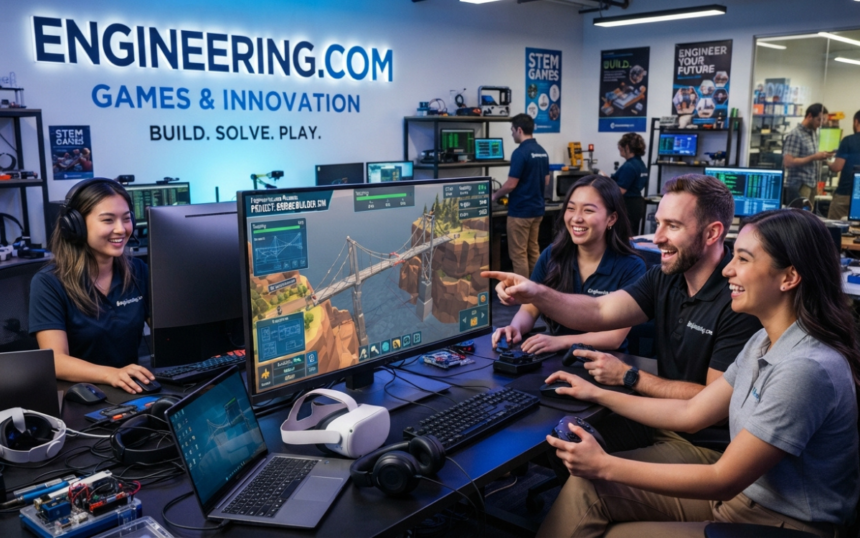
Engineering.com games are interactive experiences designed to combine entertainment with engineering education. Unlike traditional games that focus only on points or competition, these challenges encourage players to think like designers, builders, and problem-solvers. Whether you are a student exploring STEM concepts, an educator searching for engaging classroom activities, or an engineering enthusiast looking for creative challenges, these games offer a practical way to understand complex ideas.
The appeal of Engineering.com games comes from their ability to turn abstract engineering principles into visual and interactive experiences. Players can experiment with structures, machines, physics concepts, and design decisions while developing skills that mirror real engineering workflows.
What Are Engineering.com Games and Why Do They Matter?
Engineering.com games are educational and recreational tools that introduce engineering concepts through gameplay mechanics. They often focus on areas such as mechanical design, construction, physics, architecture, manufacturing, and problem-solving.
Instead of simply reading about force, motion, or material strength, players experience those ideas directly. A virtual bridge-building challenge, for example, allows users to test designs, identify weak points, and improve their creations.
The core value of Engineering.com games is experiential learning. Engineers rarely solve problems by memorizing formulas alone. They create models, test assumptions, analyze failures, and refine solutions.
Key learning benefits include:
- Critical thinking development: Players evaluate situations and make strategic decisions.
- Creative design practice: Users experiment with different approaches instead of following one fixed answer.
- Engineering mindset growth: Challenges encourage testing, iteration, and improvement.
- STEM engagement: Interactive learning makes science and mathematics more approachable.
For younger learners, these experiences can spark interest in engineering careers. For experienced professionals, they can provide a relaxing way to explore design concepts outside of daily work.
How Engineering.com Games Support STEM Education
Modern STEM education increasingly focuses on active participation rather than passive learning. Engineering.com games fit naturally into this approach because they allow students to apply concepts immediately.
A classroom lesson about structural engineering becomes much more memorable when students can design a structure and watch how it responds under pressure. A physics lesson becomes more engaging when learners can adjust variables and observe real-time results.
Teachers can use these games to introduce:
- Mechanical engineering concepts
- Civil engineering principles
- Computer-aided design ideas
- Physics simulations
- Manufacturing processes
- Engineering optimization
The biggest advantage is feedback. In traditional assignments, students may not understand why an answer is incorrect. Interactive engineering challenges show the consequences of design choices instantly.
A failed design is not treated as a mistake. It becomes data. That mirrors the professional engineering process, where prototypes fail before successful solutions emerge.
Engineering.com Games and the Development of Real Engineering Skills
How Engineering.com Games Build Problem-Solving Ability
Engineering is fundamentally about solving problems under constraints. Engineers must consider budgets, materials, safety requirements, efficiency, and user needs.
Engineering.com games recreate many of these conditions in simplified formats. Players often need to balance competing goals, such as creating the strongest structure while using limited resources.
These activities develop transferable skills:
- Analytical reasoning: Understanding why a design succeeds or fails.
- Spatial awareness: Visualizing objects and systems in three dimensions.
- Decision-making: Selecting the best option among multiple possibilities.
- Iteration skills: Improving designs through repeated testing.
A strong engineering education is not only about knowing technical information. It is also about developing the confidence to experiment.
Engineering.com Games as Digital Engineering Simulations
Many engineering simulations used in professional environments rely on concepts that are introduced through simplified educational games. While a game is not a replacement for professional engineering software, it provides a foundation.
Players become familiar with ideas such as:
- Load distribution
- Material behavior
- Mechanical movement
- System optimization
- Design constraints
This early exposure can make advanced engineering topics less intimidating later.
Different Types of Engineering.com Games You Can Explore
Engineering covers many disciplines, and interactive challenges can represent almost every branch.
Construction and Structural Design Games
These games focus on building stable structures. Players may design bridges, towers, buildings, or mechanical frameworks.
Important concepts include:
- Weight distribution
- Balance
- Structural integrity
- Material selection
They demonstrate why real engineers carefully calculate forces before construction begins.
Mechanical Engineering Challenges
Mechanical-focused games allow users to work with machines, gears, motors, and moving systems.
Players learn about:
- Motion transfer
- Mechanical advantage
- Machine efficiency
- Component interaction
These challenges are especially useful for anyone interested in robotics or product design.
Physics-Based Engineering Games
Physics simulation games explore real-world principles through interactive environments.
Common topics include:
- Gravity
- Friction
- Energy transfer
- Motion
- Forces
These games transform formulas into visible outcomes, helping learners connect theory with practical examples.
Design and Innovation Games
Some challenges focus less on calculations and more on creativity. Players must invent solutions, improve products, or optimize designs.
These activities encourage:
- User-focused thinking
- Innovation
- Creative experimentation
- Design strategy
How Engineering.com Games Compare With Traditional Learning Methods
Traditional engineering education provides essential knowledge, but interactive learning adds another dimension.
A textbook might explain how a structure handles stress. A simulation allows students to create that structure, apply forces, observe failure, and redesign it.
This difference matters because experience creates deeper understanding.
Engineering.com games provide several advantages:
- Immediate feedback: Users see results instantly.
- Safe experimentation: Mistakes do not have real-world consequences.
- Higher engagement: Interactive activities maintain attention.
- Practical application: Concepts connect to realistic scenarios.
However, games should complement formal education rather than replace it. Engineering requires mathematics, science, technical training, and professional judgment.
How to Get the Most Value From Engineering.com Games
Simply playing a game is not always enough. The greatest learning happens when players approach challenges with an engineering mindset.
Try these strategies:
- Analyze before building.
Think about the problem requirements before making decisions. - Test multiple designs.
Engineers rarely find the perfect solution immediately. - Study failures.
A broken design reveals important information. - Connect gameplay to real examples.
Ask how the same principles appear in buildings, vehicles, or machines. - Document improvements.
Keeping notes helps develop professional engineering habits.
Engineering.com games become much more powerful when users treat them as virtual laboratories rather than simple entertainment.
Why Engineering.com Games Are Popular Among Students and Professionals
The popularity of Engineering.com games comes from their unique combination of challenge and creativity.
Students enjoy the competitive aspects, while educators appreciate the learning opportunities. Professionals may enjoy them because they provide a simplified environment for exploring ideas without the pressure of real-world projects.
Several factors drive their popularity:
- Increased interest in STEM careers
- Growth of digital learning platforms
- Demand for interactive education
- Better access to simulation technology
Engineering concepts can sometimes appear difficult because they involve invisible forces and complex calculations. Interactive experiences make those concepts easier to visualize.
The Future of Engineering.com Games and Digital Learning
Technology continues to transform engineering education. Artificial intelligence, virtual reality, and advanced simulations are creating new possibilities for interactive learning.
Future engineering games may include:
- More realistic physics engines
- AI-powered design feedback
- Virtual laboratories
- Collaborative engineering challenges
- Real-time performance analysis
The goal is not simply to create more entertaining games. The goal is to create better learning environments where users can explore, test, and innovate.
As digital education evolves, Engineering.com games represent a growing bridge between curiosity and technical knowledge.
Frequently Asked Questions About Engineering.com Games
1. Are Engineering.com games suitable for beginners?
Yes. Engineering.com games are designed for different skill levels, including beginners who have little technical background. They introduce engineering concepts gradually through interactive challenges, making complex topics easier to understand.
2. Can Engineering.com games help students learn engineering?
Yes. Engineering.com games can support STEM learning by allowing students to practice problem-solving, design thinking, and experimentation. They work especially well as supplements to classroom instruction.
3. What makes Engineering.com games different from normal video games?
Engineering.com games focus on learning outcomes alongside entertainment. Instead of only completing levels, players often analyze systems, make design decisions, and understand real engineering principles.
4. Can Engineering.com games replace engineering courses?
No. Engineering.com games are learning tools, not replacements for formal engineering education. Professional engineers need mathematics, science knowledge, practical experience, and accredited training.
5. What skills can players develop through Engineering.com games?
Players can develop creativity, logical thinking, design skills, analytical reasoning, and an understanding of engineering concepts. These skills are valuable in both academic and professional environments.
Final Thoughts: Start Exploring Engineering Through Interactive Challenges
Engineering.com games offer a unique way to experience engineering concepts through creativity, experimentation, and problem-solving. They transform difficult ideas into practical challenges that encourage curiosity and innovation.
Whether you are a student preparing for a STEM career, a teacher searching for engaging resources, or simply someone who enjoys building and designing, these interactive experiences provide meaningful learning opportunities.
Start with a challenge that interests you. Experiment with different solutions. Analyze what works and what fails. The best engineers are not those who never make mistakes; they are the ones who learn from every attempt.