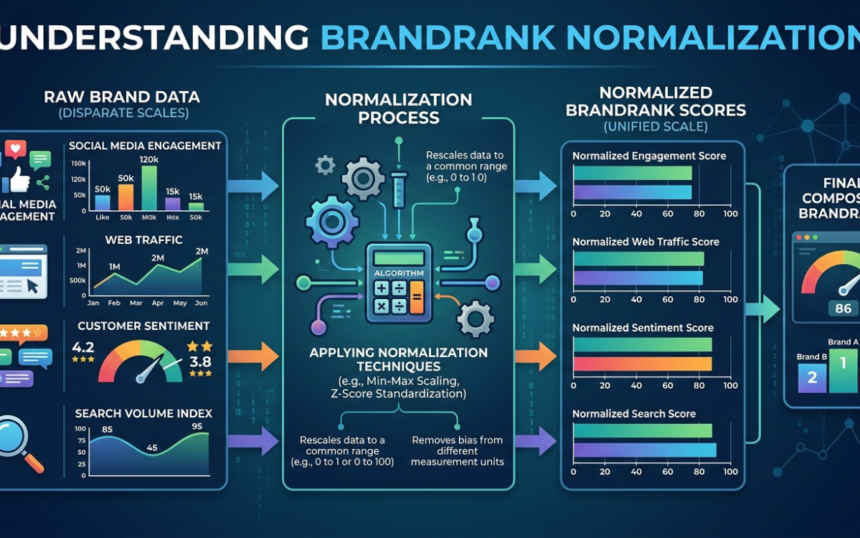
BrandRank.ai normalization transformation rules are best understood as a practical framework for cleaning inconsistent brand data and converting AI-generated answers into structured, comparable signals. The crucial fact is that, as of August 26, 2026, BrandRank.AI’s public website, FAQ, and recent announcements do not publish a proprietary technical specification under this exact name. Instead, the company publicly discusses AI Search Visibility, Brand Vulnerability, Content Readiness, Brand Health and Trust, Recommendation Share, prompt tracking, citations, accuracy, sentiment, and competitive benchmarking.
That distinction matters. Some articles treat BrandRank.ai normalization transformation rules as if BrandRank.AI has released a public rulebook containing hidden formulas, regex patterns, or scoring thresholds. The stronger interpretation is more evidence-based: normalization and transformation are the data-governance processes needed to make AI visibility measurement consistent, auditable, and useful.
What Are BrandRank.ai Normalization Transformation Rules?
At a practical level, BrandRank.ai normalization transformation rules combine two related operations.
Normalization makes different representations of the same entity comparable. It might map “Brand Rank AI,” “BrandRank,” “BRANDRANK.AI,” and “brandrank.ai” to one canonical entity while retaining each original mention.
Transformation converts raw information into analytical fields. An AI answer can be transformed into values such as brand mentioned, recommendation status, cited source, sentiment, claim accuracy, competitor presence, topic, model, market, language, and timestamp.
The purpose is not cosmetic cleanup. It is to stop inconsistent inputs from fragmenting metrics or creating false conclusions.
What BrandRank.AI Actually Documents
BrandRank.AI says it tracks how brands appear across AI answer engines, tests priority prompts, compares competitors, identifies cited sources, monitors vulnerabilities, and evaluates whether content is ready to be understood and cited by AI systems. Its public platform currently emphasizes AI Search Visibility, Brand Vulnerability, Content Readiness, Recommendation Share, accuracy, sentiment, and competitive analysis.
The company also publicly uses a Brand Health and Trust framework. Through its partnership with Burke, Inc., BrandRank.AI introduced BRAND ANSWER, a diagnostic designed to reveal how AI answers portray a brand, where the brand is absent from important consumer questions, and how it compares with competitors.
What the reviewed public materials do not provide is an official BrandRank.ai normalization transformation rules specification. There is no publicly disclosed alias dictionary, entity-resolution threshold, transformation schema, private ranking formula, or normalization engine documentation under that name.
That means any claimed “exact BrandRank.AI rule” should be treated as unverified unless BrandRank.AI itself publishes it.
Normalization and Transformation Are Not the Same Thing
Suppose an AI engine returns:
“Brand Rank AI helps marketers monitor AI visibility. Source: https://www.brandrank.ai/?utm_source=test.”
A normalization layer could convert the observed brand name to BrandRank.AI and clean the tracked URL to its canonical version. A transformation layer could then produce fields such as brand_mentioned = true, citation_domain = brandrank.ai, topic = AI visibility, and source_type = first-party.
This is the simplest way to understand BrandRank.ai normalization transformation rules. Normalization asks, “What entity or source is this?” Transformation asks, “What measurable meaning should be extracted from it?”
Core Brandrank.ai Normalization Transformation Rules
1. Canonicalize Brand Identity
Create one canonical record for each real entity. Store the official name, primary domain, known aliases, old names, product relationships, subsidiaries, markets, and a stable entity ID.
Do not erase aliases after matching them. Preserve the raw string so analysts can audit whether “Acme,” “Acme Inc.,” and “Acme UK” truly belong to the same reporting entity.
A useful entity record includes:
- Canonical entity ID
- Canonical name
- Observed alias
- Primary domain
- Market or locale
- Relationship type
- Confidence score
- Manual-review status
This makes BrandRank.ai normalization transformation rules an entity-resolution system rather than a simple spelling cleanup exercise.
2. Normalize URLs Before Counting Citations
One page can appear under multiple URL variations because of UTM parameters, fragments, redirects, protocol differences, trailing slashes, or locale parameters.
Counting every variation separately can inflate citation metrics. Normalize nonessential tracking parameters, hostnames, redirects, and canonical URLs while preserving the original URL for traceability.
Be careful, though. Two similar URLs should remain separate when parameters change the language, region, product, or actual page content.
3. Keep Parent Brands, Products, and Sub-Brands Distinct
A parent company and a product are related, but they are not the same entity.
If an answer recommends a specific product, automatically converting that into a recommendation for every brand owned by the parent company would distort visibility and recommendation share.
Strong BrandRank.ai normalization transformation rules therefore preserve relationships such as:
product_ofowned_byparent_ofregional_variant_offormerly_known_as
This relationship-aware approach is far more accurate than merging every connected name into one brand bucket.
4. Normalize Geography and Language
AI answers can vary significantly by country, city, language, and local source ecosystem. A brand may also share its name with an unrelated company in another region.
Standardize country names, state or province formats, language codes, and market labels. Keep market distinctions when they affect identity, product availability, regulation, or the sources an answer engine is likely to use.
BrandRank.AI’s public materials discuss AI performance across platforms and markets, making location-aware normalization important for meaningful comparison.
5. Deduplicate Citations at URL and Domain Level
Citation counting should have at least two views: unique URLs and unique domains.
Three pages from one publisher are not the same as three independent publishers. Without domain-level deduplication, a single website can appear to contribute more independent authority than it actually does.
Useful transformed fields include unique cited URL, unique cited domain, first-party or third-party classification, citation frequency, source topic, and cross-engine recurrence.
This gives BrandRank.ai normalization transformation rules a direct role in measuring source diversity and citation share.
6. Preserve Every Raw AI Answer
Never discard the source evidence after extracting metrics.
Store the full answer, prompt, engine, timestamp, locale, citations, observed entity strings, normalized values, transformation version, and confidence score. If your logic changes later, the original data can be reprocessed.
This principle is critical because AI outputs are variable. A clean dashboard without a raw evidence layer is difficult to audit.
7. Normalize Prompts Without Erasing Search Intent
“Best running shoes for flat feet” and “Which shoes help overpronation?” may belong to the same topic cluster, but they are not the same question.
Use separate fields for raw prompt, normalized prompt, intent, topic, funnel stage, language, and market. That supports aggregate reporting while preserving the wording that may cause different AI answers.
For BrandRank.ai normalization transformation rules, prompt normalization is especially important because prompt-level tracking is central to AI visibility measurement.
8. Separate Mentions, Recommendations, Sentiment, and Accuracy
A mention is not automatically a recommendation. A citation is not an endorsement. Positive wording does not guarantee factual accuracy.
An answer such as “Brand X is popular, but its 2024 product was recalled” can contain positive sentiment, negative risk, a historical qualifier, and a product-specific factual claim at the same time.
A mature transformation layer should therefore separate:
- Brand mention
- Recommendation
- Sentiment
- Factual claim
- Accuracy
- Vulnerability or risk
- Product scope
- Time context
BrandRank.AI itself publicly emphasizes accuracy, sentiment, vulnerability, and how brands are represented in AI answers.
Why Provenance Is Essential
Every normalized value should answer three questions: Where did it come from? Which rule changed it? How confident is the system?
Store the raw value, normalized value, rule ID, rule version, timestamp, confidence score, and any human override. This makes BrandRank.ai normalization transformation rules reproducible rather than opaque.
Without provenance, an apparent visibility increase may not represent real improvement. A new alias rule may simply start counting mentions that the old system missed.
Version the Rules
Do not silently overwrite transformation logic.
If a new version begins mapping a recently acquired company into its parent entity, historical numbers may change. Versioned rules allow teams to reproduce older reports and decide whether previous periods should be recalculated.
Create an Exception Queue
Ambiguous matches should trigger review instead of forced certainty.
If an alias, URL, or entity match falls below a confidence threshold, send it to an analyst. A small review queue is cheaper than contaminating thousands of rows with false merges.
What Should Not Be Normalized?
Over-normalization is one of the biggest weaknesses in poorly designed BrandRank.ai normalization transformation rules.
Do not merge differences that carry business meaning. Keep separate records when variations represent distinct products, legal entities, markets, franchises, time periods, or materially different source pages.
Common examples include:
- Parent company vs. consumer brand
- Current product vs. discontinued or recalled model
- US entity vs. German entity
- Main domain vs. regional domain
- Homepage vs. product-support article
- Brand mention vs. explicit recommendation
Clean data is valuable. Artificially uniform data is not.
How Entity SEO and Structured Data Fit In
Brands can reduce ambiguity before any monitoring platform processes their data.
Google says Organization structured data can help it understand administrative details and disambiguate an organization. Its documentation recommends relevant properties such as url and sameAs, while Schema.org defines sameAs as a URL that unambiguously identifies the same entity.
A practical identity program should align the official brand name, website URL, logo, organization schema, major social profiles, product naming, business listings, and factual company information.
But BrandRank.ai normalization transformation rules should not be sold as a shortcut that guarantees AI citations. Google explicitly says websites do not need special AI markup, special schema, or new machine-readable files to appear in AI Overviews or AI Mode. Existing SEO fundamentals, crawlability, useful content, and accurate structured data remain relevant.
That is an important information-gain point: entity consistency improves clarity and measurement, but it does not create a guaranteed AI ranking advantage on its own.
Why BrandRank.ai Normalization Transformation Rules Matter for AEO
Answer Engine Optimization depends on understanding whether an AI system recognized the right entity, cited the right source, and represented that entity accurately. If aliases, domains, products, and recommendations are classified inconsistently, AEO decisions can be based on noisy data.
Well-designed BrandRank.ai normalization transformation rules make those measurements easier to compare over time. They help teams distinguish genuine changes in AI visibility from changes caused by naming variations, URL duplication, or altered classification logic.
How These Rules Connect to BrandRank.AI
The relationship is logical and operational, not a publicly documented proprietary feature.
BrandRank.AI measures prompt results, brand visibility, recommendation share, competitors, cited sources, content readiness, accuracy, sentiment, and vulnerability across AI answer engines. Comparing those outputs consistently requires some form of standardization and structured extraction, even though BrandRank.AI does not reveal its private implementation.
The safest interpretation of BrandRank.ai normalization transformation rules is therefore: a data-governance framework for turning inconsistent brand and AI-answer signals into reliable analytics.
That explanation avoids pretending to know BrandRank.AI’s private code while still answering the search intent thoroughly.
How to Measure Whether Your Rules Work
Do not judge a normalization system because the database looks tidy. Judge it by error rates and reproducibility.
Track:
- Alias precision: percentage of alias mappings that are correct
- False-merge rate: distinct entities incorrectly combined
- Unresolved rate: mentions that remain ambiguous
- Citation deduplication accuracy: duplicates removed correctly
- Manual override rate: analyst corrections to automated mappings
- Metric drift: score changes caused by rule updates
- Cross-engine consistency: comparable outputs classified the same way
- Reprocessing success: historical data rebuilt correctly under a new version
These QA metrics are often missing from articles about BrandRank.ai normalization transformation rules, yet they determine whether the final dashboard is trustworthy.
Step-by-Step Implementation Checklist
Use this sequence to avoid building complex analytics on top of weak identity data:
- Build a canonical brand registry containing names, domains, aliases, products, subsidiaries, regions, and identifiers.
- Preserve raw prompts, answers, citations, and observed entity strings.
- Normalize deterministic fields first, including whitespace, case, domains, URLs, dates, and known aliases.
- Add relationship-aware entity resolution for products, parents, subsidiaries, and markets.
- Transform answers into separate fields for mentions, recommendations, citations, claims, sentiment, accuracy, and competitors.
- Assign confidence scores and route ambiguous records to manual review.
- Version each rule so reports can be reproduced.
- Test against human-labeled examples to measure false merges and missed matches.
- Monitor rebrands, acquisitions, new products, and retired domains.
- Reprocess historical data when a major rule change alters interpretation.
Applied this way, BrandRank.ai normalization transformation rules become a practical governance layer for trustworthy AI visibility measurement.
Common Mistakes to Avoid
The first mistake is inventing proprietary details. If BrandRank.AI has not published a formula, threshold, or schema, do not describe it as official.
The second is destructive cleaning. Overwriting the raw evidence makes errors difficult to investigate.
The third is over-merging entities. Products, parent companies, local brands, and legacy names may require distinct reporting.
The fourth is equating visibility with recommendation. AI can mention a company negatively or cite it without recommending it.
The fifth is assuming standardization guarantees AI ranking. Reliable entity data improves clarity, but visibility still depends on relevance, authority, cited sources, content quality, trust signals, and the behavior of each answer engine.
Frequently Asked Questions About Brandrank.ai Normalization Transformation Rules
Are BrandRank.ai normalization transformation rules an official BrandRank.AI feature?
Based on the public materials reviewed as of August 26, 2026, the exact phrase is not presented as an official BrandRank.AI technical framework. BrandRank.AI publicly documents AI Search Visibility, Brand Vulnerability, Content Readiness, Brand Health and Trust, Recommendation Share, accuracy, source analysis, and prompt tracking instead.
The phrase is better used descriptively for the normalization and transformation processes that make AI brand-monitoring data comparable.
What Is the Difference Between Normalization and Transformation?
Normalization standardizes identity and formatting. It decides when verified aliases, URL variants, or location formats should point to one canonical record.
Transformation extracts analytical meaning. It can convert a raw AI answer into structured fields such as recommendation, citation, sentiment, claim accuracy, competitor presence, topic, and risk.
Can These Rules Improve AI Search Visibility?
They can improve data consistency, entity clarity, and the accuracy of your own monitoring, but they should not be presented as a guaranteed AI ranking factor. Consistent organization details, accurate structured data, useful content, and authoritative references reduce ambiguity.
Google also states that no special AI-specific schema or machine-readable file is required for its AI features.
How Often Should Transformation Rules Be Reviewed?
Review them on a regular governance schedule and whenever the business changes. Rebrands, mergers, acquisitions, new products, domain migrations, market expansion, and source-format changes can invalidate old mappings.
High-impact changes should receive a new rule version and regression test. Reprocess historical data when necessary so trend lines remain comparable.
What Should Be Stored Before Applying Brandrank.ai Normalization Transformation Rules?
Preserve the original evidence: raw prompt, complete AI answer, engine, timestamp, locale, citations, observed brand names, and source metadata. Then attach normalized entities, cleaned URLs, transformed fields, confidence scores, rule IDs, versions, and manual overrides.
This gives you both a clean reporting layer and an auditable evidence layer. If a rule is later found to be wrong, the original data remains available for reprocessing.
Conclusion
BrandRank.ai normalization transformation rules are most useful when treated as a disciplined data-quality framework, not a mysterious proprietary algorithm. A strong system canonicalizes brand identities, normalizes URLs and markets, preserves product relationships, deduplicates citations carefully, separates mentions from recommendations and sentiment, and makes every transformation traceable to the raw evidence.
Start by creating a canonical brand registry and preserving your original AI-answer data. Then introduce versioned rules, confidence thresholds, QA metrics, and an exception queue before relying on visibility, recommendation share, sentiment, accuracy, or competitor dashboards for strategic decisions.