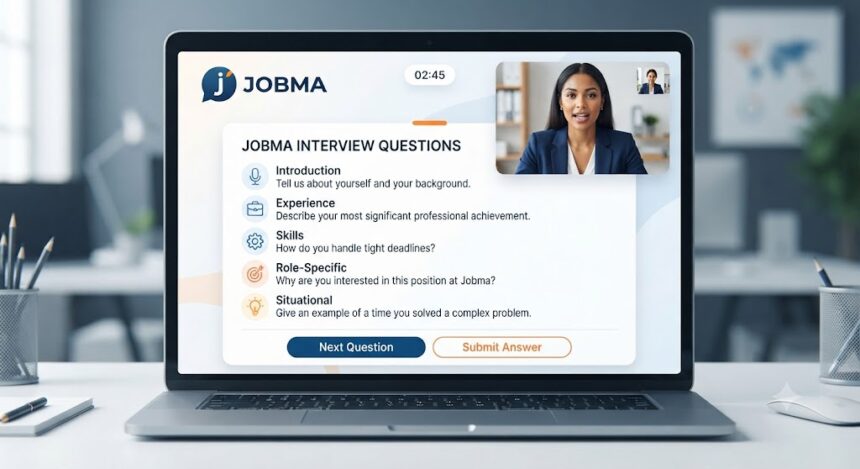
Preparing for Jobma interview questions feels different from preparing for a traditional interview. You may be speaking to a camera, working within a countdown, and deciding whether an answer is strong enough before using a limited retake.
The key fact is simple: Jobma is the interview platform, not the employer making the hiring decision. Companies can create their own interview kits and choose video, audio, written, multiple-choice, or assessment prompts, so there is no universal Jobma question bank. plains the most likely Jobma interview questions, what recruiters are evaluating, and how to build answers that sound prepared without sounding memorized.
What Is a Jobma Interview?
A Jobma interview can take the form of a one-way recorded interview, a video interview, or an AI interview. In the one-way interview, users answer prompts and record their answers. The one-way interview recording process often starts with the system showing the company name, job title, duration of the recording, and the number of questions. It also enables a test of your connection, camera, and microphone and provides a practice question that does not get saved or shared with the employer. There are several parameters in a one-way interview that are controlled by the company or the hiring manager. These include
question type and order,
preparation or “think” time,
recording limits,
whether retakes are allowed,
number of retakes,
written, audio, and video questions,
multiple-choice questions, and assessments.
Jobma notes that an initial one-way interview often involves five to eight questions on average depending on the employer and the job.
Most employers conduct one-way interviews using Jobma interview questions to screen applicants before deciding whether to move them to the next stage of the hiring process. Using Jobma interview questions enables the reviewers to compare applicants based on similar criteria instead of relying on each other’s impressions of a candidate. The US Office of Personnel Management highlights that structured interviews use standardized, pre-determined questions and evaluation criteria to hire employees based on merit. This method usually works better because it can help organizations find the best candidate. In a one-way interview, recruiters and employers often look out for relevance, evidence, judgment, communication, and fit. In relevance, they look at whether the candidate has responded to the prompt. On the other hand, recruiters look at whether the applicant uses examples to demonstrate his or her statements in evidence. Employers also look at the judgments made and whether they are reasonable. Communication is also key and determines how well the candidate conveys his or her thoughts. Finally, the interviewer looks at whether the applicant’s skills and experience match the requirements of the job. While lighting is important during interviews, good lighting cannot compensate for unclear responses. On the other hand, a candidate’s good responses can sometimes override poor delivery due to a lack of confidence.
25 Common Jobma Interview Questions
The wording will vary, but most Jobma interview questions fall into predictable groups. Prepare adaptable stories and talking points rather than memorizing rigid speeches.
General Screening Questions
1. Tell me about yourself
Use a present-past-future structure. Explain what you do now, mention the experience that prepared you, and connect your next step to this position.
Sample answer: “I’m a customer support specialist with three years of SaaS experience. I recently helped reorganize ticket priorities, which improved response times, and I’m now looking to combine customer communication with process improvement.”
2. Why are you interested in this role?
Connect the responsibilities, the employer, and your career direction. Mention a specific product, mission, customer group, or duty from the job description.
A convincing answer should explain why this particular opportunity fits you. Avoid compliments that could be copied into an application for any company.
3. What do you know about our company?
Explain what the business does, whom it serves, and one detail that attracted you. Then show how your background could contribute.
Do not simply repeat the company’s About page. Translate your research into a reason for applying.
4. Why should we hire you?
Choose two or three qualifications that closely match the role. Use the formula requirement + evidence + value.
Example: “You need someone who can manage complex accounts. I oversee 45 B2B clients with a 94% renewal rate, so I can contribute without a long learning curve.”
5. What are your greatest strengths?
Pick a strength that is observable and useful. “I turn unclear requests into organized action plans” is more persuasive than “I’m hardworking.”
Support your claim with a quick example. Recruiters remember evidence more easily than adjectives.
Behavioral Jobma Interview Questions
Behavioral prompts usually begin with “Tell me about a time.” Use STAR: Situation, Task, Action, Result to keep the response focused and evidence-based, an approach also recommended in MIT career guidance. me about a time you solved a difficult problem
Choose a problem that required analysis, not luck. Spend most of the answer explaining what you personally did and why.
End with the result and what you learned. That shows both competence and self-awareness.
7. Describe a conflict you handled at work
Present the disagreement neutrally. Show how you listened, clarified the issue, and moved the conversation toward a professional outcome.
Avoid turning the recording into a complaint about a former colleague. The recruiter is evaluating your conflict-management skills, not deciding who was right.
8. Tell me about a mistake you made
Choose a genuine mistake with manageable consequences. Take ownership, explain the correction, and identify what you changed to prevent repetition.
Weak answers disguise strengths as faults. “I work too hard” rarely demonstrates meaningful self-awareness.
9. Give an example of working under pressure
Clarify what created the pressure and how you prioritized. Add a measurable result when possible.
A good response may involve a customer escalation, tight deadline, staffing shortage, or unexpected change. Explain how you remained organized instead of merely saying you stayed calm.
10. Tell me about a time you showed leadership
You do not need a management title. Leadership may involve creating clarity, influencing a decision, supporting a struggling team, or accepting ownership.
Strong answers also show how your actions helped other people perform better.
11. Describe a time you received difficult feedback
Explain the feedback, the change you made, and how your performance improved. Avoid claiming that you have never received meaningful criticism.
Mentioning a later review, improved metric, or changed work habit makes the answer more credible.
12. Tell me about a goal you achieved
Describe the target, obstacles, actions, and result. Be precise about your contribution instead of hiding behind “we.”
Whenever possible, quantify the result through revenue, time saved, errors reduced, customer satisfaction, project delivery, or another relevant measure.
Situational Jobma Interview Questions
Situational Jobma interview questions ask what you would do in a realistic scenario. They test prioritization, customer awareness, ethics, communication, and professional judgment.
13. What would you do if two urgent deadlines conflicted?
Assess impact, dependencies, and consequences. Communicate trade-offs early and escalate when the decision affects other teams or customers.
The wrong approach is silently choosing one task and surprising everyone when the other deadline is missed.
14. How would you handle an angry customer?
Listen, confirm the issue, identify the underlying problem, and provide a realistic next step. Never promise an outcome outside your authority.
A strong answer balances empathy with accuracy. It reassures the customer without creating expectations the company cannot meet.
15. What would you do if you disagreed with your manager?
First understand the manager’s reasoning. Then present your concern with evidence, explain the business impact, and support the final decision unless it creates a legal, ethical, or safety issue.
This demonstrates respectful disagreement rather than blind compliance or needless confrontation.
16. How would you approach an unfamiliar task?
Clarify the expected result, review available resources, break the task into parts, ask targeted questions, and test your understanding early.
Employers do not expect you to know everything. They want to see that you can learn without creating unnecessary delays or risks.
Motivation and Culture Questions
17. What motivates you?
Name the work conditions that bring out your best performance, such as solving problems, helping customers, building expertise, or achieving measurable goals. Connect the answer directly to the role.
Avoid vague statements such as “success motivates me.” Explain what success looks like in your daily work.
18. What type of environment helps you perform best?
Describe an environment where you have succeeded while showing reasonable flexibility. Do not imitate what you think the employer wants to hear.
You might mention clear priorities, independent focus time, regular feedback, collaborative problem-solving, or transparent communication.
19. Where do you see yourself in three to five years?
Discuss capabilities and contribution rather than demanding a title. Explain what you want to master and how this role supports that direction.
Ambition is valuable, but it sounds more credible when paired with patience, performance, and realistic development.
20. Why are you leaving your current job?
Keep the answer factual and forward-looking. Focus on the responsibilities, growth, schedule, industry, or environment you want next.
Avoid criticizing your current manager or employer. Even legitimate complaints can distract from your suitability for the new position.
Role-Specific and Practical Questions
21. Which experience best prepares you for this position?
Identify the position’s most important requirement and choose the experience that proves you can handle it. Make the connection explicit.
Do not list your entire employment history. Select the experience that gives the recruiter the strongest evidence.
22. How do you prioritize your workload?
Describe your actual system. Strong factors include impact, urgency, dependencies, deadlines, customer risk, and changing information.
Mention how you communicate when priorities conflict. Employers value visibility as much as personal organization.
23. How do you measure success?
Use role-relevant measures such as revenue, accuracy, turnaround time, satisfaction, retention, adoption, quality, or risk reduction.
You may also mention qualitative signals. Not every valuable result fits perfectly into a dashboard.
24. What salary range are you seeking?
Give a researched range when required. Explain that your expectation depends on the role’s full scope, total compensation, location, and responsibilities.
Keep your answer calm and concise. You do not need to apologize for discussing compensation.
25. When could you start?
State your real availability and notice obligation. An honest start date is better than an unrealistic promise.
Reliability begins during the hiring process. Do not damage trust by offering a date you cannot honor.
How to Answer Jobma Interview Questions on Camera
Recorded answers require tighter structure because no interviewer can interrupt, redirect, or ask you to clarify. Your goal is controlled completeness: enough detail to prove the point, but not enough to bury it.
Use this pattern for most Jobma interview questions:
- Answer immediately
- Add evidence or an example
- Connect it to the position
- Stop before repeating yourself
For a 90-second answer, you might spend 15 seconds on context, about 55 seconds on your actions and evidence, and 20 seconds on the result and relevance. Treat that as a practice framework, not a platform rule; always follow the timer shown during the real interview.
A Strong STAR Answer Example
Suppose one of your Jobma interview questions asks, “Tell me about a time you improved a process.”
Situation: “Our support team was missing response targets because every request entered the same queue.”
Task: “I was asked to reduce delays without adding headcount.”
Action: “I analyzed four weeks of ticket data, grouped requests by urgency and complexity, tested new routing rules with two agents, and documented the workflow.”
Result: “Within six weeks, first-response time fell by 32%, while overdue tickets dropped by 21%.”
The answer works because it is specific, chronological, and easy to evaluate. It also makes the candidate’s individual contribution clear.
Mistakes That Weaken Jobma Interview Questions and Answers
The biggest problem is usually not nervousness. It is lack of structure.
Avoid these mistakes:
- Taking too long to reach the point
- Reading a complete script
- Making claims without examples
- Saying “we” without explaining your role
- Ignoring the recording timer
- Repeating retakes until delivery sounds stiff
- Watching your own image instead of the camera
- Submitting without reviewing when review is enabled
Jobma advises candidates to look into the camera, use a quiet and well-lit location, and close unnecessary applications. It also confirms that question timing and retake limits may differ by employer. Checklist Before Answering Jobma Interview Questions
Jobma recommends a working camera and microphone, a stable connection, a supported desktop browser or candidate mobile app, and a quiet, well-lit space. ng:
- Charge your device
- Test the camera and microphone
- Position the camera near eye level
- Place light in front of you
- Silence notifications
- Close unnecessary tabs and apps
- Check the deadline and time zone
- Keep brief keyword notes near the camera
- Use the practice question
- Confirm your background is tidy and distraction-free
If the page closes accidentally, Jobma says you can reopen the invitation link and continue from where you stopped. If you have already submitted the interview, another attempt generally requires the employer’s approval. ctice Jobma Interview Questions Efficiently
Do not practice by silently reading. Record yourself answering ten likely Jobma interview questions in 45-second, 90-second, and two-minute versions.
Review each recording by asking:
- Did I answer in the first sentence?
- Did I use evidence instead of adjectives?
- Was my personal contribution clear?
- Did I finish with a result or role connection?
Complete one final practice round without notes. The goal is flexible command of your examples, not perfect wording.
Frequently Asked Questions
Are Jobma interview questions the same for every candidate?
Candidates applying for the same position may receive standardized prompts, but Jobma does not impose one fixed interview across all employers. The hiring company chooses the question formats, sequence, timing, and retake settings. ake answers in a Jobma interview?
Possibly. Retakes are available only when enabled by the employer, and each question can have its own limit.
After final submission, another attempt normally requires employer authorization. should my answers be?
Follow the timer displayed for each prompt. For practice, prepare concise 60- to 90-second answers for standard screening prompts and slightly longer STAR examples.
Shorten the response when the employer provides a tighter limit. Never rush through a long memorized answer merely because you prepared it.
Can I use notes while answering Jobma interview questions?
Brief keyword notes can help you remember results, dates, or STAR points. Avoid reading full paragraphs because it reduces eye contact and often makes delivery sound flat.
Place three or four prompts near the camera rather than keeping a complete script on your screen.
What happens after I submit the interview?
The employer reviews the responses and controls the next hiring step. Jobma provides the interview technology but says it does not make the hiring decision or provide application-status updates. iring company or recruiter when you need an update about your application.
Conclusion: Your Next Step
The best preparation for Jobma interview questions is a small library of strong evidence. Prepare stories about a success, mistake, conflict, deadline, leadership moment, customer problem, process improvement, and difficult decision.
Match those stories to the job description, record them under timed conditions, and complete the technical checks before the deadline. When the interview begins, look into the camera, answer directly, prove your claims, and stop cleanly.