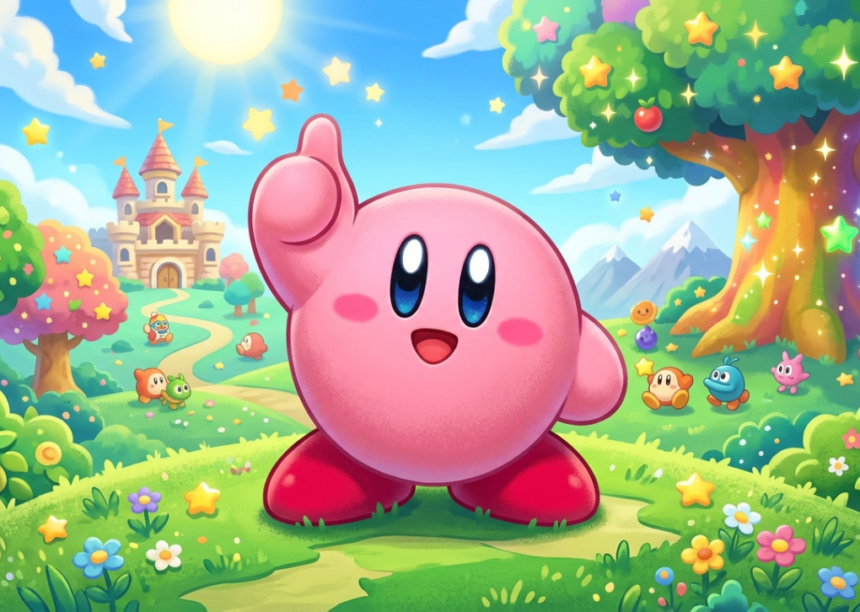
If you searched for Kirby Dedo, you probably found a strangely confident collection of explanations: a meme, a finger puppet, a fan-art trend, a Spanish-language joke, even a supposed “viral phenomenon.” The problem is that these claims are often repeated without a traceable primary source. The useful answer is more nuanced: the phrase combines Nintendo’s Kirby with the Spanish word dedo (“finger”), and online usage clusters around finger-themed Kirby memes, artwork, and small finger puppets—but there is no well-documented official definition or universally verified origin story.
That distinction matters. Nintendo unquestionably has an official Kirby franchise, and licensed or branded Kirby finger puppets do exist. What is much harder to prove is that the phrase itself has a single creator, launch date, canonical meme, or Nintendo-approved product-line name.
Research note: this guide prioritizes official Nintendo information and dictionary evidence where possible, while treating retailer descriptions and internet-origin claims according to the strength of their sourcing.
What Is Kirby Dedo?
At the simplest level, Kirby Dedo can be read as “Kirby finger.” Cambridge’s Spanish–English dictionary translates dedo as “finger” or, depending on context, “toe.” That literal translation explains why finger art, finger puppets, hand gestures, and surreal edits keep appearing around the phrase.
Kirby, meanwhile, is Nintendo’s round pink hero from Planet Pop Star. Nintendo describes him as a character who can inhale enemies and copy their abilities, and its official Kirby site traces his game history back to 1992. Those are verifiable franchise facts, not fan lore.
What the phrase does not appear to be is the name of an official Kirby character, game, ability, or standard Nintendo franchise category. Current search results use Kirby Dedo more like an informal label covering several related ideas:
- Finger-puppet collectibles featuring Kirby or other characters from the franchise.
- Fan art that places Kirby on a fingertip or reimagines his rounded arms with fingers.
- Memes and reaction images that give Kirby exaggerated hand gestures.
- Bilingual wordplay built from a Japanese game character and a common Spanish noun.
- Search-engine curiosity, where people encounter the phrase and search simply to find out what it means.
That last category is important. Sometimes a keyword becomes visible because people are confused by it, not because a single established community has agreed on a definition.
Why Kirby Dedo Is So Easy to Misunderstand
The phrase looks specific enough to sound official. It is not. That creates the perfect conditions for what might be called search-result folklore: one page proposes an interpretation, another repeats it, and a third adds dates, platforms, view counts, or origin stories that are difficult to verify.
Several recent web articles describe the term as a fan-made meme or finger-puppet concept, but they disagree on how it started and how widely it spread. The safest reading is therefore evidence-led: the literal linguistic connection is clear; the broader cultural story is fragmented.
This is where E-E-A-T matters. A trustworthy explanation should separate three levels of certainty:
- Verified: Dedo means finger; Kirby is an official Nintendo character; Kirby finger puppets exist as real merchandise.
- Strongly plausible: Fans use the phrase for finger-themed Kirby images, jokes, and collectibles.
- Unverified or context-dependent: Exact first use, a single meme creator, specific viral dates, total hashtag views, or claims that Nintendo formally branded a product range with the term.
That hierarchy is far more useful than a dramatic origin story with no source trail.
The Likely Origin of Kirby Dedo: Language Meets Visual Humor
There is no reliable primary source establishing who coined Kirby Dedo or when. The most defensible explanation starts with the words themselves. “Kirby” supplies an instantly recognizable visual character; dedo supplies the finger concept.
The joke works because Kirby’s design is extremely simple. He has rounded, mitten-like arms rather than realistic human hands. Add a detailed finger, a pointing gesture, or a tiny puppet placed on a fingertip and the visual suddenly feels both familiar and wrong.
That contrast is a classic mechanism of absurdist internet humor. Cute becomes uncanny. Minimal becomes anatomically over-detailed. A character associated with softness and simplicity is forced into a human gesture that his standard design does not require.
This also makes the concept highly remixable. A creator does not need a complicated narrative; a single visual edit can communicate the gag instantly. The language is short, the character is recognizable, and the joke survives even when the viewer knows only one of the two words.
Is It Specifically a Spanish-Speaking Meme?
Possibly in some communities, but the evidence available in indexed search results does not justify claiming a single Spanish-speaking birthplace. The word dedo is Spanish, and that naturally invites bilingual wordplay. Yet the phrase now appears across English-language sites as well, often used descriptively rather than as a documented community term.
So the responsible formulation is not “Spanish fans invented it on platform X in year Y.” It is: the phrase has a clear Spanish linguistic component, while its precise internet origin remains undocumented.
That difference may sound small. For factual publishing, it is crucial.
Is Kirby Dedo Official Nintendo Content?
No evidence on Nintendo’s official Kirby pages identifies Kirby Dedo as a character, game, Copy Ability, or official franchise term. Nintendo’s own material consistently describes Kirby through established concepts such as inhaling enemies, copying abilities, exploring Dream Land or other worlds, and appearing in titles such as Kirby and the Forgotten Land.
That does not mean every finger-themed Kirby product is unofficial. It means the phrase itself should not automatically be treated as an official Nintendo label.
This is an important distinction for collectors. A seller can offer a licensed or branded Kirby finger puppet without Nintendo necessarily using the same fan nickname that appears in search results.
Real Kirby Finger Puppets Do Exist
There is concrete evidence for the physical-product side. BoxLunch has listed a “Nintendo Kirby Characters Blind Box Finger Puppet,” describing approximately two-inch plastic finger puppets featuring Kirby, Waddle Dee, and other characters.
A Japanese collectible retailer also lists a vintage Kirby finger-puppet figure dated 1993. That historical date should be treated as retailer-supplied product information, however, rather than equivalent to primary Nintendo archival documentation.
More recent retail and comics-distribution listings also use straightforward names such as Kirby Finger Puppet Series and Kirby Finger Puppet Mini Figure, reinforcing the existence of this merchandise category without requiring the ambiguous internet nickname.
That creates a useful SEO distinction: people searching Kirby Dedo may be looking for a meme explanation, but some may actually want a Kirby finger puppet, Kirby finger toy, Kirby collectible, or Nintendo finger puppet.
Kirby Dedo as a Meme: Why the Visual Gag Works
As a meme concept, Kirby Dedo fits the internet’s long-running appetite for “cute but wrong” edits. Kirby is visually optimized for instant recognition: a pink sphere, simple face, red feet, and small rounded arms. A realistic hand or finger violates that familiar silhouette.
The resulting humor comes from incongruity. Your brain recognizes Kirby immediately, then encounters an anatomical detail that does not belong. That split-second mismatch creates surprise, and surprise is one of the simplest engines of visual comedy.
The format also works well as a reaction image. A finger can point, approve, accuse, signal, or perform an exaggerated gesture. That gives a normally simple character more recognizably human—and often more chaotic—body language.
For creators, the underlying principle is useful: preserve the recognizable core and dramatically alter one element. Too many changes weaken the contrast. One impossible finger may communicate the joke faster than an entirely redesigned character.
Why Kirby Is Particularly Suitable for This Kind of Fan Art
Kirby’s official design provides an unusually clean visual foundation. Nintendo describes him as a small, powerful pink hero, while modern games still center core mechanics such as inhaling enemies and acquiring Copy Abilities.
That simplicity creates enormous space for fan reinterpretation. Hats, expressions, props, abilities, textures, and strange anatomical edits can be added while the underlying character remains recognizable.
There is also an interesting thematic fit. Kirby has spent decades transforming through copied powers and, more recently, through mechanics such as Kirby and the Forgotten Land’s Mouthful Mode. Transformation is already part of the character’s visual language, even though finger-based fan edits are not official transformations.
Kirby Dedo Finger Puppets and Collectibles
The collectible interpretation of Kirby Dedo is less abstract because physical Kirby finger puppets are demonstrably real. They can appear as blind-box toys, small plastic figures, collectible mascots, vintage merchandise, or handmade fan items.
If you are shopping, do not rely on the keyword alone. Product titles can vary across marketplaces, languages, distributors, and resellers. Search using concrete descriptors and verify exactly what you are buying.
Useful search variations include:
- Kirby finger puppet
- Nintendo Kirby finger puppet
- Kirby blind box puppet
- Kirby mini finger figure
- Kirby collectible finger toy
- Waddle Dee finger puppet
- Kirby finger puppet blind bag
- Kirby vintage finger puppet
- Kirby of the Stars puppet mascot
Check the listing for licensing information, manufacturer or distributor details, material, dimensions, age guidance, and whether the item is a sealed blind box or an individually identified character. For vintage listings, also check condition, packaging, provenance, and whether a claimed release year can be verified outside the seller’s own description.
Official, Licensed, Fan-Made, or Counterfeit?
These labels are not interchangeable. Official merchandise is produced or authorized within the rights-holder’s commercial ecosystem, while licensed merchandise is produced by an approved partner under authorization to use the intellectual property.
Fan-made merchandise is independently created. Counterfeits, by contrast, imitate protected branding or licensed merchandise while misleading buyers about authenticity.
A listing containing the word “Kirby” is not automatically proof of licensing. Look for clear manufacturer, copyright, trademark, packaging, and rights-holder information—especially when buying through third-party marketplaces.
Price alone proves very little. A high price can indicate rarity, reseller markup, artificial scarcity, or simply an optimistic seller.
How to Evaluate Claims About Kirby Dedo Online
Because Kirby Dedo has accumulated many near-identical explainers, readers should use a simple verification workflow before accepting any elaborate origin story.
First, identify the type of claim. A dictionary translation can be checked against a reputable language reference. A Nintendo franchise fact can be checked against Nintendo. A claim about a viral post needs the original post, an archived copy, or credible reporting that identifies it.
Second, trace numbers to their source. If a page says a hashtag received “millions of views” or a post earned a precise number of likes, look for a dated platform record, screenshot, analytics source, or reputable publication. If no evidence appears, treat the figure as unverified.
Third, distinguish existence from naming. The fact that Kirby finger puppets exist does not prove Nintendo uses this particular nickname for them. Likewise, the existence of finger-themed Kirby memes does not prove that there was one centralized movement responsible for all of them.
Fourth, watch for circular sourcing. Ten websites repeating the same statement are not ten independent confirmations when none identifies the underlying source.
Fifth, inspect dates carefully. A recently published article claiming to document an older meme is not automatically evidence that the terminology existed at the earlier date. Publication date and event date are different data points.
This workflow is useful well beyond gaming fandom. It is a practical way to investigate any emerging keyword where search results grow faster than reliable documentation.
Search Intent Behind Kirby Dedo
The query Kirby Dedo has mixed informational, visual, navigational, and commercial intent. One searcher may want a definition. Another may want a funny picture. Someone else may be hunting for a finger puppet they saw in a blind bag.
That explains why a one-dimensional definition struggles to satisfy the query completely. The strongest content needs to resolve several adjacent questions without pretending they all describe one formally defined phenomenon.
The main intent clusters are:
- Definition intent: “What does it mean?”
- Language intent: “What does dedo mean?”
- Meme intent: “Why does Kirby have fingers?”
- Origin intent: “Where did this joke start?”
- Image intent: “Show me the finger meme.”
- Product intent: “Where can I find a Kirby finger puppet?”
- Authenticity intent: “Is this an official Nintendo thing?”
- Collecting intent: “What characters or variants exist?”
Semantically related entities and concepts include Nintendo, HAL Laboratory, Kirby, Dream Land, Planet Pop Star, Copy Abilities, Waddle Dee, King Dedede, Meta Knight, finger puppets, fan art, meme culture, Spanish vocabulary, collectibles, blind boxes, and licensed merchandise.
That topic cluster is more valuable than repeating one phrase mechanically. Comprehensive topical coverage answers the searcher’s actual uncertainty.
What Competitor Explanations Often Get Wrong
The biggest weakness in many pages covering Kirby Dedo is not necessarily that their interpretations are impossible. It is that they frequently collapse speculation and evidence into the same narrative voice.
For example, several pages state or imply that the concept originated in specific online communities. Others frame it as a substantial viral trend. Without primary posts, archives, platform analytics, or contemporaneous reporting, those claims should be described as theories or interpretations rather than settled history.
Another problem is semantic inflation. A simple phrase meaning “Kirby + finger” can gradually acquire claims about symbolic identity, cultural movements, global fandom, psychology, and social significance simply because publishers need more material.
Sometimes the simple explanation is the stronger one. A strange phrase can attract substantial search curiosity without representing a coherent movement at all.
There is also a product-versus-meme problem. Finger puppets objectively exist, while finger-based Kirby jokes objectively exist in various forms. It does not automatically follow that both developed from the same origin or were historically known by the same name.
Frequently Asked Questions
1. What does Kirby Dedo mean?
Kirby Dedo most literally suggests “Kirby finger,” because dedo is Spanish for “finger.” Online, the phrase is commonly associated with finger-themed Kirby fan art, memes, and finger puppets.
There is no single authoritative definition or documented origin that covers every use. Context matters: a shopper may mean a physical finger puppet, while someone sharing an image may be referring to a visual joke.
2. Is it an official Kirby character or game?
No official Nintendo source reviewed for this guide identifies it as a Kirby character, game, Copy Ability, or canonical franchise term. Nintendo’s official pages instead use established names for its games, characters, locations, and mechanics.
If you see the phrase presented as though it were a Nintendo character or game title, look for a direct Nintendo source before accepting that claim.
3. Are Kirby finger puppets real?
Yes. Commercial listings show Kirby finger puppets as real products. BoxLunch, for example, has listed a Nintendo Kirby blind-box finger puppet assortment containing characters from the franchise.
Retail listings from other sellers also use terms such as “Kirby Finger Puppet Series” and “Finger Puppet Mini Figure.” The existence of those products does not, by itself, establish the ambiguous fan phrase as an official product-line name.
4. Where did the meme come from?
The exact origin is unclear. Recent articles offer different narratives, but the indexed evidence reviewed here does not establish a verifiable first post, original creator, definitive date, or single platform.
The strongest explanation is linguistic and visual: Kirby plus the Spanish word for finger, combined with the absurdity of giving a famously simple character realistic digits or turning the character into a finger puppet.
5. Why do people search for it?
Some searchers want the meaning; others are looking for memes, fan art, collectibles, or finger puppets. The ambiguity itself likely contributes to the search demand.
When an unfamiliar phrase looks as though it could be an official character, product, meme, or foreign-language term, searching becomes the fastest way to resolve that uncertainty.
Final Takeaway: Treat Kirby Dedo as a Fan-Led Search Term, Not Canon
The most accurate way to understand Kirby Dedo is as an informal, internet-driven label sitting at the intersection of Kirby fandom, Spanish wordplay, surreal meme imagery, and real finger-puppet merchandise. The literal linguistic connection is easy to verify. The merchandise category is real. The sweeping origin stories are substantially less certain.
If you are researching the term, use a simple evidence ladder: official Nintendo information first, authoritative language references second, verifiable product records third, fan interpretations after that, and unsourced viral claims last.
If you are shopping, search for “Kirby finger puppet” alongside the unfamiliar phrase and verify licensing, packaging, seller credibility, dimensions, and whether the item is a blind-box collectible. Do not assume every marketplace title reflects Nintendo’s official naming.
If you are creating content, the opportunity is even clearer. Credit original artists, distinguish memes from licensed merchandise, avoid turning repeated fan lore into Nintendo canon, and state uncertainty whenever an origin claim cannot be traced.
That approach does more than produce a better page. It gives the reader the one thing most competing explanations are missing: a clear separation between what can be verified, what is reasonably inferred, and what remains internet folklore.