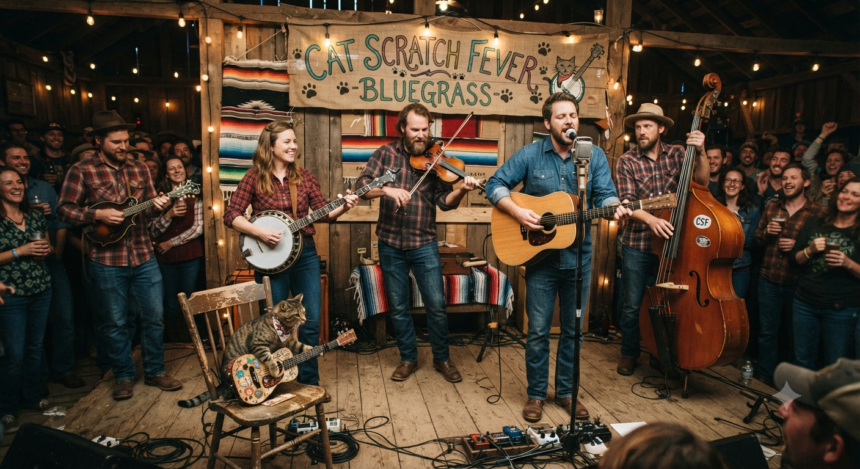
If you searched for Cat scratch fever bluegrass version videos, you are probably trying to find one of two things: a recognizable acoustic remake of Ted Nugent’s 1977 hard-rock staple, or the specific fast-picking “rockgrass” version associated with Hayseed Dixie. The search results can be confusing because they mix established commercial recordings, old fan uploads, recent reinterpretations, Shorts, and AI-labeled covers.
That distinction matters. The most historically established bluegrass-style recording is Hayseed Dixie’s “Cat Scratch Fever,” while newer YouTube uploads such as the Mountain of Truth version take the same song in a more modern bluegrass-country direction. Understanding who recorded what, when it appeared, and how the arrangement changes the original makes Cat scratch fever bluegrass version videos much easier to explore.
Why Cat Scratch Fever Works Surprisingly Well as Bluegrass
Ted Nugent’s original “Cat Scratch Fever” is built around a blunt, instantly recognizable guitar riff and a driving rock pulse. Official YouTube metadata identifies the song with Nugent’s 1977 release, and the track remains closely associated with the album of the same name.
Bluegrass approaches rhythm differently, but that does not mean the song’s core energy has to disappear. A strong Cat scratch fever bluegrass version videos arrangement can transfer the electric-guitar attack into banjo rolls, mandolin chops, fiddle phrases, acoustic guitar rhythm, and upright or acoustic bass.
The key is not simply replacing electric instruments with acoustic ones. Good rock-to-bluegrass arranging preserves the song’s rhythmic identity while changing its texture, articulation, and instrumental conversation.
The Riff Survives the Genre Change
The original riff is repetitive, syncopated, and easy to recognize within seconds. That makes it ideal for bluegrass because short melodic figures can be passed between banjo, mandolin, guitar, and fiddle without losing the hook.
In the best Cat scratch fever bluegrass version videos, the riff becomes a recurring motif rather than a wall of amplified guitar. One instrument states it, another decorates it, and the rhythm section keeps the tune moving.
Bluegrass Adds Motion Where Rock Adds Weight
Hard rock often creates power through distortion, drums, sustain, and volume. Bluegrass usually creates intensity through tempo, picking precision, syncopation, and rapid note movement.
That is why a successful acoustic version does not need to imitate Nugent’s tone. It needs to recreate the feeling of forward momentum.
The Hayseed Dixie Version Is the Essential Starting Point
For anyone researching Cat scratch fever bluegrass version videos, Hayseed Dixie is the most important name to know. The band’s official discography lists A Hillbilly Tribute to Mountain Love, and AllMusic identifies “Cat Scratch Fever” as one of the rock songs given the group’s bluegrass treatment on that album.
Hayseed Dixie built its identity around translating hard rock into acoustic “rockgrass.” AllMusic describes the group’s 2002 A Hillbilly Tribute to Mountain Love as a continuation of that formula, applying bluegrass treatment to assorted rock songs.
The result is important because it is not merely a novelty uploaded years later by an anonymous channel. It is part of a documented album release from a band whose catalog deliberately explores the collision between hard rock and mountain music.
What Makes the Hayseed Dixie Recording Stand Out?
The Hayseed Dixie arrangement demonstrates why the concept works musically. Instead of trying to reproduce the electric recording instrument for instrument, it recasts the song through acoustic picking, bluegrass phrasing, tight ensemble playing, and comic rockgrass attitude.
AllMusic’s review specifically notes that the musicianship is strong enough that the covers can function as genuine bluegrass performances, not only as jokes. That helps explain why this is often the version listeners mean when they search Cat scratch fever bluegrass version videos.
A long-running user-uploaded YouTube video of the Hayseed Dixie track has also circulated for years, while an auto-generated YouTube music upload credits Hayseed Dixie and the song directly.
Newer Cat Scratch Fever Bluegrass Version Videos Are Not All the Same
Search results in 2026 include newer interpretations that are very different from the Hayseed Dixie recording. One recent YouTube result from Free Roam Music presents “Mountain of Truth” performing a bluegrass/country take and explicitly labels the upload with AI-related tags.
That makes source-checking important. If you are comparing Cat scratch fever bluegrass version videos, do not assume that every convincing acoustic vocal, band image, or polished mix represents a traditional live band captured in a studio.
Established Recording vs. AI-Assisted Reinterpretation
The Hayseed Dixie track belongs to a documented album and artist discography. The newer Mountain of Truth upload is presented by its channel as part of a conceptual music catalog and uses “AI music” labeling in the video metadata.
Neither format automatically tells you whether you will enjoy the result. But it does tell you what you are listening to, which is essential when Cat scratch fever bluegrass version videos are being used for music discovery, research, reaction content, or playlist curation.
Fan Uploads and Auto-Generated Tracks
YouTube search pages may show a fan upload, an official audio upload, an auto-generated distributor track, a Short, and a new cover next to one another. The title alone does not reliably tell you whether the audio is an original performance, a re-upload, or a derivative recording.
Before saving or citing Cat scratch fever bluegrass version videos, check the channel name, description, release credits, album information, and whether the uploader identifies the performer.
How to Find the Best Cat Scratch Fever Bluegrass Version Videos
Typing the exact phrase into YouTube can work, but more precise searches surface better results. Start with the artist or arrangement type you actually want.
Useful searches include:
- “Hayseed Dixie Cat Scratch Fever” for the established rockgrass recording.
- “Cat Scratch Fever bluegrass cover” for newer reinterpretations.
- “Cat Scratch Fever banjo cover” for banjo-forward arrangements.
- “Cat Scratch Fever acoustic bluegrass” for stripped-down versions.
- “Cat Scratch Fever live bluegrass” for stage or jam performances.
- “Cat Scratch Fever AI bluegrass cover” when you specifically want synthetic or AI-assisted experiments.
When evaluating Cat scratch fever bluegrass version videos, open the description before deciding that two uploads are different performances. Old songs are frequently distributed, re-uploaded, clipped into Shorts, or paired with new artwork.
Check Five Signals Before Trusting the Label
A quick verification routine saves time:
- Artist credit: Is the performer actually named?
- Release context: Is an album, concert, channel project, or session identified?
- Instrument evidence: Can you hear or see banjo, mandolin, fiddle, acoustic guitar, or bass?
- Disclosure: Does the uploader mention AI, synthetic vocals, generated art, or a concept band?
- Upload type: Is it a performance video, official audio, distributor upload, Short, or fan repost?
These checks make Cat scratch fever bluegrass version videos more useful as music sources and prevent a common mistake: treating a newly uploaded video as a newly recorded performance.
What to Listen for in a Strong Bluegrass Arrangement
The most enjoyable Cat scratch fever bluegrass version videos usually succeed because of arrangement decisions, not because the performers simply play the rock song faster.
1. Banjo Articulation
A banjo can reproduce the urgency of the original guitar riff without mimicking distortion. Rolling patterns also fill the rhythmic space that would normally be occupied by sustained electric guitar and drums.
Listen for whether the banjo supports the groove or overwhelms it. The best arrangement leaves room for vocals and instrumental answers.
2. Mandolin Chop
The mandolin’s off-beat chop can act almost like a snare drum. It gives Cat scratch fever bluegrass version videos a crisp backbeat while keeping the sound completely acoustic.
That percussive role is one reason bluegrass can carry a hard-rock song without a conventional rock drum kit.
3. Fiddle Commentary
A fiddle can answer vocal lines, double parts of the riff, or take over the role normally reserved for a guitar lead. In a strong arrangement, it adds tension and personality instead of simply decorating the melody.
This is where one cover can sound distinctly Appalachian while another leans toward country, folk, or novelty music.
4. Vocal Delivery
Singers face an interesting choice: imitate the swagger of the rock original or reshape it with bluegrass harmony and phrasing. The more convincing Cat scratch fever bluegrass version videos usually commit to the new genre rather than singing a rock vocal over acoustic backing.
Harmony vocals can make the transformation especially obvious. They move the song away from a single-frontman rock format and toward ensemble-based roots music.
5. Tempo and Groove
Faster is not automatically better. A version played too quickly may lose the heavy, stalking character of the riff.
The best performers find a tempo where the acoustic instruments can sparkle while the central hook still lands with weight.
Why “Rockgrass” Is a Better Description Than Novelty Cover
Calling every acoustic rock remake a novelty song misses what skilled players are doing. Hayseed Dixie’s catalog is built around a deliberate blend of hard-rock repertoire and bluegrass instrumentation, and the band itself describes its approach as hard rock played on bluegrass instruments.
That makes Cat scratch fever bluegrass version videos part of a larger crossover tradition. The appeal comes from the contrast, but the arrangement only works when the musicians understand both sides of that contrast.
A listener familiar with rock hears the riff in a new sonic vocabulary. A bluegrass listener hears familiar instrumental techniques applied to material that normally lives outside the genre.
Are These Videos Legal to Upload and Share?
Watching a publicly available cover is straightforward, but uploading your own version raises copyright questions. YouTube explains that Content ID automatically scans uploaded material and may monetize, track, or block matched copyrighted content depending on the rights holder’s settings.
YouTube also has a revenue-sharing process for some eligible cover-song videos when music publishers claim the composition. That does not mean every cover is automatically cleared, and the U.S. Copyright Office advises musicians using someone else’s work to make sure each intended use is lawful.
For viewers, the practical lesson is simple: Cat scratch fever bluegrass version videos may appear, disappear, become region-restricted, or change monetization status over time. A missing upload does not necessarily mean the recording itself has vanished.
For creators, avoid assuming that changing genre makes the underlying composition free to use. A bluegrass arrangement can be musically transformative while still using a copyrighted song.
How to Compare Multiple Versions Fairly
If you want to rank or review Cat scratch fever bluegrass version videos, use the same criteria for every performance. That produces a more meaningful comparison than choosing whichever upload has the loudest master or funniest thumbnail.
Score each version on:
- Riff recognition: Does the hook remain instantly identifiable?
- Bluegrass authenticity: Do the instrumental roles feel native to the genre?
- Arrangement creativity: Is the cover doing more than swapping instruments?
- Performance quality: Are timing, tuning, vocals, and ensemble dynamics convincing?
- Recording quality: Can you clearly hear the acoustic instruments?
- Source transparency: Does the uploader disclose who performed or generated the track?
- Replay value: Would you listen again after the novelty wears off?
This framework is especially useful because Cat scratch fever bluegrass version videos now span traditional recorded musicianship, user-generated performance, archival uploads, and AI-assisted experiments.
The Best Starting Order for New Listeners
If you are new to the concept, start with Hayseed Dixie. Their version provides historical context for the rock-to-bluegrass idea and comes from an established release rather than a recent search-driven upload.
Then compare it with a newer interpretation such as the Mountain of Truth/Free Roam Music upload. The contrast shows how Cat scratch fever bluegrass version videos have evolved from early-2000s “rockgrass” recordings into a broader online category that now includes digitally produced and AI-labeled material.
After that, search specifically for live or instrument-focused covers. Banjo-only, acoustic trio, festival, and jam-session versions can reveal arrangement ideas that are harder to hear in a polished studio production.
FAQ About Cat Scratch Fever Bluegrass Version Videos
Who Performs the Best-Known Bluegrass Version of “Cat Scratch Fever”?
Hayseed Dixie is the key artist associated with the established bluegrass-style version. Their official discography includes A Hillbilly Tribute to Mountain Love, and AllMusic lists “Cat Scratch Fever” among the rock songs reworked in the band’s bluegrass style.
For most people researching Cat scratch fever bluegrass version videos, that recording is the logical benchmark because it has a documented artist, album context, and long-standing circulation online.
Is the Hayseed Dixie “Cat Scratch Fever” Version a Real Band Recording?
Yes. Hayseed Dixie has an extensive documented discography and built its reputation around performing rock material with bluegrass instrumentation. Its official site lists the album containing the track, and major music databases describe the band’s rock-to-bluegrass approach.
This is important because not every modern result for Cat scratch fever bluegrass version videos has the same provenance.
Are There AI Versions of “Cat Scratch Fever” in Bluegrass Style?
Yes. At least one recent YouTube result from Free Roam Music presents a Mountain of Truth bluegrass/country cover and includes AI-related labeling in its metadata.
If AI provenance matters to you, inspect the description and channel information rather than relying on the thumbnail or audio alone.
What Instruments Should I Expect in a Bluegrass Version?
Typical bluegrass textures may include banjo, mandolin, fiddle, acoustic guitar, and acoustic or upright bass. Not every cover uses the same lineup, and some modern productions may simulate or layer these timbres digitally.
The real test is functional: does the arrangement use bluegrass-style rhythm, picking, interplay, and phrasing? That is more meaningful than simply hearing one banjo.
Why Do Some Cat Scratch Fever Bluegrass Videos Disappear?
Copyright management is one possible reason. YouTube’s Content ID system can apply different actions to copyrighted matches, including monetization, tracking, or blocking, and some actions can vary by geography.
Re-uploads may also be removed by uploaders or replaced by distributor-generated versions. If a favorite entry among Cat scratch fever bluegrass version videos disappears, search again by performer and track title rather than only by the old video title.
Final Take: Start With the Source, Then Explore the Variations
The smartest way to explore Cat scratch fever bluegrass version videos is to begin with the Hayseed Dixie recording, because it gives you a clear reference point for how the song works as established “rockgrass.” Then move into live covers, banjo-led versions, country-bluegrass hybrids, Shorts, and newer AI-labeled experiments.
Do not judge a version only by how closely it copies Ted Nugent’s original. Listen for how intelligently it translates the riff, groove, vocal attitude, and instrumental roles into a bluegrass language of its own.
Your next step is simple: search Cat scratch fever bluegrass version videos by performer rather than by generic title, verify the upload source, and compare at least three different arrangements. You will hear much more than a novelty cover—you will hear how one durable rock riff can survive a complete change of musical machinery.