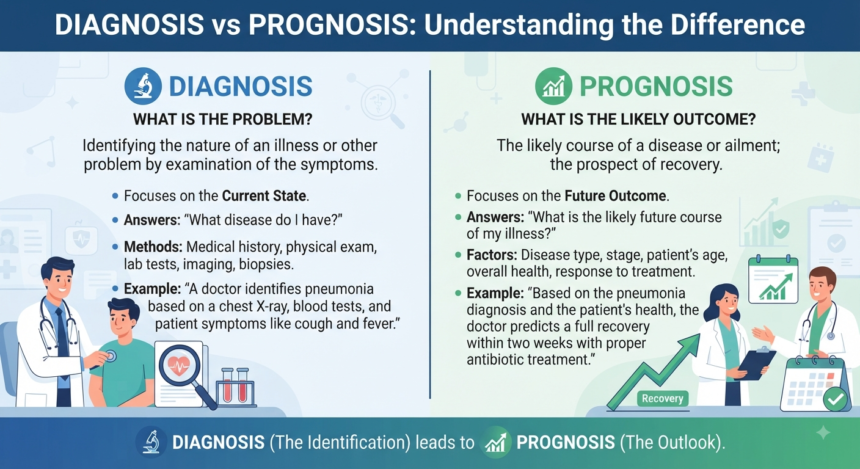
Understanding the diagnosis vs prognosis definition can make a medical conversation much easier to follow. A diagnosis identifies the disease, condition, or injury a person has, while a prognosis estimates the likely course and outcome of that condition over time.
The distinction sounds simple, but it matters. Diagnosis helps answer “What is happening?” Prognosis helps answer “What is likely to happen next?” The National Cancer Institute defines diagnosis as identifying a disease, condition, or injury from signs and symptoms, often with help from medical history, physical examination, laboratory testing, imaging, or biopsy. A prognosis concerns the likely course or outcome of a disease, including possibilities such as recovery or recurrence.
Diagnosis vs Prognosis Definition at a Glance
The most useful way to understand the diagnosis vs prognosis definition is to separate identification from prediction. Diagnosis classifies the current health problem; prognosis estimates how that problem may develop.
| Question | Diagnosis | Prognosis |
|---|---|---|
| Core meaning | Identifies a disease, condition, or injury | Estimates its likely course and outcome |
| Main question | “What condition do I have?” | “What is likely to happen?” |
| Time focus | Present condition | Future course |
| Based on | Symptoms, history, examination, tests, diagnostic criteria | Diagnosis, severity, stage, health status, treatment response and outcome data |
| Can it change? | Yes, if new evidence changes or refines the diagnosis | Yes, as treatment response or health status changes |
| Is it certain? | May be confirmed, provisional or uncertain | Usually probabilistic rather than certain |
A helpful memory shortcut is diagnosis = identification; prognosis = outlook. For anyone comparing the diagnosis vs prognosis definition, that is more accurate than assuming diagnosis is always immediately certain or that prognosis is simply a guess.
What Is a Diagnosis?
A diagnosis is the clinical process of determining the nature of a health problem and distinguishing it from other possible conditions. Medical professionals may combine health history, symptoms, physical findings, laboratory tests, imaging, pathology and other evidence before reaching a diagnosis.
This means a diagnosis is not merely the name printed on a chart. In a complete diagnosis vs prognosis definition, diagnosis is the conclusion reached after clinicians interpret available evidence and decide which explanation best fits the patient’s signs, symptoms, test results and history.
How Doctors Reach a Diagnosis
In practice, the diagnostic process may involve several stages rather than one test or appointment. The exact sequence depends on the symptoms, suspected condition and urgency of the situation.
- Documenting symptoms, including when they started and how they have changed.
- Reviewing personal, family, medication and exposure history.
- Performing a physical examination or other relevant clinical assessment.
- Ordering blood tests, imaging, pathology, genetic testing or specialized assessments.
- Comparing findings with recognized diagnostic criteria.
- Ruling out diseases that can produce similar symptoms.
- Revising the working diagnosis when new evidence becomes available.
The National Academies describes diagnosis as an iterative process involving information gathering, interpretation, clinical reasoning and refinement of a working diagnosis over time. In other words, diagnostic medicine often involves updating the explanation as more evidence becomes available.
What Is a Differential Diagnosis?
A differential diagnosis is not the same thing as a final diagnosis. It is a list of possible conditions that might explain a person’s symptoms.
Healthcare professionals narrow that list by considering symptoms, medical history, family history, medications, lifestyle factors, examination findings and test results. Tests can then help confirm or rule out possibilities until the most likely or final diagnosis becomes clearer.
Diagnosis Does Not Always Mean Absolute Certainty
One important nuance missing from many diagnosis vs prognosis definition explanations is that diagnosis itself can evolve. A clinician may initially work with several possibilities or document a working diagnosis while evidence is incomplete.
Later testing may confirm the original conclusion, identify a more specific subtype or reveal that a different condition better explains the symptoms. The diagnostic process can therefore unfold over time rather than occurring as a single, perfectly certain event.
What Is a Prognosis?
A prognosis is an evidence-based estimate of how a diagnosed condition is likely to progress and what outcomes may be expected. Depending on the disease, prognosis can include its probable course, duration, possibility of recovery, potential complications, quality of life or life expectancy.
That makes prognosis much broader than “Will I survive?” A medically accurate diagnosis vs prognosis definition must recognize that, for many chronic illnesses, the important questions may concern symptoms, future function, complications, recurrence, treatment response, independence or long-term disease control.
What Factors Influence Prognosis?
There is no universal prognostic formula that applies to every disease. Instead, clinicians combine disease-specific evidence with characteristics of the individual patient.
Important prognostic factors can include:
- The specific diagnosis and subtype
- Disease severity
- Stage, grade or extent of disease
- Age
- Overall health and functional status
- Other medical conditions or comorbidities
- Availability of effective treatments
- Response to treatment
- Biological or genetic characteristics
- Development of complications
- Recurrence or progression
- Outcome data from patients with similar conditions
Cleveland Clinic notes that providers may use disease type, progression, biological characteristics, overall health, available treatment, treatment response and functional status when estimating prognosis. Which factors matter most depends heavily on the particular condition.
For cancer specifically, the National Cancer Institute identifies factors such as cancer type and location, stage, grade, characteristics of cancer cells, age, prior health and response to treatment. These details illustrate why two people with the same broad diagnosis can have significantly different outlooks.
Diagnosis vs Prognosis Definition: The Core Difference
The central difference in the diagnosis vs prognosis definition is the type of clinical question being answered. Diagnosis concerns classification and explanation; prognosis concerns probability and future course.
Think of diagnosis as identifying where you are on a map. Prognosis is the forecast for the journey ahead, based on the location, terrain, available routes, treatment options and what happens as you move forward.
Example 1: Pneumonia
Suppose a patient has fever, cough, shortness of breath and findings consistent with pneumonia. Pneumonia is the diagnosis.
The prognosis could address how likely the patient is to recover, how long recovery may take or whether complications are a significant concern. The diagnosis names the problem; the prognosis estimates the likely outcome. This example shows the diagnosis vs prognosis definition in its most practical form.
Example 2: Breast Cancer
A biopsy might establish a diagnosis of breast cancer and identify important biological features. Additional pathology and imaging can provide information about stage, grade and other characteristics relevant to treatment and expected outcomes.
The prognosis then incorporates those findings alongside factors such as age, overall health and treatment response. In cancer care, survival statistics can contribute to prognosis, but the NCI stresses that group statistics cannot predict exactly what will happen to one individual.
Example 3: A Chronic Condition
A person may receive a diagnosis of rheumatoid arthritis, diabetes or another long-term condition. The prognosis does not automatically concern whether the disease will be “cured.”
Instead, clinicians may focus on disease control, complications, physical function, quality of life and long-term response to management. This is why a useful diagnosis vs prognosis definition should never equate prognosis exclusively with life expectancy.
Diagnosis Comes First, but Prognosis Is Not Fixed
Usually, a meaningful prognosis depends on understanding the diagnosis because clinicians need to know what condition they are dealing with before estimating its likely course. MedlinePlus notes that determining prognosis may be particularly difficult when the underlying diagnosis is unknown.
Even after diagnosis, however, prognosis can change. Treatment response, complications, disease progression, remission, new test findings or changes in health status can alter what clinicians expect to happen.
That dynamic nature is a critical part of the diagnosis vs prognosis definition. Diagnosis may become more precise with additional evidence, while prognosis can be repeatedly updated as the patient’s actual clinical course provides new information. Cleveland Clinic likewise notes that prognosis may be revised when new information becomes available.
Is Prognosis the Same as Survival Rate?
No. A survival rate is a statistic describing outcomes in a group of people, whereas prognosis is a broader clinical estimate that can use survival statistics as one piece of evidence.
The National Cancer Institute distinguishes measures such as overall survival, cancer-specific survival, relative survival and disease-free survival. These statistics help researchers and clinicians understand patterns among groups of patients.
This distinction prevents a common misunderstanding of the diagnosis vs prognosis definition. When interpreting the diagnosis vs prognosis definition in real clinical care, remember that a five-year survival statistic is not a personal expiration date and may include patients whose treatment circumstances differ from yours.
Why Group Statistics Cannot Predict One Person Perfectly
Population statistics summarize what happened across many patients. An individual can differ in disease biology, age, health, treatment, treatment response and other characteristics that influence outcomes.
The NCI specifically cautions that statistics based on large groups cannot determine exactly what will happen to one person. It also notes that outcome statistics can lag behind current treatment because researchers need time to observe long-term results.
Prognosis Can Be Good, Fair, Poor, Guarded or Uncertain
Healthcare providers sometimes communicate prognosis using broad categories instead of exact percentages. Terms such as excellent, good, fair and poor may be used as starting points for discussing the expected outlook.
A guarded prognosis generally indicates that there is not yet enough information to confidently judge the likely outcome. Cleveland Clinic also emphasizes that there is no single required way for clinicians to communicate prognosis; estimates may be expressed as ranges, best- and worst-case scenarios or the most likely outcome.
For patients, descriptive labels are most helpful when followed by specifics. Ask which outcome, over what period, and which clinical factors are driving the assessment.
Diagnosis, Prognosis and Treatment Are Connected—but Not Interchangeable
Another useful layer in the diagnosis vs prognosis definition is understanding where treatment fits. Diagnosis helps clinicians determine which management options may be appropriate, while prognosis can inform decisions about likely benefits, risks, goals and expectations.
Treatment can also influence prognosis. If therapy successfully controls a disease, prevents complications or improves function, the expected outlook may change; if a condition progresses despite treatment, clinicians may revise their expectations.
This feedback loop matters because prognosis is not merely something announced at the beginning of care. It can be revised as new information accumulates, which is one reason a practical diagnosis vs prognosis definition should emphasize change over time.
Diagnosis vs Prognosis in Mental Health
The same distinction applies in mental healthcare, although the methods used to establish a diagnosis may differ from those used for many physical illnesses. Mental health diagnosis can involve clinical history, interviews, symptom patterns, functional impairment, assessments and established diagnostic criteria.
The National Academies notes that the diagnostic process applies broadly to mental healthcare and that mental health diagnoses can rely on specified symptom patterns and diagnostic criteria.
Prognosis addresses the likely future course—such as whether symptoms may improve, persist or recur and how treatment could affect functioning. The basic diagnosis vs prognosis definition therefore remains unchanged: diagnosis identifies the condition, while prognosis estimates its likely course.
Diagnosis vs Prognosis vs Prediction: Why “Prediction” Needs Context
Calling prognosis a prediction is useful, but the word can imply more certainty than medicine can provide. A better mental model is an evidence-informed forecast expressed in probabilities.
Clinicians combine medical evidence with individual clinical information to estimate what is more or less likely. MedlinePlus emphasizes that prognosis is probabilistic: a particular course may be likely without being certain.
That nuance gives the diagnosis vs prognosis definition greater practical value. Prognosis should communicate uncertainty rather than creating the impression that a patient’s future has already been determined.
Why Diagnosis and Prognosis May Change Over Time
Both terms are sometimes treated as permanent labels, but real clinical care is more dynamic. New symptoms, repeat imaging, laboratory findings, pathology results and treatment response can provide information that was unavailable during the first appointment.
A working diagnosis may therefore become more specific, while prognosis may improve or worsen as clinicians observe the disease trajectory. This evolving nature of the diagnosis vs prognosis definition is especially important when interpreting older medical records or early-stage assessments.
Questions to Ask Your Healthcare Provider
Knowing the terminology is useful only when it improves communication. After receiving a diagnosis, the following questions can help distinguish established findings from future estimates.
- How certain is this diagnosis?
- Are there other conditions that could explain my symptoms?
- What evidence supports the diagnosis?
- Do I need additional testing to confirm or refine it?
- What is the expected course of this condition?
- Which factors improve or worsen my prognosis?
- What outcome are we discussing—recovery, recurrence, function, complications or survival?
- What time period does this prognosis cover?
- How could treatment change my prognosis?
- When should my prognosis be reassessed?
- Are the statistics based on patients similar to me?
- What factors make my situation different from the average patient?
These questions turn the diagnosis vs prognosis definition into a practical healthcare tool. They help separate what healthcare professionals believe is happening now from what they estimate may occur later.
Common Mistakes When Comparing Diagnosis and Prognosis
Several misconceptions can make medical information unnecessarily frightening or confusing. Avoiding them can help patients interpret clinical conversations and online health information more accurately.
- Mistake: A diagnosis predicts the future.
A diagnosis identifies a health problem; its expected future course belongs to prognosis. - Mistake: Prognosis is a guarantee.
Prognosis is generally an estimate based on probabilities, clinical evidence and individual characteristics. - Mistake: Prognosis only means life expectancy.
Prognosis may concern recovery, complications, recurrence, function, symptom progression, treatment response or quality of life as well as survival. - Mistake: A diagnosis can never change.
Diagnostic conclusions can be revised as additional information becomes available. - Mistake: A survival rate equals an individual prognosis.
Population-level survival statistics can inform prognosis but cannot determine one person’s exact outcome. - Mistake: Poor prognosis automatically means treatment is pointless.
Prognosis and treatment goals are separate questions. Depending on the condition, treatment may aim to cure disease, control progression, manage symptoms, preserve function or improve quality of life.
Understanding these distinctions gives the diagnosis vs prognosis definition real-world meaning. It becomes much more than a comparison of two medical vocabulary terms.
FAQ About Diagnosis vs Prognosis Definition
What Is the Simplest Diagnosis vs Prognosis Definition?
The simplest diagnosis vs prognosis definition is this: a diagnosis tells you what condition you have, while a prognosis describes what is likely to happen because of that condition. Diagnosis focuses primarily on identifying the health problem, while prognosis focuses on its expected course and outcome.
Which Comes First, Diagnosis or Prognosis?
In most situations, diagnosis comes first because clinicians need to understand the condition before making a meaningful estimate about its course. The amount of prognostic certainty may increase as the diagnosis, severity, subtype, stage or other relevant characteristics become clearer.
Early prognostic discussions can still occur while evaluation is continuing, particularly when clinicians already have important information about the seriousness of a patient’s condition. A prognosis can then be refined when additional diagnostic evidence becomes available.
Can a Prognosis Change After Treatment Starts?
Yes. Prognosis can change when healthcare professionals learn how a patient responds to treatment, when disease severity changes, when complications develop or when new clinical information becomes available.
That is why prognosis is better understood as an updated estimate than as a permanent verdict. Treatment response itself is an important prognostic factor for many conditions.
Does Poor Prognosis Mean Someone Will Die?
Not necessarily. A “poor prognosis” indicates a relatively unfavorable expected outcome, but the outcome being discussed might involve survival, recovery, disability, complications, disease progression or another condition-specific measure.
Ask the clinician what “poor” specifically refers to and what time frame is being considered. Prognostic terminology without context can easily be misunderstood.
What Is the Difference Between Diagnosis, Prognosis and Treatment?
Diagnosis identifies the health condition. Prognosis estimates its likely course and outcome, while treatment refers to interventions intended to cure, control, relieve or otherwise manage that condition.
The three concepts interact closely but serve different purposes. An accurate diagnosis informs treatment decisions, while the disease itself, individual characteristics and response to treatment can all influence prognosis.
Conclusion: Use the Diagnosis vs Prognosis Definition to Ask Better Questions
The diagnosis vs prognosis definition ultimately separates two different types of medical knowledge. Diagnosis explains what the condition is; prognosis estimates where the condition may go from here.
If you are reading a medical report or discussing a new health condition, separate those questions deliberately. First ask how the diagnosis was established and how certain it is; then ask what outcomes are considered most likely, what evidence supports the prognosis, what could change it and when the outlook should be reassessed.
That approach gives you something more useful than a medical label or an isolated survival statistic. It gives you a clearer picture of what is known, what remains uncertain and which questions or decisions matter next.