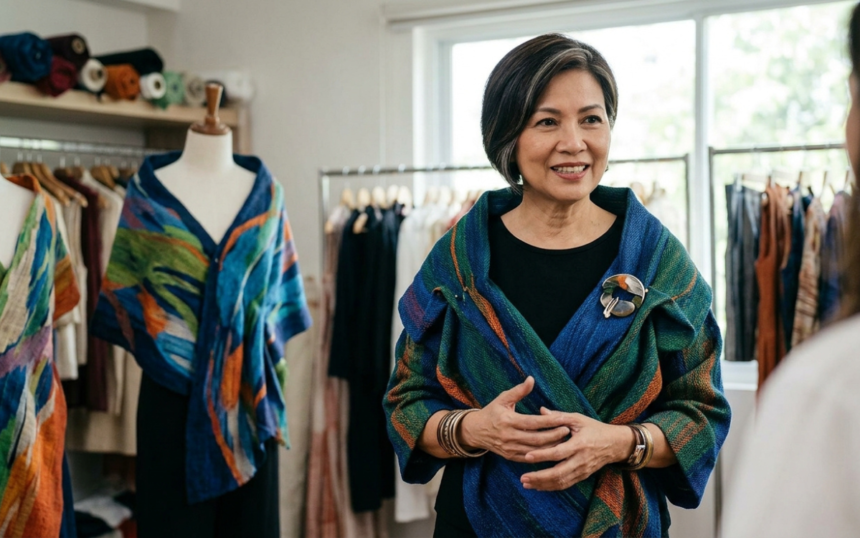
Dita Sandico is a Filipino fashion designer celebrated for turning indigenous Philippine textiles into modern works of wearable art. Her career is not simply about creating beautiful garments; it is about connecting designers, artisans, communities, and cultural traditions through fashion. Known internationally as a “wrap artiste,” Dita Sandico has spent decades proving that local materials can compete on the world stage when paired with creativity, craftsmanship, and respect for heritage.
Her designs stand out because they carry stories. A fabric is never just fabric in her world. It represents the hands that created it, the communities that preserved the technique, and the natural resources that made the material possible.
Key highlights of her career include:
- Promoting indigenous Philippine textiles through contemporary fashion.
- Developing signature fabrics, including banaca, a banana-abaca textile.
- Supporting weaving communities across different regions of the Philippines.
- Bringing Filipino craftsmanship to international audiences through fashion showcases.
Dita Sandico’s Early Life and Inspiration Behind Her Fashion Journey
The story of Dita Sandico began with an early fascination with fabrics, culture, and craftsmanship. Growing up around fashion influences, she developed an appreciation for textiles and design from a young age. Her mother’s involvement in fashion merchandising introduced her to the business side of clothing, while her father’s connection with indigenous communities exposed her to traditional weaving practices.
During childhood trips to Mindoro, she witnessed Mangyan communities creating textiles by hand. Watching cotton transform into thread and eventually into woven fabric left a lasting impression. That experience shaped her belief that Philippine materials deserved recognition beyond local communities.
Instead of following international fashion trends alone, she looked inward. She explored the Philippines’ natural resources and traditional techniques to create something distinctly Filipino.
How Dita Sandico Became a Pioneer of Indigenous Fashion
Before sustainable fashion became a global conversation, Dita Sandico was already working with local fibers and artisan communities. She recognized that Philippine textiles had enormous creative potential but needed fresh interpretation to appeal to modern consumers.
Her approach combined:
- Traditional weaving knowledge.
- Contemporary silhouettes.
- Sustainable material choices.
- Community-based production.
This philosophy helped position her as one of the designers who contributed to the revival of modern Filipiniana fashion. Her collections demonstrated that indigenous materials could move beyond traditional clothing and become part of sophisticated international fashion.
Dita Sandico’s Signature Banaca Fabric and Textile Innovation
One of the most recognizable achievements of Dita Sandico is her work with banaca, a textile made from banana and abaca fibers. This material became closely associated with her design identity because of its unique texture, structure, and versatility.
Creating fashion from natural fibers is challenging. Materials like abaca can be difficult to manipulate because of their texture and strength. However, Dita Sandico experimented with techniques that transformed these fibers into elegant wraps, gowns, accessories, and contemporary garments.
Her designs showed that indigenous materials were not limited to traditional applications. They could become luxurious, artistic, and internationally relevant.
Dita Sandico’s Famous Wrap Designs and Creative Philosophy
The wrap became the centerpiece of Dita Sandico’s artistic language. Unlike ordinary fashion pieces, her wraps allow the wearer to participate in the design process. The fabric can be shaped, folded, layered, and styled in different ways.
This flexibility reflects her broader belief that fashion should encourage creativity rather than impose limitations.
Her wrap creations are recognized for:
- Architectural shapes that create movement.
- Natural textures that highlight Filipino fibers.
- Versatility suitable for different generations.
- Cultural storytelling through materials and craftsmanship.
A major reason her designs remain relevant is their ability to balance tradition and modernity.
Dita Sandico’s Role in Supporting Filipino Weavers
Beyond clothing design, Dita Sandico’s work has always involved collaboration with artisans. She has worked with weaving communities in places such as Mindoro, Ilocos, Catanduanes, and other areas known for traditional craftsmanship.
Her model focuses on creating opportunities for local makers. Instead of treating indigenous weaving as a decorative element, she considers artisans essential creative partners.
This approach supports:
- Preservation of traditional skills.
- Sustainable livelihood opportunities.
- Greater appreciation for Filipino craftsmanship.
- Cultural continuity for younger generations.
For Dita Sandico, every finished garment represents a relationship between designer and maker.
Dita Sandico and Sustainable Fashion Advocacy
Sustainability is one of the strongest themes connected to Dita Sandico’s career. Long before eco-conscious fashion became mainstream, she promoted the use of organic and indigenous materials.
Her philosophy challenges the idea that fashion must rely on mass production and disposable trends.
Instead, she emphasizes:
Responsible sourcing: Using materials connected to local agriculture and communities.
Craftsmanship over speed: Valuing handmade processes and traditional knowledge.
Longevity: Creating pieces designed to be worn and appreciated for years.
This perspective aligns with modern conversations about ethical fashion and conscious consumption.
Dita Sandico’s International Recognition and Global Influence
Although her work is deeply rooted in Philippine culture, Dita Sandico’s designs have reached international audiences. Her collections featuring Filipino textiles have been presented in various fashion destinations, including Paris, Rome, Dubai, New York, Tokyo, and other global locations.
Her international presence helped introduce Philippine weaving traditions to audiences who may not have encountered them before.
Rather than simply exporting clothing, she exported a story about Filipino creativity.
The Legacy of Dita Sandico in Philippine Fashion
The impact of Dita Sandico extends beyond individual collections. Her greatest contribution may be changing how people view indigenous textiles.
She helped demonstrate that:
- Traditional materials can become modern luxury.
- Local artisans deserve recognition as creative professionals.
- Cultural heritage can inspire innovation.
- Filipino fashion can have a distinct global identity.
Many emerging designers now explore indigenous materials with renewed confidence, continuing a movement that values authenticity and cultural pride.
Dita Sandico’s Book “It’s A Wrap” and Reflection on Her Career
A major milestone in her journey is the publication of “It’s A Wrap: Unraveling the Future of Fashion,” a book documenting her decades in fashion, textile exploration, and community work. The publication reflects on her creative process, collaborations with artisans, and the evolution of her design philosophy.
The book is more than a personal biography. It serves as a record of Philippine textile traditions and a learning resource for future designers who want to build meaningful fashion practices.
What Makes Dita Sandico’s Fashion Approach Different?
Many designers focus primarily on aesthetics. Dita Sandico focuses on meaning.
Her creative process begins with questions:
- Where did this material come from?
- Who created it?
- How can fashion preserve rather than erase tradition?
- How can design improve communities?
That mindset separates her work from ordinary fashion production.
Her garments are not only worn. They communicate.
Frequently Asked Questions About Dita Sandico
Who is Dita Sandico?
Dita Sandico is a Filipino fashion designer known for promoting indigenous Philippine textiles and creating contemporary designs inspired by traditional weaving practices. She is internationally recognized for her innovative wrap creations and advocacy for local artisans.
What is Dita Sandico famous for?
Dita Sandico is famous for her signature wraps and her use of indigenous materials, especially banaca, a textile combining banana and abaca fibers. Her work helped bring Filipino textiles into modern fashion conversations.
What is banaca fabric?
Banaca is a textile created from banana and abaca fibers. It became closely associated with Dita Sandico’s designs because of its distinctive appearance, natural texture, and suitability for artistic fashion creations.
How did Dita Sandico support Filipino weaving communities?
Dita Sandico collaborated with local artisans and weaving communities to develop products that preserve traditional skills while creating economic opportunities. Her work highlights the importance of treating craftspeople as partners in fashion development.
Why is Dita Sandico important in Philippine fashion history?
Dita Sandico is important because she helped redefine how indigenous materials are viewed in fashion. She showed that Philippine textiles could represent innovation, luxury, sustainability, and cultural identity at the same time.
Final Thoughts: Why Dita Sandico’s Legacy Matters
Dita Sandico’s journey proves that fashion can be more than appearance. It can preserve history, empower communities, and create a stronger cultural identity.
Her work reminds future designers that innovation does not always require abandoning tradition. Sometimes, the most powerful ideas come from rediscovering what already exists.
For anyone interested in Filipino fashion, sustainable design, or cultural craftsmanship, exploring Dita Sandico’s creations offers a deeper understanding of how clothing can become a bridge between people, places, and generations.