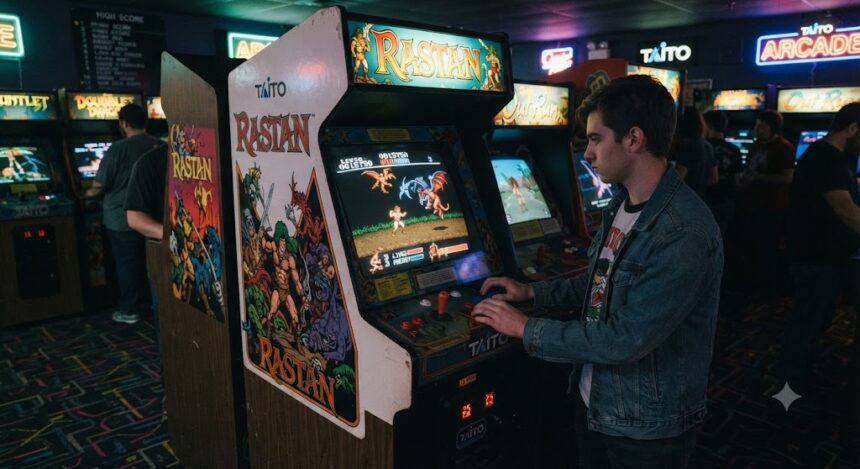
Rastan arcade rev 1 usually refers to a revised 1987 arcade program set for Taito’s fantasy action game Rastan, known as Rastan Saga in Japan. It is not a sequel, remake, or modern fan edition. The label identifies a specific software revision preserved and documented by arcade historians and emulation projects.
That distinction matters. Search results often mix the World, US, and Japanese releases with home-console ports, bootlegs, downloadable ROM archives, and the 2024 Arcade Archives release. This guide separates those categories, explains what the revision label means, and shows how collectors and players can verify what they have without relying on vague filenames.
Key takeaways
- Rastan arcade rev 1 is a program revision, not a second game.
- Current MAME source identifies World Rev 1, US Rev 1, and Japan Rev 1 sets.
- The revised World and US sets contain documented byte changes, but their visible purpose is not conclusively described.
- Original hardware uses a Motorola 68000 main CPU, Z80 audio CPU, YM2151 music chip, and MSM5205 sample hardware.
- The safest modern option is the licensed Arcade Archives release; MAME itself does not include copyrighted game ROMs.
What Is Rastan Arcade Rev 1?
The phrase Rastan arcade rev 1 most commonly refers to the World version that current MAME knows as “Rastan (World Rev 1).” MAME internally uses the short name rastan for that version. The same driver also contains “Rastan (US Rev 1)” under the name rastanu and “Rastan Saga (Japan Rev 1)” as rastsaga.
A revision number typically indicates that the manufacturer fixed some bugs after a certain release. The changes may include updates to program ROMs for bug fixing, region-specific variations in gameplay, different coinage schemes, game texts, operator-related features, or minor code adjustments. In this case, the technical differences between the versions are not extensive enough to confidently identify all changes as bug fixes.
Rev 1 Does Not Mean Rastan II
Rastan arcade rev 1 remains the original 1987 title. It should not be confused with Rastan Saga II, also known in some regions as Nastar or Nastar Warrior, or with Warrior Blade: Rastan Saga Episode III. The “Rev 1” suffix describes the software revision of the first game, not its position in the series.
Why the Search Term Causes Confusion
Collectors often use board labels, MAME set names, ROM filenames, and title-screen text interchangeably. Those identifiers overlap, but they are not identical. A board may display Rastan, boot as Rastan Saga, use a regional coin table, or contain replacement EPROMs, so identification should be based on checksums and program labels rather than title art alone.
Rastan Arcade Rev 1 Version Map
Current MAME source lists several related sets built from newer revised code and several based on an earlier code base. The revised group includes World Rev 1, World, US Rev 1, US, and Japan Rev 1. Separate entries preserve earlier World, US, Japanese, and bootleg code bases.
This structure is valuable because it prevents distinct program histories from being flattened into a single generic “Rastan ROM.” For preservation, the exact set matters. For ordinary play, the differences may be subtle, but accurate naming helps diagnose audit errors, mismatched files, altered boards, and regional behavior.
| MAME short name | Current description | Region or role |
|---|---|---|
rastan |
Rastan (World Rev 1) | Revised World parent set |
rastana |
Rastan (World) | World variant |
rastanu |
Rastan (US Rev 1) | Revised US set |
rastanua |
Rastan (US) | US variant |
rastsaga |
Rastan Saga (Japan Rev 1) | Revised Japanese set |
rastanb |
Rastan (World, earlier code base) | Earlier World program |
rastanub |
Rastan (US, earlier code base) | Earlier US program |
World Rev 1
For most emulator users, Rastan arcade rev 1 means the rastan parent set. MAME labels it “World Rev 1” and associates it with Taito. Its revised program includes the ROM marked B04-43-1.9, while the unrevised World set uses a related program ROM without the “-1” revision suffix.
US Rev 1
The US counterpart is rastanu, labeled “Rastan (US Rev 1)” and attributed to Taito America. MAME’s driver notes indicate that the World and US revised games are effectively the same in gameplay code apart from regional handling, although the US ROM contains duplicated copyright messaging.
Japan Rev 1
The Japanese release is named Rastan Saga. MAME’s research notes describe presentation differences, including a notice screen, an opening sequence, different inter-level messages, a post-final-boss message, and copyright text during the scrolling credits. These are regional content differences, not proof that one release is mechanically superior.
What Actually Changed in Rastan Arcade Rev 1?
The strongest documented evidence is surprisingly narrow. MAME’s source records byte changes at ROM offsets 0x5203 and 0x520B for the revised World and US program ROMs. In the World set, B04-43-1 contains 0x00 at both positions, while the related non-revision ROM contains 0x01 and 0x03.
That confirms a real program difference, but it does not automatically reveal the player-visible effect. Without a disassembly that traces those bytes to a specific routine, claims such as “Rev 1 fixes collision detection,” “improves difficulty,” or “removes a crash” remain speculation. A trustworthy guide should preserve that uncertainty rather than manufacture a neat explanation.
What the Evidence Supports
The evidence supports three conclusions: Rastan arcade rev 1 is a distinct dumped program set, its revised ROM differs from the related version at documented locations, and MAME classifies it within a newer revised code base. It does not support a long list of dramatic gameplay changes.
What Players Are Likely to Notice
Most players will notice region-specific presentation, coinage behavior, operator settings, or title differences before they notice the two-byte revision itself. MAME’s notes state that region data affects coinage tables and that Rastan Saga includes narrative and copyright screens absent from the international Rastan presentation.
Rastan Arcade Rev 1 Hardware Specifications
The original board is more sophisticated than its simple two-button control scheme suggests. MAME’s hardware model, with several clock rates marked as verified on PCB, uses a Motorola 68000 main processor at 8 MHz and a Z80 sound processor at 4 MHz. Custom Taito chips handle tilemaps, sprites, coin I/O, and CPU communication.
For sound, Rastan arcade rev 1 uses a Yamaha YM2151 running at 4 MHz alongside an MSM5205 sample chip driven from a 384 kHz clock and configured for 8 kHz ADPCM playback. Audio is mono. This combination produces the game’s melodic score, effects, and sampled voice-like sounds.
Core hardware summary
- Main CPU: Motorola 68000 at 8 MHz
- Audio CPU: Z80 at 4 MHz
- Music synthesis: Yamaha YM2151
- Sample playback: MSM5205 ADPCM
- Video: Horizontal raster, 60 Hz
- Frame area modeled by MAME: 320 × 256, with a 320 × 240 visible region
- Controls: Eight-way joystick, attack button, jump button
- Players: Two players alternating, not simultaneous co-op
Video and Sprite System
The driver models a Taito PC080SN tilemap generator and PC090OJ sprite generator. The screen refreshes at 60 Hz, with two tilemap layers and sprites drawn over them. This architecture helps explain the game’s scrolling scenery, large enemies, layered landscapes, and clear separation between foreground action and background artwork.
Operator DIP Switches
The emulated DIP switches cover upright or cocktail cabinet mode, screen flipping, difficulty, bonus-life thresholds, starting lives, coinage, and whether continuing is allowed. Lives can be set from three to six, while bonus-life schedules vary according to the operator’s selection.
How Rastan Arcade Rev 1 Plays
At its core, Rastan arcade rev 1 is a side-scrolling hack-and-slash platform game. You guide a barbarian warrior through outdoor routes, castles, hazards, and boss encounters while using directional attacks and carefully timed jumps. The official Arcade Archives description emphasizes sword combat, weapons, armor, and collectible items.
The arcade machine uses an eight-way joystick and two buttons: sword and jump. Museum documentation also notes that pressing up with jump produces a higher leap and that jumping attacks can deal more damage when special weapons are unavailable. These mechanics reward deliberate positioning rather than constant button mashing.
Combat, Weapons, and Items
Rastan can replace his standard sword with temporary weapons and collect defensive equipment or power-enhancing items. Some pickups are beneficial, while cursed items can harm the player. Weapon duration and route knowledge matter because later enemy formations punish slow reactions and poorly timed jumps.
Level Structure and Difficulty
The game contains six major stages with a boss at the end of each. Its difficulty comes from enemy placement, limited recovery opportunities, environmental hazards, and strict late-game pressure. The final stretch is especially demanding, making health conservation and weapon timing central to a successful clear.
How to Identify an Original Rastan Arcade Rev 1 Board
Start with the program EPROM labels. For the World revision, MAME documents B04-43-1.9 as the revised ROM in the final main-CPU program pair. A genuine board can still have replacement EPROMs, handwritten labels, repair work, or mixed regional chips, so a label is evidence—not absolute proof.
Next, compare dumped data against trusted CRC and SHA-1 values from the current MAME source. Checksums are far more reliable than ZIP names because any archive can be renamed. When buying a PCB, request clear photographs of both board sides, ROM labels, edge connector, custom chips, repair areas, and any daughterboards.
Collector verification checklist
- Confirm the board layout matches known Taito Rastan hardware.
- Photograph every socketed program ROM before removing anything.
- Record EPROM labels exactly, including revision suffixes.
- Check for erased windows, relabeling, bent pins, corrosion, and trace repair.
- Dump ROMs with suitable hardware and compare cryptographic hashes.
- Preserve original chips even if verified replacements are installed.
- Do not “upgrade” an unidentified set until its original contents are archived.
Identifying the Set in MAME
Run a software audit rather than trusting the displayed filename. A correct Rastan arcade rev 1 World set should resolve to the current rastan definition and match the expected ROM hashes. When an audit reports missing or incorrect files, confirm that your MAME version and legally obtained dumps belong to the same set definition.
Parent, Clone, Split, and Merged Sets
MAME may organize related games as a parent with multiple clones. A split collection stores shared parent files separately, while a merged collection can place parent and clone data together. Therefore, a clone may fail when required parent data is absent, even when the clone archive itself appears complete.
Troubleshooting Rastan Arcade Rev 1
When Rastan arcade rev 1 fails to start in an emulator, the most common cause is not inadequate computer performance. It is usually a set mismatch: files from an older database, a clone without required parent data, renamed archives, damaged dumps, or ROMs that do not match the current driver’s checksums.
Use the emulator’s built-in verification command first. Then review the exact missing filename and hash instead of downloading random replacement archives. On original hardware, begin with power-rail measurements, visual inspection, socketed-chip reseating, clock activity, reset behavior, and known-good video and audio connections.
Black Screen or Reset Loop
A black screen can result from corrupted program ROMs, unstable voltage, failed RAM, poor sockets, clock faults, watchdog resets, or monitor wiring issues. On real PCBs, avoid replacing multiple chips blindly. Document the symptoms, test voltages under load, and work from the CPU reset and clock lines outward.
Missing Music, Effects, or Samples
Because the board separates CPU-driven audio, YM2151 synthesis, and MSM5205 sample playback, partial failures are possible. Music without samples, samples without music, or total silence point to different diagnostic paths. Check the audio CPU section, clock signals, amplifier stage, speaker wiring, and relevant ROM data.
Wrong Difficulty, Lives, or Coin Settings
Unexpected difficulty does not necessarily indicate the wrong revision. Operator DIP settings control difficulty, bonus-life schedules, starting lives, coinage, and continues. Record the existing switch positions before changing them, especially on a cabinet that may have a historically significant operator configuration.
Legal and Authentic Ways to Play
For a convenient licensed version, Hamster released Arcade Archives RASTAN SAGA for Nintendo Switch and PlayStation 4 on May 2, 2024. The release offers adjustable game settings, CRT-style display options, and online rankings. It is the clearest legal recommendation for players who do not own original hardware.
For hardware authenticity, an original Taito PCB in a correctly wired cabinet remains the reference experience. Rastan arcade rev 1 was designed for a horizontal standard-resolution raster display, mono audio, an eight-way joystick, and two action buttons, with two players taking alternating turns.
Using MAME Responsibly
MAME is a preservation and educational project that emulates machine behavior, but its executable does not contain original game code. MAME’s official policy states that ROM images remain copyrighted and must be supplied by the user; it also rejects the idea that supported software is automatically “abandonware.”
Original PCB Versus Licensed Re-Release
Choose an original board when physical preservation, cabinet behavior, input feel, and repair history matter most. Choose Arcade Archives when accessibility, legal clarity, modern display support, and easy configuration matter more. Both can preserve appreciation for the game, but they serve different audiences.
Common Myths About Rastan Arcade Rev 1
The first myth is that “Rev 1” guarantees a major gameplay overhaul. The documented changes are real, yet the available source does not describe a sweeping redesign. The second myth is that every file labeled “Rastan Rev 1” is accurate. Names can be changed; checksums and board evidence carry more weight.
The third myth is that the World, US, and Japanese sets are simply cosmetic duplicates. MAME’s notes document region-based coinage and presentation differences, while the Japanese Rastan Saga includes additional narrative screens and messages. Those differences are meaningful even when the core action remains closely related.
Why Rastan Arcade Rev 1 Still Matters
Rastan arcade rev 1 captures a period when arcade action games blended platforming, directional melee combat, fantasy artwork, synthesized music, and operator-controlled difficulty into a compact coin-operated design. Its hardware shows how Taito divided responsibilities among a main CPU, audio CPU, custom video chips, and dedicated sound components.
It also demonstrates why revision-level preservation matters. If historians preserved only one generic copy, regional screens, coinage behavior, code changes, earlier program bases, and bootleg relationships could disappear. Accurate documentation lets future researchers compare software evolution instead of treating every surviving board as interchangeable.
Conclusion
Treat Rastan arcade rev 1 as a precise preservation label, not marketing language. Identify the region, record the program ROM labels, verify hashes against a current database, document any PCB repairs, and avoid claiming undocumented fixes. That process protects both historical accuracy and the value of the hardware.
For playing, use the licensed Arcade Archives release or verified dumps from hardware you are legally entitled to preserve. For collecting, prioritize provenance and board condition over a seller’s filename. The next practical step is simple: audit your set, photograph your board, and write down exactly which revision you own.
Frequently Asked Questions
Readers usually want to know whether the revision changes gameplay, which regional set is correct, and how to play without using questionable downloads. The answers below separate confirmed technical evidence from assumptions that have circulated through ROM sites and forum discussions.
Because emulator databases evolve, these answers describe the current MAME source reviewed on July 16, 2026. Anyone maintaining a long-term collection should record the emulator version, set name, ROM hashes, and hardware provenance alongside the files.
What does Rastan arcade rev 1 mean?
Rastan arcade rev 1 means a revised program version of Taito’s original 1987 arcade game. In current MAME naming, rastan is “Rastan (World Rev 1),” while rastanu is the US revision and rastsaga is the Japanese Rastan Saga revision. It does not mean Rastan Saga II.
Is Rastan arcade rev 1 different from the original World set?
Yes, at the ROM-data level. MAME documents different final program ROMs and specific byte changes between the revised and related World sets. However, the available driver comments do not conclusively identify a dramatic player-visible fix, so claims about major gameplay improvements should be treated cautiously.
Which MAME set is Rastan World Rev 1?
The current MAME short name is rastan, and it is the parent entry labeled “Rastan (World Rev 1).” Because MAME definitions can evolve as preservation knowledge improves, check the source or software list included with the version you actually use rather than relying on an old tutorial.
What hardware does Rastan arcade rev 1 use?
The documented configuration uses an 8 MHz Motorola 68000 main CPU, a 4 MHz Z80 audio CPU, Yamaha YM2151 synthesis, MSM5205 ADPCM samples, Taito tilemap and sprite hardware, a 60 Hz horizontal raster display, mono sound, and an eight-way joystick with two buttons.
Can I legally download the Rastan arcade rev 1 ROM?
A random internet download is not automatically legal. MAME states that original ROM images are copyrighted and are not included with the emulator. A safer option is to use a licensed release such as Arcade Archives RASTAN SAGA or preserve data from hardware you own where local law permits.