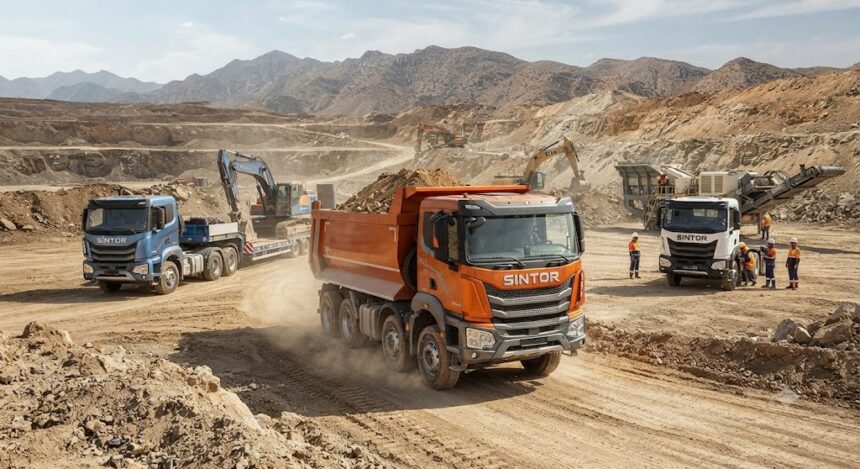
Sintor trucks occupy a rare corner of the custom-vehicle market. They begin as Ford Super Duty pickups, then receive extensive suspension, axle, body, wheel, tire and appearance changes intended to create a diesel-powered “supertruck” with the presence of an exotic vehicle and the utility of a heavy-duty pickup.
That description sounds simple, but the finished product is far more complex than a conventional lifted truck. A Sintor build may combine 46-inch tires, widened carbon-fiber bodywork, upgraded F-450 running gear, a custom coilover suspension and premium trim from the donor vehicle.
Buyers therefore need to evaluate more than horsepower and visual impact. Build documentation, towing geometry, tire availability, warranty exposure, insurance and long-term serviceability all matter when considering Sintor trucks.
What Are Sintor Trucks?
Sintor Trucks is a custom truck upfitter that specializes in heavily modified Ford F-350, F-450 Super Duty vehicles. Their first public order was a 6,7-liters Power Stroke Ford F-350 for Sinister Diesel, which, as Diesel World magazine noted, was the prototype that defined the Sintor’s concept.
In contrast to original equipment manufacturers, who produce thousands of cars, Sintor creates modified vehicles from existing models. Thus, apart from a number of pre-owned Ford trucks, the resulting supertruck could be equipped with different powerplants, suspension, and other modifications.
This approach to the manufacturing process is not without its flaws since the starting point of each modified vehicle, or its base model, can vary, which affects the differences between the final products.
The word supertruck itself implies the ultimate version of a pickup. In this respect, Sintor products are more powerful than the usual lifted truck, yet they manage to retain the torque of diesel engines, four-wheel drive, and the ability to tow, depending on the configuration.
How the Sintor Supertruck Concept Began
The original Sintor-style Ford F-350 was not merely a static display vehicle. Diesel World reported that the truck used Ford’s 6.7-liter Power Stroke diesel, produced more than 600 horsepower and 1,200 lb-ft of torque in modified form, and ran 46-inch Michelin tires on custom 20-inch wheels.
Industry coverage later identified Brian George as a representative of the company and described the build philosophy as a combination of aggressive proportions, Raptor-inspired styling and functional suspension engineering.
MotorTrend covered a Sintor at the Off-Road Expo in 2019, while other automotive publications documented the company’s Ford Super Duty conversion work.
That history helps explain why Sintor trucks look different from trucks assembled from unrelated aftermarket parts. The visual package and mechanical changes are intended to work as one conversion rather than as a sequence of independent upgrades.
What Goes Into a Sintor Trucks Conversion?
No two used examples should be assumed to have identical equipment. Build content changes according to the donor truck, model year, customer request and the stage of the company’s development.
Buyers should always ask for the original build sheet. A social media caption or auction description may not reveal every mechanical change.
Ford Super Duty Donor Platform
Many documented builds use Ford F-350 or F-450 crew-cab trucks equipped with the 6.7-liter Power Stroke turbodiesel V8.
For example, a 2022 F-350 listed by Bring a Trailer retained its factory-rated 475 horsepower and 1,050 lb-ft of torque, paired with a 10-speed automatic transmission and dual-range transfer case.
For Sintor trucks, the donor vehicle determines the:
- Interior specification
- Infotainment system
- Driver-assistance technology
- Cab configuration
- Original payload label
- Factory powertrain equipment
- Initial warranty coverage
A Limited, Platinum or Lariat donor can make the finished vehicle feel exceptionally luxurious. However, the factory trim badge does not tell you how well the conversion itself was engineered, installed or maintained.
F-450 Axles, Gearing and Braking Hardware
A recurring feature in documented Sintor trucks is the use of F-450 axles or an upgraded F-450 front axle.
The 2022 F-350 auction example used F-450 axles with 4.88:1 gearing. Earlier coverage also described F-450 brakes, an electronic locker and custom steering components.
In Sintor trucks, this hardware is important because 46-inch tires add considerable rotating mass and leverage. Lower gearing can help recover effective torque at the wheels, while heavier-duty axle and brake components may be better suited to the conversion than standard F-350 hardware.
Still, upgraded parts do not automatically preserve the factory tow rating or payload capacity. The completed vehicle must be assessed as a modified truck, with attention to:
- Actual front and rear axle weights
- Tire load ratings
- Wheel load ratings
- Hitch height and geometry
- Suspension configuration
- Brake condition
- Overall curb weight
A specification taken from an ordinary F-350 or F-450 brochure may not accurately describe the finished custom vehicle.
Coilover Suspension and Steering Changes
Sintor trucks commonly use a front coilover conversion with premium dampers from King or Fox, plus rear shock, leaf-spring or air-support changes.
Documented examples include King coilovers and bypass shocks, Deaver rear leaf springs, steering stabilizers, traction arms, upgraded tie rods and onboard air systems.
This is more involved than installing a basic spacer lift. Steering geometry, caster, track-bar position, driveshaft angles and shock tuning all influence how a tall truck tracks, brakes and responds to bumps.
A proper test drive should include:
- Low-speed steering
- Full-lock turns
- Rough pavement
- Highway cruising
- Firm braking
- Four-wheel-drive engagement
- Acceleration under load
Listen for tire contact, driveline vibration, steering oscillation, suspension clunks and excessive compressor cycling.
46-Inch Tires and Custom Wheels
The most recognisable components are the enormous tires. Several published builds use 46-inch 395/85R20 Michelin XZL tires on 20-inch Sintor wheels, sometimes with rock rings or beadlock-style hardware.
On Sintor trucks, these tires create ground clearance and dramatic visual scale. They also change several important driving characteristics:
- Braking feel
- Acceleration
- Steering effort
- Turning radius
- Speedometer accuracy
- Fuel economy
- Wheel-bearing load
- Replacement cost
A buyer should confirm the exact tire model, DOT markings, date codes, load rating, wheel specification and whether a matching spare is included.
Do not assume that a normal passenger-vehicle tire shop can source, mount or balance them. Before purchasing one of these trucks, locate a commercial or specialist tire facility willing to service the wheel-and-tire package.
Carbon-Fiber Bodywork and Exterior Equipment
Widened fenders and bedsides are another defining feature. Auction and magazine coverage has documented carbon-fiber fenders, bedside panels, hood details, custom grilles, widened inner wheel wells and specialised bumpers.
Depending on the individual build, accessories may include:
- Warn winches
- LED exterior lighting
- Power-operated steps
- Front and rear cameras
- Custom exhaust components
- Onboard air compressors
- Adjustable receiver hitches
- Auxiliary air horns
- Custom grille assemblies
These pieces add capability and visual impact, but replacement parts may not be available through a Ford dealership.
Inspect carbon-fiber panels carefully for cracks, stress marks, poor repair work, loose mounting points and uneven panel gaps. Damage that would require a simple bolt-on fender replacement on a stock truck can become a specialist fabrication job on a custom build.
Sintor Trucks Specifications at a Glance
Specifications differ between builds. The following should therefore be treated as a profile of commonly documented equipment rather than a universal factory specification.
- Base vehicle: Ford F-350 or F-450 Super Duty crew cab
- Engine: Commonly a 6.7-liter Power Stroke turbodiesel V8
- Transmission: Factory automatic transmission for the donor model year
- Drive system: Four-wheel drive with a dual-range transfer case on documented examples
- Axles: F-450 axles or an upgraded F-450 front axle on many builds
- Gearing: 4.88:1 gearing appears on multiple documented vehicles
- Tires: Often 46-inch 395/85R20 Michelin XZL tires
- Wheels: Custom 20-inch Sintor wheels
- Suspension: Coilover conversion with King or Fox components
- Body: Widened carbon-fiber fenders and, on some trucks, carbon-fiber bedsides
- Accessories: Winches, onboard air, custom lighting, cameras and hitch hardware
The safest way to compare Sintor trucks is by VIN, donor model year and individual build sheet. A specification copied from another vehicle can be materially wrong for the truck being considered.
How Much Do Sintor Trucks Cost?
Public pricing is inconsistent because the market includes conversion-only quotes, complete trucks, older builds and privately listed used vehicles.
Historical social posts associated with the company have advertised builds starting at approximately $98,000 to $110,000. Other posts have promoted complete trucks at around $189,000 to $195,000.
Those figures should not be treated as a universal or permanently valid official price list. The total cost depends on:
- Donor vehicle price
- Ford trim level
- Model year
- Suspension package
- Axle and gearing changes
- Carbon-fiber bodywork
- Wheel-and-tire package
- Winches and accessories
- Interior specification
- Shipping and taxes
- Additional powertrain work
A social listing has also promoted an F-450 Sintor at $189,000, showing that six-figure asking prices remain part of the market. Asking price, however, is not the same as transaction value.
Custom vehicles usually have a narrower pool of qualified buyers than factory-standard trucks. That can produce a considerable difference between the original build cost, current asking price and eventual resale value.
Costs Beyond the Purchase Price
The acquisition price is only the first line of the ownership budget. Prospective buyers should also estimate the cost of:
- Specialty tire replacement
- Commercial tire mounting and balancing
- Custom alignment work
- Steering-component inspections
- Increased fuel consumption
- Carbon-fiber body repair
- Custom paint matching
- Winch and compressor maintenance
- Shipping to a specialist workshop
- Agreed-value insurance
- Secure storage and parking
A pre-purchase inspection may cost more than a routine used-truck inspection. The evaluator needs experience with diesel powertrains, custom suspension geometry, oversized tires and fabricated body components.
Can Sintor Trucks Still Tow?
Many Sintor trucks are promoted as tow-capable builds, and some retain receiver or fifth-wheel-related equipment.
One auctioned F-450 included an adjustable Gen-Y receiver hitch and a spare mounted over a fifth-wheel assembly. A company-related social post also cited a 15,000-pound towing figure for a particular build.
That does not establish a universal tow rating for all Sintor trucks.
Large tires, altered suspension, changed curb weight, hitch position and non-stock wheels can affect towing performance and available payload. A converted truck may weigh considerably more than the original vehicle represented on its factory payload label.
Before towing, owners should:
- Weigh the truck by axle on a certified scale.
- Review the door-jamb certification labels.
- Confirm tire and wheel load capacities.
- Inspect the hitch and mounting hardware.
- Check the upfitter’s build documentation.
- Calculate the trailer’s loaded tongue or pin weight.
- Confirm that the brakes and suspension are correctly maintained.
The trailer’s real loaded weight must fit within the truck’s verified remaining capacity—not a generic marketing estimate or the rating of an unmodified donor vehicle.
Road Manners, Off-Road Ability and Daily Use
The strongest argument for Sintor trucks with a professionally integrated conversion is that the suspension, steering and axle components can be selected as a system.
Magazine coverage describes the original truck as a vehicle that was driven and used rather than built solely for display.
Even so, physics remains unchanged. A vehicle on 46-inch tires has a higher centre of gravity, greater unsprung mass and more tire inertia than a factory-standard pickup.
Drivers should allow additional braking distance, corner conservatively and become familiar with the truck’s width and turning requirements.
Daily usability can also be limited by physical dimensions. Potential problem areas include:
- Parking garages
- Residential garages
- Automatic car washes
- Drive-through lanes
- Hotel parking structures
- Low tree branches
- Workshop service doors
- Standard vehicle lifts
A published profile described one Sintor as approximately 7 feet 10 inches tall. The precise height can vary, so every owner should measure their own truck.
Reliability, Maintenance and Warranty Considerations
The underlying Ford powertrain may still be serviceable through a broad dealership network. Modified suspension, custom wheels, carbon-fiber panels and auxiliary electrical equipment may require specialist support.
Owners should maintain records for every component, including:
- Manufacturer
- Part number
- Installation date
- Alignment settings
- Shock specification
- Axle ratio
- Wheel dimensions
- Tire load rating
- Wiring diagrams
- Warranty information
Ford states that aftermarket modifications do not automatically void the entire new-vehicle warranty. However, if an aftermarket product fails or causes another component to fail, the related repair may not be covered.
That makes documentation essential. Ask who installed each component, what warranty the upfitter provided, whether it transfers to a later owner and which workshop is expected to perform future repairs.
Important Maintenance Areas
Owners of Sintor trucks should regularly monitor:
- Front-end ball joints and rod ends
- Tie rods and steering stabilisers
- Wheel bearings
- Axle seals
- Tire wear and date codes
- Driveshaft joints
- Driveline vibration
- Shock leaks
- Suspension mounting hardware
- Brake pads, rotors and fluid
- Onboard air fittings
- Compressor duty cycles
- Carbon-fiber mounting points
- Winch cables and electrical connections
- Battery and charging-system load
Inspection intervals may need to be shorter than those for a standard road truck, particularly after towing, off-road use or long-distance highway driving.
Legality, Registration and Insurance
Vehicle modification rules vary by state and locality. Height, bumper position, tire coverage, lighting, emissions equipment and overall width can all affect road legality.
NHTSA explains that manufacturers and vehicle alterers operate within federal vehicle-safety requirements. Its published interpretations also indicate that width changes can trigger additional lighting requirements in certain circumstances.
Owners should confirm the rules in the jurisdiction where the truck will be registered—not merely where it was built or purchased.
Insurance deserves equal attention. A standard insurer may value the truck primarily as a Ford Super Duty and give limited credit for an expensive custom conversion.
Request written confirmation that the modifications are covered. An agreed-value policy supported by invoices, detailed photographs and an independent appraisal may provide stronger protection than a policy based only on standard used-vehicle valuation data.
How to Inspect a Used Sintor Truck
Used Sintor trucks should be evaluated as both Ford diesel pickups and custom-built specialty vehicles. The following process reduces the risk of paying premium money for an undocumented or poorly maintained example.
1. Verify the Donor Vehicle
Run the VIN and confirm the original model, trim level and factory equipment. Review the title history, accident record, mileage history and open recalls.
Compare the VIN-derived specification with the seller’s description. Do not rely on exterior badges alone.
2. Obtain the Complete Build File
Request the original build sheet, installation invoices, alignment reports, component warranties and repair photographs.
Confirm whether the conversion was completed by Sintor Trucks or whether another workshop later altered the suspension, drivetrain, wheels or bodywork.
3. Inspect the Chassis and Steering
Look for:
- Cracked welds
- Bent brackets
- Elongated bolt holes
- Loose rod ends
- Damaged bushings
- Fluid leaks
- Tire-contact marks
- Worn steering joints
- Uneven shock travel
Check tire clearance at full steering lock. Where it can be done safely, examine clearance through the suspension’s operating range.
4. Inspect the Tires and Wheels
Check all tire date codes, tread depth, sidewalls and load ratings. Inspect the wheels for cracks, loose hardware, impact damage or incorrect fasteners.
Confirm that the spare matches the road wheels and that equipment is available to remove and handle such a heavy tire.
5. Scan the Electronic Systems
Use a Ford-capable diagnostic scanner to check active, stored and pending fault codes.
Confirm that the following systems work as represented:
- Front and rear cameras
- Parking sensors
- Tire-pressure monitoring
- Four-wheel drive
- Driver-assistance features
- Power steps
- Auxiliary lights
- Onboard compressor
- Winch controls
Large tires and aftermarket electrical components can create warning lights or calibration issues when the conversion is not properly configured.
6. Test the Truck Under Real Conditions
Start the truck when the engine is cold. Observe smoke, idle quality, warning lights and fluid pressure behaviour.
Drive at highway speed and over imperfect pavement. Check:
- Straight-line tracking
- Steering return
- Braking stability
- Transmission shifts
- Driveline vibration
- Four-wheel-drive operation
- Tire rubbing
- Suspension noise
A low-speed drive around a dealership lot is not sufficient for evaluating a vehicle of this complexity.
7. Confirm Service Access Before Buying
Identify a workshop that is prepared to service the truck before completing the purchase.
A spectacular build becomes difficult to own when no nearby facility can lift it, align it, mount its tires or source its custom components.
Advantages and Trade-Offs
Sintor trucks appeal to buyers who want exclusivity, extreme visual presence and Ford diesel capability in one package. The coordinated body and suspension treatment can look more cohesive than a conventional aftermarket lift assembled from unrelated components.
The trade-offs are significant. Purchase price, operating costs, dimensions, parts availability and resale liquidity can all be less favourable than with a factory-standard F-450 or mildly modified F-350.
Potential Advantages
- Distinctive and limited-production appearance
- Heavy-duty Ford Super Duty donor platform
- Premium suspension components on documented builds
- F-450 axle hardware on many examples
- Diesel torque and four-wheel drive
- Luxury interiors from upper Ford trim levels
- Integrated carbon-fiber body design
- Strong visual appeal at shows and events
Potential Disadvantages
- Six-figure pricing for many complete examples
- Expensive and uncommon tires
- Greater braking and handling demands
- Increased fuel consumption
- Possible warranty disputes involving modified parts
- Specialist repair requirements
- Registration and insurance complications
- Height and parking restrictions
- Narrower resale market
- Limited availability of custom body components
Are Sintor Trucks Worth Buying?
Sintor trucks can be worth buying for enthusiasts who understand custom vehicles, have access to specialist service and value the design enough to accept greater operating complexity.
They are less suitable for buyers seeking the simplest towing vehicle, lowest cost per mile or easiest nationwide repair experience.
The best example is not necessarily the newest or most powerful truck. It is the one with:
- A clear build history
- Complete maintenance records
- Correct suspension geometry
- A healthy diesel powertrain
- Undamaged bodywork
- Properly rated tires and wheels
- Reliable steering and braking
- A realistic purchase price
Buy the documentation as much as the truck. A well-recorded build gives future technicians, insurers and buyers evidence of what was installed, who installed it and how it was maintained.
Frequently Asked Questions About Sintor Trucks
Are Sintor trucks made by Ford?
No. They use Ford Super Duty donor vehicles, but the Sintor conversion is performed by an independent custom upfitter.
Ford supplies the original truck, cab, powertrain and factory systems. The conversion changes major exterior, suspension, wheel, tire and chassis components.
What size tires do Sintor trucks use?
Many well-documented examples use 46-inch 395/85R20 Michelin XZL tires mounted on custom 20-inch wheels.
Specifications vary between vehicles, so buyers should confirm the exact package from the individual truck’s build sheet and tire markings.
How tall is a Sintor truck?
One published profile described a build standing approximately 7 feet 10 inches tall. Height can change according to tire selection, suspension setup and vehicle load.
Owners should measure their specific truck before entering garages, service bays, car washes or parking structures.
Do Sintor trucks have F-450 axles?
Many documented conversions do. Published specifications include F-450 axles, F-450 brakes and, on some examples, 4.88:1 gearing.
This should not be assumed for every truck. The axle tags, build records and physical components should be inspected before purchase.
Where can you buy a Sintor truck?
Examples appear through company social channels, specialty dealers, private listings and enthusiast auction platforms.
Availability is irregular. Buyers should compare the VIN, build documentation, mechanical inspection and market value rather than purchasing solely because a vehicle carries Sintor branding.
Final Verdict
Sintor trucks are not ordinary lifted pickups. They are high-cost, highly visible Ford Super Duty conversions that combine huge tires, custom suspension, widened bodywork and heavy-duty diesel hardware in a package aimed at buyers who want something genuinely uncommon.
Approach one like a specialty vehicle. Verify the donor truck, demand the complete build file, inspect the steering and suspension, confirm tire availability, calculate real towing capacity and secure written insurance coverage before money changes hands.
The right Sintor can deliver enormous road presence and a distinctive ownership experience. The wrong one can become an expensive collection of hard-to-source parts.
Careful inspection, specialist advice and complete documentation are what separate those two outcomes.