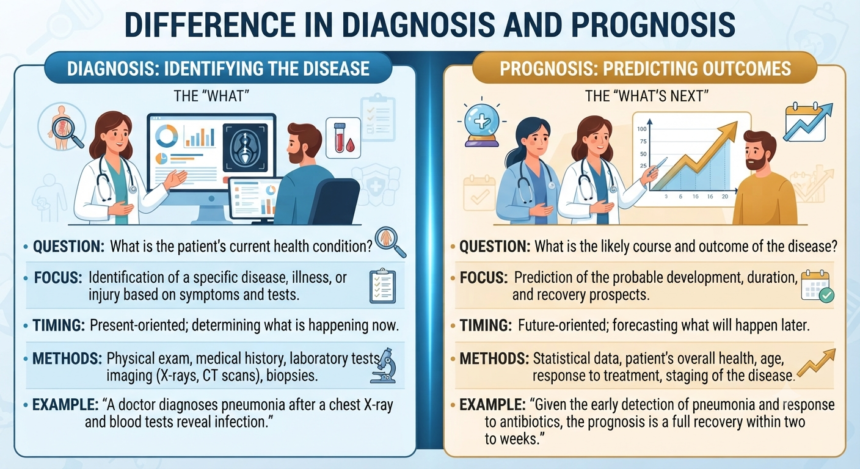
Understanding the difference in prognosis and diagnosis can make medical conversations far less confusing. Although healthcare professionals often use these terms together, they answer two completely different questions: What condition does the patient have, and what is likely to happen next?
A diagnosis identifies the disease, disorder, or injury affecting a person. A prognosis estimates the condition’s likely course, including the possibility of improvement, complications, recurrence, disability, or recovery.
The distinction sounds simple. In practice, however, diagnosis and prognosis are closely connected, may change over time, and are rarely based on a single test or observation.
Medical note: This article explains general terminology and should not be used to diagnose a condition or predict an individual medical outcome.
Diagnosis vs. Prognosis at a Glance
The easiest way to understand the difference in prognosis and diagnosis is to compare the questions they answer.
| Medical term | Main question | Primary focus | Common basis |
|---|---|---|---|
| Diagnosis | What condition does the patient have? | Identifying the current medical problem | Symptoms, history, examination, laboratory tests, imaging, biopsies |
| Prognosis | What is likely to happen over time? | Predicting the future course and outcome | Diagnosis, severity, stage, age, health status, treatment response and research data |
| Treatment plan | What should be done about it? | Managing, controlling or curing the condition | Diagnosis, prognosis, patient goals, benefits and risks |
The National Cancer Institute defines diagnosis as the process of identifying a disease, condition, or injury using signs, symptoms, medical history, physical examination, and appropriate testing. It defines prognosis as the likely course or outcome of a disease, including the chance of recovery or recurrence.
In plain English:
- Diagnosis names or describes the medical problem.
- Prognosis estimates where that problem may lead.
- Treatment attempts to influence the outcome.
What Is a Diagnosis?
A diagnosis is a clinician’s determination of what condition best explains a patient’s symptoms, physical signs, test results, and medical history.
For example, chest discomfort is a symptom, not a diagnosis. Possible diagnoses might include acid reflux, muscle strain, anxiety, pneumonia, angina, or a heart attack.
Doctors do not usually reach a reliable diagnosis by matching one symptom to one disease. They gather evidence, compare possible explanations, rule out urgent conditions, and update their reasoning as new information becomes available.
A major review of the diagnostic process describes diagnosis as a clinical hypothesis about the nature of a person’s illness. Confidence in that hypothesis increases or decreases as information supports it or points toward competing explanations.
Information Used to Make a Diagnosis
Depending on the medical problem, the diagnostic process may involve:
- A description of current symptoms
- The timing and progression of those symptoms
- Personal and family medical history
- Medication and allergy history
- Lifestyle or occupational exposures
- Physical examination findings
- Blood, urine or tissue testing
- X-rays, ultrasound, CT scans or MRI
- Endoscopy or biopsy
- Genetic or molecular testing
- Response to an initial treatment
Medical tests can serve several purposes. They may help detect a condition, confirm a diagnosis, guide treatment, monitor disease progression, or determine whether therapy is working.
Preliminary, Differential and Definitive Diagnosis
Not every diagnosis carries the same level of certainty.
A preliminary diagnosis is an initial clinical judgment based on the information currently available. It may appear in an emergency-room note before laboratory or imaging results return.
A differential diagnosis is a list of plausible conditions that could explain the patient’s presentation. Clinicians compare these possibilities and use additional questions, examinations, or tests to narrow the list. MedlinePlus explains that this process is particularly useful when symptoms do not have one obvious cause.
A definitive diagnosis is the final determination made after sufficient evidence has been obtained. In some illnesses, this may require a biopsy, culture, genetic test, or other confirmatory procedure.
These stages help explain why a diagnosis written early in a medical record may later be revised.
What Is a Prognosis?
A prognosis is an evidence-based estimate of how a disease or health condition is likely to progress.
It may address whether symptoms are expected to improve, remain stable, fluctuate, return after treatment, or become more severe. It can also describe possible complications, expected functional ability, quality of life, treatment response, recurrence risk, or survival.
This is the central difference in prognosis and diagnosis: diagnosis deals mainly with identifying the present condition, while prognosis deals with estimating its future path.
A prognosis is not necessarily a prediction of death. Someone with a sprained ankle, viral infection, anxiety disorder, chronic back problem, or fractured bone can also receive a prognosis.
What Can a Prognosis Include?
Depending on the condition, a clinician may discuss:
- Expected recovery time
- Likelihood of complete recovery
- Chances of symptom improvement
- Possibility of long-term disability
- Risk of complications
- Risk of relapse or recurrence
- Expected response to treatment
- Ability to work or perform daily activities
- Need for ongoing monitoring
- Life expectancy or survival probability
Patients often want more than a survival statistic. They may also want to know whether they will be able to walk, work, drive, sleep normally, care for family members, or live independently.
Research on prognosis as a health trajectory emphasizes that patients commonly want information about symptoms, function, independence, and quality of life—not only mortality.
The Main Difference in Prognosis and Diagnosis
The difference in prognosis and diagnosis can be summarized through time, purpose, certainty, and clinical use.
Diagnosis Identifies; Prognosis Predicts
Diagnosis explains what condition is present. Prognosis estimates what may happen because of that condition.
For example:
- Diagnosis: Bacterial pneumonia
- Prognosis: Recovery is likely with appropriate antibiotics, although risk may be higher in an older patient with severe lung disease.
The prognosis cannot be interpreted properly without understanding the diagnosis, but two people with the same diagnosis may have very different outcomes.
Diagnosis Focuses on Current Evidence
A diagnosis is based primarily on evidence available now: symptoms, examination findings, laboratory values, imaging, pathology, and clinical criteria.
A prognosis uses that information but extends the analysis into the future. It combines the diagnosis with severity, stage, patient characteristics, available treatments, and outcomes observed in comparable groups.
Diagnosis Is a Classification
A diagnosis places a patient’s problem within a recognized disease or condition category. That classification helps clinicians communicate, select treatments, document care, and investigate possible causes.
Prognosis is more individualized. It attempts to estimate the probable trajectory within that diagnostic category.
Prognosis Is Usually Probabilistic
Prognostic statements often use words such as:
- Likely
- Unlikely
- Possible
- Favorable
- Guarded
- Poor
- High risk
- Low risk
This language reflects uncertainty. A prognosis is an estimate, not a guarantee.
How Diagnosis Influences Prognosis
Another important part of the difference in prognosis and diagnosis is their relationship. Prognosis usually depends on first establishing the most accurate diagnosis possible.
A mild skin infection and an aggressive skin cancer can both initially appear as a changing skin lesion. Their likely courses differ dramatically, so identifying the correct condition is essential before discussing outcome.
Even after a diagnosis is established, the name of the disease may not provide enough prognostic information. Clinicians may also need to determine:
- Disease subtype
- Severity or stage
- Organs involved
- Duration of illness
- Biological or genetic features
- Presence of complications
- Response to previous treatment
- Other health conditions
In cancer care, for example, staging helps clinicians estimate prognosis, plan treatment, and evaluate whether a patient may qualify for certain clinical trials.
Factors That Can Change a Prognosis
The difference in prognosis and diagnosis becomes clearer when two patients share a diagnosis but have different risk profiles.
Important prognostic factors may include:
- Disease severity: Mild and advanced forms of the same illness may behave differently.
- Stage or extent: Localized disease may have a better outlook than disease affecting several organs.
- Age: Age can influence resilience, treatment tolerance, and complication risk.
- Overall health: Heart, lung, kidney, liver, or immune problems may affect recovery.
- Treatment availability: Some conditions have highly effective therapies, while others remain difficult to control.
- Treatment response: Early improvement may produce a more favorable outlook.
- Adherence: Taking medication correctly and attending follow-up appointments can influence outcomes.
- Genetics and biomarkers: Molecular characteristics may help predict disease behavior or treatment response.
- Lifestyle and environment: Smoking, nutrition, activity, occupational exposure, and access to care can matter.
- Complications: Infection, bleeding, organ damage, or delayed treatment may worsen the expected course.
A prognostic factor is a patient characteristic or clinical condition used to estimate the likelihood of recovery or recurrence.
Examples of Diagnosis and Prognosis
Realistic examples make the difference in prognosis and diagnosis easier to remember.
Example 1: Bone Fracture
Diagnosis: A nondisplaced wrist fracture confirmed by X-ray.
Prognosis: The bone will probably heal with immobilization, although stiffness may temporarily continue after the cast is removed.
The diagnosis identifies the injury. The prognosis describes the likely recovery.
Example 2: Type 2 Diabetes
Diagnosis: Type 2 diabetes based on symptoms and qualifying blood glucose or HbA1c results.
Prognosis: The condition is usually long-term, but blood sugar and complication risk may be substantially reduced through appropriate medication, nutrition, physical activity, and monitoring.
A chronic diagnosis does not automatically mean an unfavorable prognosis. Good management can change the likely outcome.
Example 3: Pneumonia
Diagnosis: Community-acquired pneumonia based on symptoms, examination findings, and chest imaging.
Prognosis: A healthy adult with mild disease may recover fully, while an older adult with low oxygen levels and several chronic illnesses may have a higher risk of hospitalization and complications.
The diagnosis is the same, but the prognoses differ.
Example 4: Cancer
Diagnosis: Breast cancer confirmed through imaging and tissue biopsy.
Prognosis: The likely outcome depends on stage, tumor biology, age, general health, treatment options, and response to therapy.
Cancer prognosis is commonly based on the type and stage of disease, treatment received, and outcomes among people with similar characteristics. It remains an estimate rather than a fixed prediction for one person.
Example 5: Depression
Diagnosis: Major depressive disorder based on clinical symptoms, duration, functional impairment, and exclusion of other likely causes.
Prognosis: Many patients improve with suitable therapy, medication, lifestyle support, or a combination of approaches, although recurrence can occur and follow-up may be necessary.
Psychiatric conditions also have diagnoses and prognoses, even when no single blood test or scan can confirm them.
What Do “Good,” “Poor” and “Guarded” Prognosis Mean?
Doctors may use broad terms when exact numerical estimates would be misleading.
A good or favorable prognosis generally means meaningful improvement or recovery is likely. A poor prognosis indicates a higher likelihood of severe progression, major complications, limited recovery, or shortened survival.
A guarded prognosis means the outcome is uncertain and could change significantly. Clinicians may use this term when the patient is critically ill, when treatment response is not yet known, or when the available evidence does not support a confident prediction.
These terms are contextual. A “good prognosis” may mean complete recovery in one disease but years of stable symptom control in another.
Can a Diagnosis Be Correct but the Prognosis Be Wrong?
Yes. This is a crucial difference in prognosis and diagnosis.
A diagnosis can be strongly confirmed while the patient’s future course remains difficult to predict. Medicine works with probabilities, and individuals do not always follow the average pattern.
Several factors can cause an outcome to differ from the original estimate:
- Unexpected treatment response
- New complications
- Changes in general health
- Advances in available treatment
- Differences in biology or genetics
- Incomplete information at the time of prediction
- Rare disease behavior
- Greater or lower treatment tolerance than expected
Prognostic estimates are especially challenging for rare disorders because relatively few patients may be available for comparison. MedlinePlus notes that genetic-condition prognosis may depend on the specific diagnosis, symptoms, genetic variant, and availability of effective management.
Can a Diagnosis or Prognosis Change?
Both can change, but for different reasons.
A diagnosis may change when new testing reveals that the original explanation was incomplete or incorrect. A patient initially thought to have a viral infection, for example, may later receive a diagnosis of an autoimmune disorder after persistent symptoms and specialist testing.
A prognosis may change even when the diagnosis remains the same. Successful treatment, disease progression, a complication, or a new therapy can alter the expected course.
This dynamic quality is central to understanding the difference in prognosis and diagnosis. Neither term should always be treated as a permanent statement made at one moment in time.
Prognosis vs. Treatment Response
Prognosis and treatment response are related but not identical.
Treatment response describes what has happened after therapy begins. A tumor may shrink, blood pressure may fall, pain may improve, or an infection may clear.
Prognosis uses this response—along with other factors—to estimate what may happen later. A strong early response may improve the outlook, but it does not always eliminate the risk of relapse or complications.
Doctors often revise a prognosis after observing:
- Early symptom improvement
- Laboratory changes
- Follow-up imaging
- Medication tolerance
- Functional recovery
- Disease recurrence
- New complications
Prognosis vs. Survival Rate
The difference in prognosis and diagnosis is sometimes confused further by survival statistics.
A survival rate describes what happened to a defined group of patients over a specific period. It does not reveal exactly what will happen to one individual.
For example, median survival is the length of time at which half of a studied group remains alive. It is not an expiration date, and some patients live for substantially less or more time.
Personal prognosis may differ from population statistics because of:
- Age and overall health
- Disease subtype or stage
- Newer treatments
- Access to specialist care
- Response to therapy
- Differences between the patient and the research population
Statistics should therefore be discussed with a clinician who understands the individual case.
Why the Difference Matters for Patients
Understanding the difference in prognosis and diagnosis helps patients participate more effectively in healthcare decisions.
A diagnosis may explain why treatment is recommended. Prognostic information helps determine whether the expected benefits justify the risks, burdens, cost, or side effects.
For example, a patient might reasonably ask:
- Is the treatment intended to cure the disease or control it?
- What happens without treatment?
- How likely is meaningful improvement?
- What complications should I watch for?
- When will we know whether treatment is working?
- Could the prognosis improve or worsen?
- How might this condition affect daily life?
- Which part of the estimate is most uncertain?
Medical decisions are not based on statistics alone. Patients and clinicians may value possible benefits, risks, quality of life, independence, and treatment burden differently, which is why shared decision-making matters.
Questions to Ask Your Doctor
When discussing the difference in prognosis and diagnosis in a real appointment, ask for clear, specific explanations.
Useful questions include:
- How certain is the diagnosis?
- Are other conditions still being considered?
- Which test results support this diagnosis?
- What is the usual course of this condition?
- Which factors make my outlook better or worse?
- What is the best-case, typical, and worst-case scenario?
- How will treatment change the expected outcome?
- When should the prognosis be reassessed?
- Which symptoms require urgent attention?
Asking for a range of possible outcomes may be more useful than requesting one exact number.
Frequently Asked Questions
What is the simplest difference between diagnosis and prognosis?
A diagnosis identifies the disease, disorder, or injury affecting the patient. A prognosis estimates how that condition is likely to develop, respond to treatment, or affect the patient over time.
Put simply, diagnosis means “what it is,” while prognosis means “what may happen.”
Does prognosis come before or after diagnosis?
A formal prognosis usually follows diagnosis because clinicians need to understand the condition before estimating its likely course. However, doctors may discuss a preliminary outlook while diagnostic testing is still underway.
The estimate becomes more reliable as the diagnosis, severity, stage, and treatment response become clearer.
Is a poor prognosis the same as a terminal diagnosis?
No. A poor prognosis indicates a higher risk of unfavorable outcomes, but it does not always mean that the condition is terminal.
The term may refer to limited functional recovery, a high complication risk, repeated relapses, progressive disability, or reduced survival. Patients should ask what the clinician specifically means by “poor” in their situation.
Can two people with the same diagnosis have different prognoses?
Yes. Age, disease severity, stage, genetics, other medical conditions, treatment access, lifestyle, and response to therapy can all influence outcome.
That is why population statistics cannot precisely predict what will happen to a particular individual.
Is a prognosis guaranteed to be accurate?
No. Prognosis is an informed estimate based on current evidence and outcomes among similar patients.
It can become more favorable or less favorable as the condition changes, treatment begins, new test results appear, or complications develop. A responsible clinician should communicate both the estimated outcome and the uncertainty surrounding it.
Conclusion: Use Both Terms to Ask Better Medical Questions
The difference in prognosis and diagnosis comes down to two distinct clinical purposes. Diagnosis identifies the condition a person currently has; prognosis estimates how that condition may unfold in the future.
They are connected, but they are not interchangeable. An accurate diagnosis helps doctors choose treatment, while a thoughtful prognosis helps patients understand risks, set realistic expectations, compare options, and plan for what may come next.
After receiving a medical diagnosis, do not stop at asking, “What do I have?” Ask what the condition usually does, which personal factors affect the outlook, how treatment may change it, and when the estimate should be reviewed. Those questions turn medical terminology into information you can actually use.