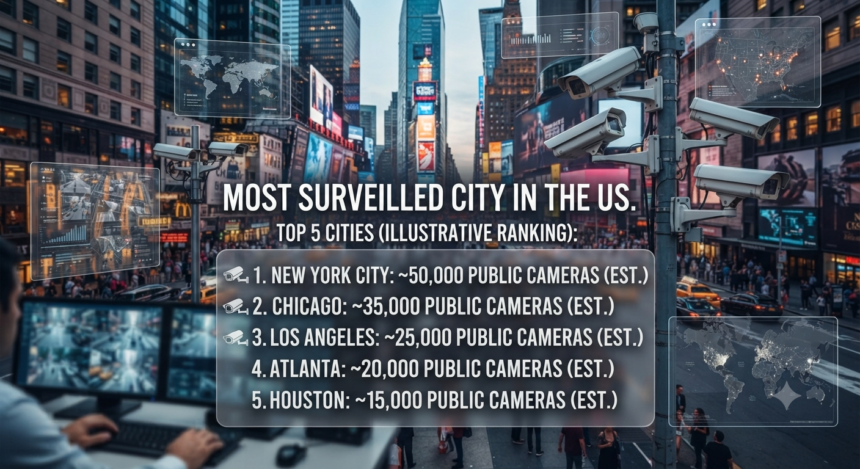
The most surveilled city in the US is Atlanta, Georgia, according to the latest comprehensive comparison of surveillance cameras across America’s 50 largest cities located for this article. The study counted 60,864 cameras serving a city population of 490,270, equal to 124.14 cameras per 1,000 residents.
That rate was more than twice Washington, D.C.’s figure and roughly four times Philadelphia’s.
That headline is accurate, but incomplete. Atlanta does not necessarily own 60,864 police cameras, nor does every device continuously track every person.
The ranking combines different equipment types, ownership models, and access arrangements. These include public cameras, transit systems, police-worn cameras, traffic devices, patrol-car cameras, and privately owned feeds that can be registered or integrated with law enforcement.
Understanding the most surveilled city in the US therefore requires more than reading a league table. You need to know what was counted, who controls the footage, how data can be searched, and what oversight exists after a camera is switched on.
Quick Answer: What Is the Most Surveilled City in the US?
Atlanta is the best-supported answer on a per-capita basis. Comparitech’s January 2024 national analysis ranked Atlanta first with 124.14 cameras per 1,000 people.
Washington, D.C. ranked second at 55.54, followed by Philadelphia at 30.73 cameras per 1,000 residents.
For searchers asking which place is the most surveilled city in the US, this is the clearest current answer. However, the answer changes when the measurement changes:
- Per 1,000 residents: Atlanta ranks first.
- Per square mile: Washington, D.C. ranks first.
- Total number of cameras: New York City ranks first.
- Breadth of surveillance technology: No authoritative national score currently measures every capability.
This distinction matters. Calling Atlanta the most surveilled city in the US is defensible when the metric is camera density per resident, but it should not be presented as a universal measurement of every surveillance system.
Top 10 Most Surveilled U.S. Cities by Camera Density
The ranking below uses one methodology so that cities are compared on a like-for-like basis. It includes camera systems available to public authorities through several channels, not merely cameras directly owned by city hall or a police department.
This is the ranking behind many most surveilled city in the US headlines.
| Rank | City | Estimated Cameras | Cameras per 1,000 Residents |
|---|---|---|---|
| 1 | Atlanta, Georgia | 60,864 | 124.14 |
| 2 | Washington, D.C. | 35,082 | 55.54 |
| 3 | Philadelphia, Pennsylvania | 46,957 | 30.73 |
| 4 | San Francisco, California | 18,200 | 25.43 |
| 5 | Denver, Colorado | 14,043 | 20.08 |
| 6 | Chicago, Illinois | 48,283 | 18.51 |
| 7 | Albuquerque, New Mexico | 9,525 | 17.05 |
| 8 | Detroit, Michigan | 10,344 | 16.65 |
| 9 | Las Vegas, Nevada | 10,159 | 15.54 |
| 10 | Memphis, Tennessee | 8,417 | 13.54 |
The table explains why the most surveilled city in the US is not New York. New York had the largest raw total in the study—70,882 cameras—but its much larger population reduced its rate to 8.99 cameras per 1,000 people.
Atlanta’s first-place position is primarily a result of its unusually high camera count relative to its city-limit population.
How the “Most Surveilled” Ranking Was Calculated
The national analysis counted much more than traditional pole-mounted CCTV. Its methodology included:
- Fixed police and municipal cameras
- Feeds accessed through real-time crime centers
- Private cameras connected to police networks
- Police body-worn cameras
- Patrol-car dash and rear-seat cameras
- Public-transport surveillance systems
- Traffic-monitoring cameras
Across the 50 cities studied, researchers identified nearly 537,000 cameras monitoring a combined population of 48.9 million. That produced an average of approximately 11 cameras per 1,000 people.
This broad methodology captures the modern surveillance environment better than a count of city-owned street cameras alone. Yet it also creates important limitations.
Registered cameras are not always watched live
A homeowner or business may register a camera, telling police where it is located and agreeing to provide footage after an incident. An integrated camera can offer more direct or real-time access, depending on the platform, equipment, and permissions involved.
Both arrangements expand investigators’ potential access to video, but they are not identical forms of monitoring.
A careful article about the most surveilled city in the US should never imply that every registered doorbell, storefront, or apartment camera is watched by police around the clock.
Camera totals are estimates and snapshots
Camera networks change constantly. New devices are installed, old equipment stops working, private participants enter or leave programs, and agencies change their reporting methods.
Available national rankings are assembled from agency records, public disclosures, media reports, and other datasets rather than one continuously updated federal registry. That means even a figure presented to two decimal places should be treated as an informed estimate, not a permanent inventory.
The latest comprehensive national comparison located for this article was updated in January 2024. Later reporting and advocacy pages continued to describe Atlanta as the most surveilled city in the US, but many refer to the same underlying comparison rather than publishing a completely new national census.
Why Atlanta Became the Most Surveilled City in the US
Atlanta’s position is largely explained by the scale of its public-private camera network.
The Atlanta Police Foundation describes Connect Atlanta and Operation Shield as an integrated system connecting the Atlanta Police Department, businesses, and residents with surveillance and police-response infrastructure.
Its current program page says Operation Shield includes more than 20,000 public- and private-sector cameras linked to the APD Video Surveillance Center. It also states that approximately 80% of the program’s cost is borne by the private sector.
That funding and ownership model matters. Atlanta’s surveillance capacity is not limited by the number of cameras the municipal government can purchase itself.
Private businesses, residences, universities, transport operators, commercial districts, and other institutions can contribute devices or feeds to the wider system.
Connect Atlanta and Operation Shield
Connect Atlanta allows residents and businesses to register their cameras so police can request footage when investigating a nearby crime.
Operation Shield is designed around a more integrated network connected to a video center that supports real-time monitoring and police dispatch.
This hybrid structure helps explain why the most surveilled city in the US can have a camera estimate far larger than the number of devices directly owned by its police department.
It also makes accountability more complicated. Ownership, access, maintenance, data storage, retention, cybersecurity, and legal responsibility may be divided among several public and private parties.
Transit and traffic cameras increase the total
The national ranking incorporated large non-police systems. Its Atlanta estimate included thousands of traffic cameras and an extensive surveillance network operating across MARTA buses, trains, stations, and other transport facilities.
A person moving through Atlanta may therefore encounter several overlapping layers of monitoring:
- A storefront or office-building camera
- A residential security system
- A transit camera
- A traffic-management device
- A police-linked video feed
- An automated license plate reader
- An officer’s body-worn camera
The phrase most surveilled city in the US describes this combined visibility better than it describes one centralized collection of police-owned cameras.
Atlanta’s Camera Map Reveals Another Important Story
Raw numbers indicate volumes of surveillance – and exactly where it is conducted. Location data helps understand the distribution.
A 2025 Mapping Atlanta analysis found that 1,755 video cameras and license plate readers would be present in the city. Researchers overlaid this data on top of proposed installations, and found 1,878 devices ready for installation. Downtown Atlanta had the highest concentration of this data. However, the Mapping Atlanta team also noted that many other “high-count” regions were found throughout the city’s black west and south areas.
The researchers stressed that this represents only a fraction of Atlanta’s overall surveillance infrastructure – with many thousands of additional private, transit, institutional, and police cameras not included in the study due to not being publicly available.
The map serves as a useful reminder that a city’s overall “volume” of surveillance is not necessarily an indicator of how safe its residents are. Variability within a region must be taken into account for meaningful discussion of where exactly surveillance is taking place – with residents of two similar-seeming districts being potentially subjected to wildly differing levels of monitoring.
Is Washington, D.C. More Surveilled Than Atlanta?
By one important metric, yes.
Washington, D.C. had 573.8 cameras per square mile, compared with Atlanta’s 448.4. That made the capital the most camera-dense city in the study when surveillance was measured against land area.
Atlanta still ranked first per resident.
This is not a contradiction. It demonstrates why surveillance rankings should always state their denominator.
Per-capita camera density
This calculation asks how many cameras exist relative to the number of people living within the city limits.
Under this measurement, Atlanta is the most surveilled city in the US.
Cameras per square mile
This metric measures how tightly cameras are packed into a geographical area.
Washington, D.C.’s relatively small land area and high number of cameras pushed it above Atlanta under this calculation.
Total camera count
A raw total does not adjust for population or land area.
New York City led this category with 70,882 cameras in the study.
Functional surveillance capability
The most revealing—but hardest to measure—question is what the devices can actually do.
A system’s power depends on whether cameras can be searched, accessed live, connected to facial recognition, linked with vehicle records, combined with other databases, or shared across agencies.
Modern Surveillance Is More Than CCTV
A camera becomes far more powerful when software can identify, categorize, or search what it records. Camera quantity therefore provides only a partial picture of modern monitoring.
Automated license plate readers
Automated license plate readers, commonly called ALPRs or LPRs, capture vehicle plates along with associated time and location information.
One reading may simply document that a vehicle passed a specific place. A large, searchable collection can reveal travel patterns, recurring destinations, associations, and routines.
The Electronic Frontier Foundation has warned that networked tools—including ALPRs, face recognition, drones, cameras, and data-analysis platforms—can generate detailed records of people’s movements and associations. Risks increase when information travels beyond the agency or jurisdiction that originally collected it.
Facial recognition
Facial recognition can convert ordinary video footage into a potential identification tool.
Its performance is not uniform across every algorithm, image, demographic group, or operating environment.
The National Institute of Standards and Technology tested nearly 200 algorithms from almost 100 developers using more than 18 million images. NIST reported demographic differentials across the majority of the algorithms examined and found that results depended on the system, application, and data supplied.
Factors such as lighting, camera angle, resolution, image quality, database composition, and operator procedures can affect real-world results.
Real-time crime centers
Real-time crime centers combine camera feeds, dispatch tools, maps, databases, alerts, and analytical software in one operational environment.
Their significance is not simply that employees can see video. It is that personnel may be able to connect an event to different data sources quickly.
This is another reason the most surveilled city in the US cannot be identified solely by counting visible devices. Ten isolated cameras may provide less investigative capability than one integrated network combining video, vehicle records, automated alerts, and historical location data.
Does Heavy Surveillance Make Atlanta Safer?
The evidence-based answer is sometimes, in certain locations and against certain offenses—but camera quantity alone does not prove citywide safety.
A systematic review by the Campbell Collaboration found that CCTV had a modest overall effect on crime. The strongest results appeared in parking facilities and against vehicle-related crimes, particularly when cameras were combined with measures such as lighting, fencing, and security personnel.
The review found weaker results in city centers, public housing, and public transportation. It also found no measurable effect on violent crime in the studies examined.
A later 40-year systematic review similarly concluded that CCTV’s crime-reduction effects varied by setting and were most consistent in parking facilities.
Those findings do not mean cameras are useless.
Recorded footage may help investigators:
- Reconstruct the sequence of an incident
- Identify a vehicle or suspect
- Corroborate a witness statement
- Locate missing people
- Direct emergency responders
- Establish when someone entered or left an area
- Collect evidence for court proceedings
However, describing the most surveilled city in the US as automatically the safest city would be unsupported.
A serious evaluation should ask:
- Did the system prevent crime or merely record it?
- Did it help solve cases?
- Which offenses were affected?
- Did criminal activity move to nearby locations?
- How many alerts produced useful evidence?
- How many alerts were incorrect?
- What were the equipment, staffing, storage, and maintenance costs?
- Were results evaluated by an independent organization?
More cameras can generate more footage. They do not automatically produce better public-safety outcomes.
Privacy and Civil-Liberties Concerns in Atlanta
The central privacy issue is not simply being seen in public. It is the possibility that observations can be stored, searched, connected, shared, and repurposed.
Being the most surveilled city in the US places Atlanta at the center of the national oversight debate.
The ACLU of Georgia, whose campaign page was updated in June 2026, argues that Atlanta needs stronger transparency and community oversight before surveillance technologies are purchased or deployed.
The organization warns that collected information can move beyond its original purpose or jurisdiction. It supports a Community Control Over Police Surveillance ordinance that would give elected officials and residents greater involvement in decisions about police technology.
EFF has also described Atlanta as heavily surveilled and argued that the city lacks protections such as a comprehensive community-control ordinance or facial-recognition ban.
For residents of the most surveilled city in the US, the most important policy questions include:
- Purpose: What specific problem is the technology intended to solve?
- Access: Who can watch live video or retrieve older recordings?
- Retention: How long is footage or metadata kept?
- Sharing: Can records be sent to other departments, federal agencies, or private companies?
- Auditing: Are searches recorded and reviewed for possible misuse?
- Accuracy: What happens when a face, vehicle, or plate is misidentified?
- Security: How are feeds protected from unauthorized access or hacking?
- Redress: Can an affected person challenge an incorrect match or improper search?
- Effectiveness: Does the agency publish measurable outcomes?
- Accountability: What consequences apply when employees violate the rules?
These questions separate meaningful oversight from vague promises that information will be used responsibly.
Potential Benefits of a Connected Camera Network
A balanced assessment should acknowledge why cities, businesses, and residents participate in surveillance programs.
A connected network can potentially help law enforcement obtain footage faster after a shooting, robbery, traffic collision, missing-person report, or property crime. Investigators may spend less time visiting businesses individually to ask whether a relevant recording exists.
Real-time access can also help dispatchers provide responding officers with more accurate information about an active incident.
Private participants may view integration as a way to protect employees, customers, tenants, or property. Transit agencies use cameras for passenger safety, operational monitoring, incident investigation, and claims management.
These potential benefits are strongest when the system has:
- A clearly defined purpose
- Trained personnel
- Narrow access permissions
- Reliable cybersecurity
- Limited retention periods
- Documented search procedures
- Independent audits
- Penalties for misuse
- Public effectiveness reports
Without those controls, the same network that helps investigate a serious crime can also support unnecessary monitoring or unauthorized searches.
How to Evaluate Surveillance Rankings Like an Expert
When another article names the most surveilled city in the US, inspect the methodology before trusting the headline.
Check the date of the underlying data
A webpage published in 2026 may still rely on a study conducted in 2023 or updated in 2024.
Always distinguish the article’s publication date from the dataset’s collection date.
Examine what counts as a camera
A dataset including body cameras, transit devices, private integrations, and traffic systems cannot be compared directly with one counting only police-owned fixed CCTV.
Both measurements may be useful, but they answer different questions.
Review the geographic boundary
City limits, counties, metropolitan regions, transport networks, and downtown business districts cover different populations and land areas.
Atlanta’s municipal population is much smaller than the wider Atlanta metropolitan area. Using a city population as the denominator while counting a system that extends beyond the same boundary can distort a rate.
Separate ownership from accessibility
A privately owned camera registered with police is not the same as a police-owned camera with continuous live access.
Look for the following categories:
- City-owned
- Police-owned
- Transit-owned
- Privately registered
- Privately integrated
- Available only after a request
- Continuously accessible
- Located outside the municipal boundary
Look for missing data
Some agencies provide detailed inventories. Others disclose partial figures or do not release exact camera locations.
A ranking that presents estimates as perfect counts may appear precise while hiding major uncertainty.
Compare capabilities, not only hardware
The most surveilled city in the US is ultimately a policy question as much as a statistical one.
A city with fewer cameras but widespread facial recognition, long retention periods, unrestricted database sharing, and weak audit controls may create greater privacy risks than a city with more cameras but narrow rules and strong oversight.
What the Most Surveilled City in the US Tells Us About the Future
Atlanta represents a broader shift from standalone cameras to networked surveillance ecosystems.
Growth is driven not only by municipal purchases but also by private integrations, vendor platforms, institutional networks, transit systems, residential cameras, and automated analytical tools.
This model can expand faster than traditional public infrastructure. Cameras already owned by businesses or residents can be added to a shared network without the government purchasing every device.
It can also blur accountability. Public and private actors may divide the cost, storage, control, technical operation, and legal responsibility.
Future rankings should measure more than cameras per resident. A meaningful urban surveillance index would also consider:
- Live-access capability
- Facial-recognition deployment
- ALPR coverage
- Geographic search reach
- Data-retention periods
- Interagency and federal sharing
- Public reporting requirements
- Warrant or approval standards
- Audit frequency
- Cybersecurity protections
- Documented misuse
- Correction and complaint procedures
Until a standardized index exists, Atlanta remains the most surveilled city in the US under the best-known per-capita camera comparison. Washington, D.C. and New York lead under other measurements.
Frequently Asked Questions
1. What is the most surveilled city in the US in 2026?
Atlanta remains the strongest evidence-based answer because the latest comprehensive national comparison located for this article ranked it first at 124.14 cameras per 1,000 residents.
Current advocacy and local-analysis sources still describe Atlanta as the most surveilled city in the US, although the underlying national dataset was updated in January 2024 rather than produced as an entirely new 2026 census.
2. How many surveillance cameras are in Atlanta?
The national study estimated 60,864 cameras across the categories it counted.
A current Atlanta Police Foundation page separately says Operation Shield contains more than 20,000 public and private cameras. The figures are not necessarily inconsistent because they involve different dates, definitions, and system boundaries.
3. Why does Atlanta have so many surveillance cameras?
Atlanta combines police-accessible feeds with private business and residential cameras, transit cameras, traffic systems, institutional networks, body-worn devices, and vehicle cameras.
The public-private Connect Atlanta and Operation Shield structure allows the network to grow beyond equipment directly purchased by the city.
4. Which U.S. city has the most cameras in total?
New York City had the largest raw number in the national comparison, with 70,882 cameras.
It did not rank as the most surveilled city in the US per capita because its population is much larger than Atlanta’s.
5. Do surveillance cameras reduce crime?
Research suggests a modest and highly context-dependent effect rather than a universal reduction.
CCTV has shown stronger results for vehicle and property crime in parking facilities, especially when paired with lighting, security personnel, fencing, or other interventions. Evidence that cameras reduce violent crime is considerably weaker.
Conclusion: Look Beyond the Camera Count
Atlanta is the most surveilled city in the US under the most widely cited per-capita comparison, with an estimated 124.14 cameras for every 1,000 residents.
Yet the real story is not one number. It is the merger of public cameras, private feeds, traffic devices, transit systems, license plate readers, body cameras, and analytical platforms into a connected surveillance environment.
Readers, journalists, and policymakers should accept neither “more cameras automatically mean greater safety” nor “every camera creates the same risk.”
Ask for the use policy, retention schedule, sharing rules, access logs, audit results, accuracy records, effectiveness data, and complaint process. Those details reveal whether surveillance is targeted, secure, proportionate, and accountable—or simply expanding because the technology is available.