Seam types play a major role in how a garment looks, feels, stretches, and performs over time. A seam does far more than simply hold two pieces of fabric together. It can affect strength, flexibility, comfort, durability, edge finishing, appearance, and overall garment quality.
That is why professional sewing is never about choosing a stitch at random. The correct construction depends on the fabric, the stress placed on the garment, the desired appearance, and even the equipment being used.
A seam that works beautifully on lightweight cotton may fail completely on stretch jersey. A construction suited to chiffon may become unnecessarily bulky on denim.
Understanding the most important seam types helps you make better sewing decisions, avoid common mistakes, and create garments that last longer and look more professionally finished.
What Are Seam Types?
Seam types describe the different ways fabric layers, edges, or components are arranged and joined together during sewing.
The important point is that a seam is not defined only by the stitch. It also depends on how the fabric pieces are positioned, folded, overlapped, enclosed, or bound.
This distinction matters.
A seam describes the construction of the fabric connection. A stitch describes the way thread is formed through or around the material.
For example, two pieces of woven cotton can be joined using a standard plain seam with a straight stitch. Stretch jersey, however, may require a narrow zigzag stitch, stretch stitch, or overlock construction even when the basic purpose of the seam is similar.
Seam Types vs. Stitch Types: What Is the Difference?
The terms are often used interchangeably, especially in beginner sewing guides. Technically, however, they describe different things.
A seam refers to how the fabric components are joined.
A stitch refers to the thread formation used to create that connection.
This difference becomes particularly important in professional garment production, textile engineering, and quality control.
The international standard ISO 4916 classifies sewn seam constructions according to how the material components are positioned. A separate standard, ISO 4915, classifies stitch types used in hand and machine sewing.
In practical terms, a flat-felled seam is a seam construction. A lockstitch, chain stitch, or overlock stitch refers to the stitch formation used to produce the seam.
Understanding that distinction makes troubleshooting much easier because sewing problems may originate from the seam construction, the stitch type, the needle, the thread, or the fabric itself.
The Most Important Seam Types Explained
Most garment and home-sewing projects rely on a relatively small number of common constructions.
Learning how and when to use them gives you a strong foundation for almost every type of sewing.
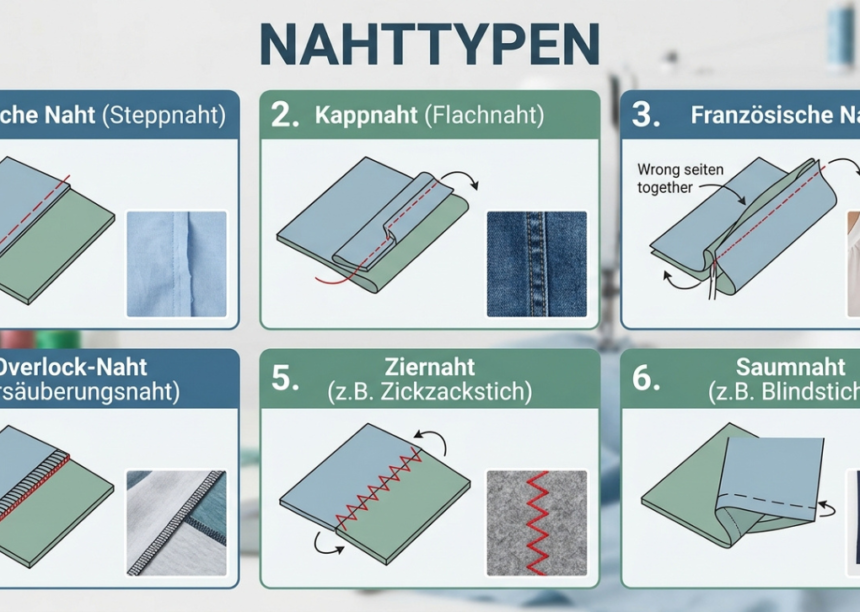
1. Plain Seam
The plain seam is the most common of all seam types used in garment construction.
Two pieces of fabric are normally placed right sides together and stitched along the designated seam line. After sewing, the seam allowances may be pressed open or pressed to one side.
Plain seams work particularly well with woven fabrics such as:
- Cotton poplin
- Linen
- Wool
- Twill
- Polyester blends
- Lightweight denim
The raw edges usually need additional finishing if the fabric frays easily. Common options include overlocking, zigzag stitching, pinking, binding, or serging.
Plain seams are widely used for dresses, shirts, skirts, trousers, jackets, pillowcases, and many other projects.
Their biggest advantage is simplicity.
They are fast, versatile, easy to alter, and suitable for a wide range of fabrics.
2. French Seam
A French seam completely encloses the raw edges of the fabric inside the seam construction.
Unlike a standard seam, the first line of stitching is typically sewn with the wrong sides of the fabric facing each other. The seam allowance is then trimmed, the fabric is turned so the right sides face each other, and a second seam encloses the first.
The result is extremely clean.
French seams are especially useful for:
- Chiffon
- Organza
- Voile
- Lightweight cotton
- Sheer fabrics
- Delicate blouse fabrics
Because no raw edges remain visible, French seams are ideal for garments without lining.
They are less suitable for thick or bulky fabrics. Enclosing several heavy layers can create unnecessary thickness and make pressing difficult.
Among decorative and functional seam types, the French seam is one of the best choices when the inside of a garment needs to look almost as polished as the outside.
3. Flat-Felled Seam
The flat-felled seam is strong, durable, and visually clean.
The seam allowances are folded and enclosed so that raw edges are hidden. Additional topstitching secures the construction and creates the distinctive appearance associated with jeans and workwear.
Flat-felled seams are commonly used in:
- Jeans
- Denim jackets
- Casual shirts
- Workwear
- Children’s clothing
- Outdoor garments
One reason they perform well is that the load is distributed across multiple layers and stitch lines.
They also create a smooth interior surface with few exposed edges.
However, flat-felled seams require more precision than basic plain seams. Accurate trimming, folding, pressing, and topstitching are essential.
When sewing thick denim, the number of fabric layers must also be considered because bulky intersections can become difficult for domestic sewing machines.
4. Overlock Seam
An overlock seam can join fabric layers, trim the fabric edge, and finish the raw edge in a single operation.
That efficiency explains why overlock machines are so widely used in commercial garment manufacturing.
Overlock seams are particularly useful for:
- Jersey
- Knit fabrics
- Sportswear
- T-shirts
- Stretch garments
- Casual clothing
Many overlock stitches contain enough thread to accommodate fabric movement without breaking immediately under stretch.
However, settings matter.
Thread tension, differential feed, stitch width, cutting width, and presser-foot pressure can all affect the result.
It is also worth noting that “overlock” technically refers to a category of stitch formation and machine operation rather than one universal seam construction. In everyday sewing terminology, however, the phrase overlock seam is commonly used to describe seams created with an overlocker or serger.
5. Flat Seam
Flat seam constructions are designed to minimize bulk.
Instead of creating a raised ridge where several fabric layers meet, the goal is to produce a connection that sits as flat as possible against the body.
This makes flat seam constructions especially useful for:
- Activewear
- Base layers
- Sportswear
- Underwear
- Compression garments
- Performance clothing
Reduced bulk can improve comfort, especially in garments that fit tightly against the skin.
Flat seams may also reduce rubbing and chafing during repeated movement.
Be aware that the terms flat seam, flatlock seam, and decorative overlock flatlocking are sometimes used inconsistently. Industrial flatlock constructions may differ significantly from decorative techniques performed on domestic overlock machines.
6. Bound Seam
A bound seam or bound edge uses an additional strip of fabric or tape to cover the raw edge.
Bias tape is one of the most common materials used for this purpose.
Bound constructions are often found in:
- Unlined jackets
- Bags
- Quilts
- Necklines
- Armholes
- Decorative interior finishes
Binding can be both functional and decorative.
Because bias-cut fabric has greater flexibility than fabric cut along the straight grain, bias tape can follow curves more easily. This makes it particularly useful around necklines and rounded edges.
Among visible seam types, bound constructions can produce some of the cleanest and most attractive interior finishes.
7. Lapped Seam
A lapped seam is created when one fabric section overlaps another rather than being joined edge to edge.
The overlapping area is then secured with one or more rows of stitching.
This construction is useful for:
- Heavy fabrics
- Technical textiles
- Leather alternatives
- Decorative panels
- Outdoor products
- Structural textile applications
The amount of overlap is important because it affects the strength of the finished connection.
A narrow overlap may not provide enough support under tension, while an excessively wide overlap can create unnecessary stiffness or bulk.
8. Edge and Hem Constructions
Not all sewing constructions join two separate pieces of fabric.
Many seam-like structures are used to finish the edge of a single fabric component.
Examples include:
- Double-fold hems
- Narrow hems
- Blind hems
- Rolled hems
- Coverstitched hems
- Bound edges
The correct technique depends heavily on fabric weight and garment function.
A lightweight chiffon blouse may need a tiny rolled hem, while denim trousers require a much stronger hem capable of holding several thick fabric layers.
Seam Types According to ISO 4916
For professional manufacturing, informal names such as “plain seam” or “flat-felled seam” are not always precise enough.
That is why technical sewing uses standardized classification systems.
ISO 4916 classifies sewn seams according to the arrangement and minimum number of material components involved.
The system divides seams into several major classes, including constructions based on:
- Superimposed fabric layers
- Lapped fabric layers
- Bound edges
- Flat or abutted components
- Ornamental stitching
- Edge finishing
- Attachment of separate components
- Single-piece fabric constructions
This classification is particularly useful in industrial manufacturing because it allows designers, factories, technicians, and quality-control teams to communicate more precisely.
Two factories may use different everyday terminology for the same construction. A standardized seam code helps remove that ambiguity.
How to Choose the Right Seam Type for Different Fabrics
Fabric characteristics should always influence seam selection.
The same seam can behave completely differently depending on whether the material is lightweight, heavy, stretchy, loosely woven, or highly structured.
Lightweight Woven Fabrics
For chiffon, voile, organza, fine cotton, and other lightweight woven fabrics, consider:
- French seams
- Narrow plain seams
- Fine edge finishes
- Rolled hems
Thin needles, lightweight thread, and controlled thread tension can help reduce puckering.
Excessive stitching density should also be avoided because too many needle penetrations can weaken delicate fabric.
Medium-Weight Woven Fabrics
For fabrics such as poplin, linen, lightweight twill, and many dressmaking fabrics, a plain seam is often the most practical solution.
The raw edges can then be finished using:
- Overlocking
- Zigzag stitching
- Binding
- Pinking
- Turned-and-stitched finishes
This combination offers a good balance between strength, speed, and ease of alteration.
Denim and Heavy Fabrics
Heavy fabrics usually benefit from simpler, stronger seam constructions.
Good options may include:
- Flat-felled seams
- Reinforced plain seams
- Double topstitching
- Overlocked seam allowances
Avoid unnecessarily complicated enclosed seams when they create excessive bulk.
Heavy intersections, such as waistband corners and jean hems, may require slower stitching, appropriate needle sizes, and careful presser-foot positioning.
Jersey and Knit Fabrics
Knit fabrics behave differently from woven materials because they stretch and recover.
Rigid stitching can break when the garment is pulled over the body.
Suitable solutions may include:
- Overlock seams
- Narrow zigzag stitches
- Stretch stitches
- Certain chain-stitch constructions
Needle selection also matters.
Ballpoint or stretch needles are often preferable because they are designed to interact more gently with knitted structures than sharp universal needles in many applications.
How to Select the Correct Seam Type in 5 Steps
Choosing the best construction becomes much easier when you follow a systematic process.
- 1. Analyze the fabric. Determine whether it is woven or knitted, heavy or lightweight, stretchy, slippery, fraying, coated, or delicate.
- 2. Evaluate the stress. Ask whether the seam must withstand movement, tension, repeated washing, abrasion, or body weight.
- 3. Consider the inside finish. Will the seam be visible? Will it touch the skin? Will the garment be lined?
- 4. Check your equipment. Not every seam effect can be reproduced equally well with every domestic sewing machine.
- 5. Sew a test sample. Test the actual fabric using the intended thread, needle, tension, stitch length, and seam allowance.
The test sample is one of the most valuable sewing habits you can develop.
A five-minute test can prevent an hour of unpicking.
Why Seam Quality Depends on More Than Seam Types
Choosing the correct construction is only one part of producing a good seam.
Seam performance depends on an entire system of interacting variables.
Important factors include:
Needle type: The needle must suit the fabric structure and thickness.
Thread: Thread size, fiber type, elasticity, and strength should be compatible with the material.
Thread tension: Excessive tension can cause puckering, thread breakage, or distortion.
Stitch length: Very short stitches can weaken delicate fabrics by perforating them too densely.
Fabric feed: Uneven feeding can cause one layer to stretch or gather relative to another.
Presser-foot pressure: Excessive pressure may distort soft or elastic fabrics.
A technically correct seam construction can still look poor if any of these variables are wrong.
That is why professional troubleshooting focuses on the complete sewing system rather than replacing the seam immediately.
Common Seam Problems and How to Fix Them
Even experienced sewists encounter problems.
The key is knowing what to inspect first.
The Seam Breaks When the Fabric Stretches
The stitch may not have enough elasticity.
Try a stretch stitch, narrow zigzag, or suitable overlock construction. Also check whether the thread and needle are appropriate for the fabric.
The Fabric Puckers Along the Seam
Puckering may be caused by:
- Excessive thread tension
- Incorrect needle size
- Very short stitches
- Feeding problems
- Thread that is too heavy
- Unstable lightweight fabric
Always test one adjustment at a time so you can identify the actual cause.
The Seam Becomes Too Bulky
This usually happens when too many layers are folded into the construction.
A French seam, for example, can look beautiful in chiffon but become thick and uncomfortable in heavyweight fabric.
Choose the least bulky construction that still provides the required durability.
Raw Edges Continue to Fray
A structural seam does not automatically finish the edge.
If the fabric frays easily, add an appropriate edge treatment such as:
- Overlocking
- Zigzag stitching
- Binding
- Enclosed seam construction
The Seam Twists After Washing
The seam itself may not be the only problem.
Possible causes include:
- Incorrect grain alignment
- Fabric distortion during cutting
- Uneven stretching during sewing
- Different shrinkage rates
- Poor prewashing or fabric preparation
Always examine the fabric structure before blaming the seam construction.
Seam Allowance: A Critical Part of Good Seam Construction
A seam allowance is the distance between the fabric edge and the actual stitching line.
It provides the fabric needed to form a secure connection.
Different seam types require different seam allowances.
A basic plain seam may need a standard allowance specified by the sewing pattern. A flat-felled seam may require trimming or unequal allowances. A French seam needs enough material to complete both stitching stages without exposing the raw edge.
Never assume that one seam allowance works for every technique.
Check the construction method before cutting the fabric.
Once the fabric has been trimmed too narrowly, it may be impossible to create the intended seam correctly.
Understanding Seam Strength, Stretch, and Comfort
The strongest seam is not automatically the best seam.
Garment performance depends on more than maximum tensile strength.
Three important characteristics should be considered together:
Seam strength: Can the construction withstand the forces placed on it?
Elasticity: Can it move with the fabric without breaking?
Material compatibility: Does the seam damage, distort, or overpower the fabric?
Comfort also matters.
A thick, rigid seam may be strong but uncomfortable in sportswear or underwear. A beautifully narrow seam may look elegant but fail under heavy stress.
The correct choice is always a balance between function, appearance, and fabric behavior.
Which Seam Types Should Beginners Learn First?
Beginners do not need to memorize every industrial seam classification.
A small group of techniques covers a very large percentage of everyday sewing projects.
Start by mastering:
- The plain seam
- Basic edge finishing
- The French seam
- The flat-felled seam
- A stretch or jersey seam
These techniques introduce the most important concepts in garment construction: seam allowance, pressing, enclosed edges, topstitching, elasticity, and fabric control.
Once those skills feel natural, more specialized constructions become much easier to understand.
FAQ About Seam Types
What are the main seam types used in sewing?
The most common seam types include plain seams, French seams, flat-felled seams, overlock seams, flat seams, lapped seams, bound seams, and various hem or edge constructions.
Professional textile manufacturing also uses standardized seam classifications such as ISO 4916 to describe constructions more precisely.
What is the difference between a seam and a stitch?
A seam describes how fabric pieces or edges are physically arranged and joined.
A stitch describes the thread formation used to create that connection.
For example, a plain seam is a seam construction, while a lockstitch is a stitch type.
The same general seam can sometimes be produced using different stitch formations depending on the fabric, machine, and desired performance.
Which seam is best for jersey fabric?
Jersey usually requires a construction that can stretch with the fabric.
Overlock seams, narrow zigzag stitches, and specialized stretch stitches are common choices.
Needle selection is equally important. Ballpoint or stretch needles are often used Nahttypen because they are better suited to knitted structures than sharp needles in many jersey applications.
Which seam is best for chiffon?
A French seam is one of the best options for chiffon because it encloses the raw fabric edges and creates a clean interior finish.
Use a fine needle, lightweight thread, and carefully adjusted tension.
Always test the setup on a fabric scrap because chiffon can react strongly to changes in tension and stitch density.
Which seam type is the strongest?
There is no single strongest seam for every application.
Flat-felled seams are highly durable and commonly used in jeans, workwear, and shirts. Reinforced plain seams can also perform extremely well.
Actual strength depends on several factors, including the fabric, thread, stitch type, stitch density, needle, seam allowance, and direction of stress.
Final Thoughts: Choose Seam Types Based on Function, Not Habit
Good sewing is not about using the same technique for every project.
The correct seam should match the fabric, garment function, expected stress, desired appearance, and sewing equipment.
Before starting your final garment, make a small test sample using the actual fabric. Adjust the stitch, needle, thread, tension, seam allowance, and finishing method until the result behaves correctly.
That simple habit can dramatically improve the quality of your work.
When you understand seam types as part of a complete sewing system rather than as isolated techniques, you gain far more control over strength, appearance, comfort, and durability.
Choose deliberately. Test before committing. And let the fabric determine the construction.