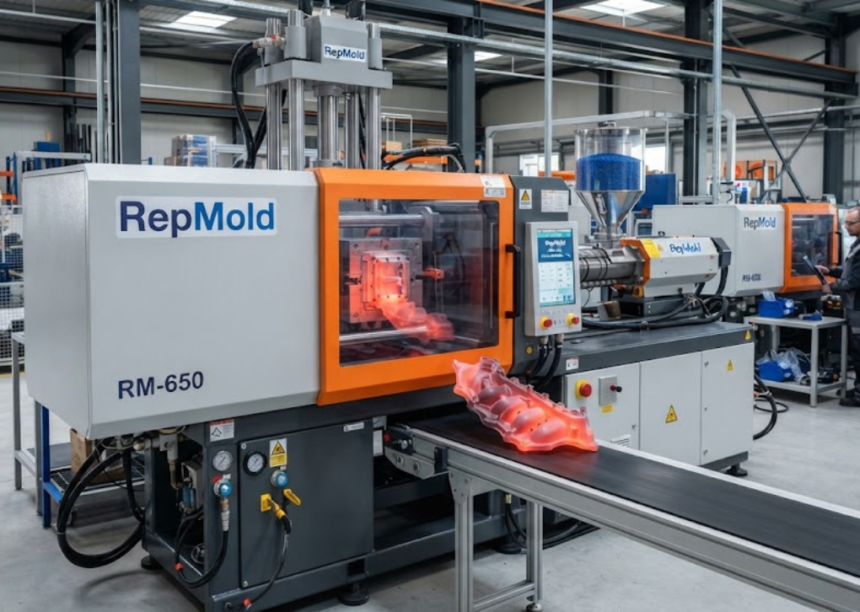
RepMold is attracting attention in manufacturing-related searches, but there is an important detail many explanations miss: the term does not currently have one universally accepted technical definition. Online, it is commonly associated with digital mold replication, rapid tooling, reverse engineering, 3D scanning, CAD modeling, additive manufacturing, and CNC machining.
That distinction matters. RepMold should not automatically be treated as a single standardized machine, material, or manufacturing process. A more useful way to understand it is as an emerging label for a digital-first approach to creating, reproducing, modifying, repairing, or validating molds and tooling.
The underlying technologies are very real. The U.S. National Institute of Standards and Technology (NIST), for example, identifies additive manufacturing applications that include molds, mold inserts, patterns, automotive components, medical products, jigs, and fixtures.
So, rather than getting caught up in the name, manufacturers should focus on the workflow behind it.
What Is RepMold?
In practical manufacturing terms, RepMold can be understood as a digitally supported mold-development and replication workflow. A project might begin with an existing physical component, an old mold, a CAD model, or even a part for which the original engineering drawings no longer exist.
The physical geometry can be captured through 3D scanning or dimensional measurement, converted into digital geometry, reconstructed or refined in CAD, validated, and then manufactured using an appropriate production method. Depending on the job, fabrication could involve CNC machining, additive manufacturing, casting, or a hybrid approach.
This interpretation fits established reverse-engineering practices. Autodesk describes modern hardware reverse engineering as a process that can begin with 3D scanning, move through point-cloud and mesh processing, continue into CAD reconstruction, and finish with validation and physical prototyping.
The important point is that the technologies should be named precisely. Calling a workflow RepMold does not turn it into a new standardized manufacturing category.
Is RepMold an Official Manufacturing Technology?
At present, available evidence does not establish RepMold as a universally standardized manufacturing technology comparable with injection molding, compression molding, CNC machining, casting, or additive manufacturing.
This is one of the biggest areas of confusion around the keyword.
Some online sources describe it as an advanced mold-making technology, while others use it more broadly for digital replication, mold restoration, rapid tooling, and prototyping. Other pages make even broader claims involving automation and artificial intelligence.
That inconsistency is itself useful information.
If a supplier advertises a RepMold service, ask what the service actually includes. Is the company performing 3D scanning? Is it reconstructing CAD data? Is the mold CNC-machined, printed, cast, or produced using multiple techniques?
Those answers matter more than the label.
How Does the RepMold Process Work?
Because there is no single standardized RepMold specification, the exact workflow can vary. A digital mold replication project, however, generally follows a logical engineering sequence.
1. Start With a Physical Part or Digital Design
Every project needs reliable source geometry.
That might be:
- an existing production component;
- a worn or damaged mold;
- an original master pattern;
- engineering drawings;
- an STL or mesh file;
- or an existing CAD model.
Starting with native CAD data is usually simpler. When CAD data is missing, reverse engineering becomes much more important.
2. Capture the Geometry
A physical object can be measured using tools such as 3D scanners, coordinate measuring machines (CMMs), calipers, or other metrology equipment.
A 3D scan normally produces a point cloud or mesh representing the object’s surface. This is valuable for complex contours that would be difficult to reconstruct using only manual measurements.
But scan data should not automatically be confused with production-ready CAD.
Autodesk notes that scan-to-CAD work can require cleaning the point cloud or mesh and rebuilding geometry into editable parametric features.
3. Clean and Reconstruct the CAD Model
Raw scan data often contains noise, gaps, excessive polygons, or artifacts. Engineers may therefore clean the mesh before using it as reference geometry for CAD reconstruction.
This is where engineering judgment becomes critical.
A worn hole, for example, should not necessarily be copied exactly. If its original diameter was 10 mm but years of wear have enlarged it, faithfully duplicating the scan would reproduce the defect.
A good digital replication workflow tries to recover design intent, not merely surface shape.
4. Design the Mold or Tooling
Once the component geometry is usable, engineers can develop the tooling around it.
Depending on the manufacturing process, that may involve determining:
- mold cavities;
- parting lines;
- draft angles;
- shrinkage allowances;
- gates and runners;
- vents;
- ejector locations;
- wall thickness;
- cooling features;
- inserts;
- and machining allowances.
This stage separates serious tooling engineering from simply making a digital copy.
5. Validate Before Manufacturing
The digital model should be checked before expensive tooling is produced.
Validation may include dimensional comparison, interference checks, tolerance analysis, mold-flow considerations, thermal analysis, structural simulation, or prototype testing.
For reverse-engineered parts, comparing the reconstructed CAD geometry against the original scan can help identify discrepancies before manufacturing begins. Autodesk includes this review and iteration stage in its description of modern reverse-engineering workflows.
6. Manufacture the Mold
The final production method depends on the application’s requirements.
CNC machining remains important when high dimensional accuracy, durable metal tooling, tight tolerances, and longer production runs are required.
Additive manufacturing can be particularly valuable for prototypes, patterns, inserts, complex internal geometries, and applications where conventional machining would require many separate operations.
NIST specifically notes that additive manufacturing is used for molds, mold inserts, and patterns, including tooling associated with sand casting and injection molding.
7. Produce and Inspect Trial Parts
The first molded component should not automatically be treated as production-approved.
Trial parts need inspection against the engineering requirements. Dimensions, surface quality, warpage, filling behavior, shrinkage, defects, and functional fit may all need to be checked.
If something is wrong, the digital workflow provides a major advantage: engineers can return to the model, identify the cause, modify the tooling, and document the revision.
Technologies Commonly Associated With RepMold
The strongest way to understand RepMold is to look at the established technologies that can sit behind the term.
3D Scanning
3D scanning captures the surface geometry of physical components and converts that information into digital data.
It can be particularly useful when:
- original CAD files are unavailable;
- tooling is old or undocumented;
- freeform surfaces are difficult to measure;
- an existing component needs to be reproduced;
- or wear needs to be compared against nominal geometry.
Scanning is powerful, but accuracy still depends on the scanner, setup, surface characteristics, calibration, data processing, and required tolerance.
CAD Modeling
Computer-aided design (CAD) turns captured or newly created geometry into an engineering model that can be inspected and modified.
This is where designers can restore nominal dimensions, add draft, change features, account for manufacturing requirements, or improve an existing design.
Additive Manufacturing
Additive manufacturing builds parts layer by layer from digital data.
For tooling applications, its value goes beyond simply printing prototypes. NIST identifies molds, mold inserts, patterns, fixtures, and other manufacturing aids among practical additive-manufacturing applications.
Additive processes can also enable internal geometries that are difficult to produce conventionally. In mold making, one notable example is conformal cooling, where cooling channels follow the shape of the molded component rather than relying entirely on straight drilled passages.
CNC Machining
CNC machining removes material using computer-controlled cutting operations.
For RepMold-style workflows, it can be used to manufacture cavities, cores, inserts, mold bases, electrodes, and other precision tooling components.
Additive manufacturing and CNC should not always be viewed as competitors. A hybrid workflow may print a near-net-shape component and then machine critical surfaces to achieve the required finish and dimensional accuracy.
Digital Inspection
Inspection closes the loop between the virtual model and the physical tool.
A scanner or metrology system can compare manufactured geometry against CAD data. Instead of relying solely on visual inspection, engineers can identify deviations numerically and decide whether they are acceptable.
RepMold and Reverse Engineering
Reverse engineering is one of the clearest real-world applications associated with the RepMold concept.
Imagine a manufacturer has a 20-year-old component but no original CAD file. Production equipment still depends on that component, and replacement stock is disappearing.
A digital workflow could:
- scan the surviving component;
- create a point cloud or mesh;
- reconstruct an editable CAD model;
- restore worn dimensions;
- validate the new geometry;
- manufacture replacement tooling;
- produce a trial component;
- inspect the component against the intended dimensions.
This is much more than simply copying an object.
The objective is to convert physical geometry into usable engineering information.
RepMold vs. Traditional Mold Making
Traditional tooling and digital mold workflows overlap significantly. The difference is often found in how information is captured, modified, transferred, and manufactured.
A conventional workflow may rely heavily on existing drawings, established machining processes, manual measurements, and dedicated hard tooling.
A RepMold-style approach emphasizes a digital thread: physical geometry becomes scan data, scan data informs CAD, CAD drives manufacturing, and inspection data feeds back into the model.
That can make engineering changes easier to track and reproduce.
However, digital does not automatically mean better.
For extremely high-volume manufacturing, hardened conventional tooling may still offer the durability, repeatability, surface finish, and economics required. The right process depends on production volume, geometry, material, tolerances, lead time, and total tooling cost.
Key Benefits of a RepMold-Style Workflow
The potential benefits come primarily from the underlying digital technologies rather than from the RepMold name itself.
Faster design iteration is one major advantage. Engineers can modify a CAD model and evaluate another version without rebuilding every stage manually.
Legacy-part recovery is another. Reverse engineering can help manufacturers reconstruct components when original engineering information is incomplete or unavailable.
Other potential benefits include:
- shorter tooling-development cycles;
- easier design modifications;
- digital storage of tooling geometry;
- improved traceability between revisions;
- production of complex mold features;
- reduced material waste in suitable additive processes;
- faster prototype development;
- more economical low-volume tooling in appropriate cases;
- and easier reproduction of obsolete components.
NIST also notes that additive manufacturing can reduce process steps and material waste in some mold, insert, and pattern applications.
Where Can RepMold Be Used?
A digital mold replication workflow can potentially support many industries, but the exact manufacturing process must match the application’s technical and regulatory requirements.
Automotive Manufacturing
Automotive applications can include replacement parts, prototype components, fixtures, patterns, tooling, and low-volume components.
Digital workflows are particularly interesting for older vehicles where original tooling or spare parts may no longer be readily available. NIST lists automotive spare parts, including applications involving rare or classic cars, among additive-manufacturing use cases.
Aerospace
Aerospace manufacturing demands tight process control, material traceability, validation, and quality assurance.
Digital tooling and additive manufacturing can support aerospace production, but safety-critical components require far more than geometric similarity. Materials, process qualification, inspection, documentation, and applicable certification requirements remain essential.
Medical and Dental Applications
Additive manufacturing is already used for customized medical and dental applications. NIST lists customized prosthetics, surgical components, and dental appliances among established use cases.
A RepMold-style workflow could therefore support certain tooling or product-development activities, but medical-device requirements must be evaluated separately from ordinary industrial tooling.
Consumer Products
Consumer-product teams often need to evaluate shape, ergonomics, fit, packaging, texture, and manufacturability before committing to high-volume tooling.
Rapid tooling and digitally controlled iteration can make that development process more flexible.
Replacement and Legacy Parts
This may be one of the most practical applications.
When drawings have disappeared but a physical example survives, scanning and reverse engineering can provide a route back to manufacturable geometry.
Limitations You Should Understand
RepMold should not be marketed as a magic replacement for conventional manufacturing.
First, scan accuracy has limits. A digital model cannot automatically recover dimensions that are hidden, damaged, distorted, or already worn away.
Second, printed tooling has material limitations. Heat resistance, pressure resistance, fatigue life, chemical compatibility, surface finish, and dimensional stability must all match the production environment.
Third, complex scan data may require substantial engineering work before it becomes usable CAD. Autodesk specifically notes that accurate editable models can require manual or semi-manual reconstruction rather than automatic conversion.
Finally, intellectual-property considerations should not be ignored. Reverse engineering has legitimate uses, but reproducing patented, copyrighted, contract-protected, or proprietary designs can create legal issues depending on the jurisdiction and circumstances.
How to Evaluate a RepMold Provider
Do not select a provider simply because its website promises faster mold production.
Ask technical questions.
- What scanning or measurement system will be used?
- What dimensional accuracy can actually be achieved?
- How will scan data be converted into editable CAD?
- How are worn surfaces reconstructed?
- Which mold material will be used?
- Will the tool be printed, machined, cast, or produced using a hybrid process?
- What tolerances can the finished tooling maintain?
- How many cycles is the mold expected to survive?
- How will trial parts be inspected?
- What quality documentation will be supplied?
A capable supplier should be able to answer these questions with measurable specifications rather than vague claims about “advanced technology.”
The Future of Digital Mold Replication
The technologies surrounding RepMold are evolving quickly.
One major development is better scan-to-CAD automation. In August 2026, Autodesk described an AI-assisted Fusion add-in designed to convert scanned or mesh geometry into editable parametric models, illustrating how software is trying to reduce one of reverse engineering’s more labor-intensive stages.
Another area is advanced mold cooling.
Additive manufacturing allows cooling channels to follow complex mold geometry. ASME has documented conformal mold approaches designed to remove heat more efficiently than conventional straight-drilled cooling channels.
The larger trend is clear: mold development is becoming more connected to scanning, simulation, CAD/CAM, additive manufacturing, automated inspection, and data-driven production.
Whether the industry ultimately adopts the RepMold label broadly is less important than that technological shift.
Frequently Asked Questions About RepMold
What is RepMold in simple terms?
RepMold is an emerging, loosely defined term associated with digital mold creation, replication, modification, and repair. It is commonly linked with established technologies such as 3D scanning, CAD, reverse engineering, CNC machining, rapid tooling, and additive manufacturing.
Is RepMold a real manufacturing technology?
The manufacturing techniques associated with the concept are real, but RepMold itself does not currently have the same standardized technical definition as established processes such as injection molding or additive manufacturing. For that reason, it is better to examine the specific technologies a supplier means when using the term.
How does RepMold differ from injection molding?
Injection molding is a specific manufacturing process in which material is injected into a mold cavity and allowed to solidify. RepMold is used more loosely to describe digitally supported workflows for developing, copying, repairing, or modifying molds. A mold produced through such a workflow could ultimately be used for injection molding.
Can RepMold reduce manufacturing costs?
It potentially can in the right application. Digital design, rapid tooling, additive manufacturing, and reverse engineering may reduce tooling-development time, process steps, or material consumption, particularly for prototypes, replacement parts, tooling inserts, and lower-volume work. NIST notes potential cost and process-step savings from additive manufacturing in mold and tooling applications.
The economics still depend on tool material, size, tolerances, production volume, post-processing, inspection requirements, and expected tool life.
Is RepMold suitable for mass production?
It depends on what manufacturing method the term describes in a particular project. Digitally developed molds can certainly contribute to production tooling, but prototype or additively manufactured tools may not always provide the durability required for very high production volumes.
For mass production, engineers should compare tool life, cycle time, dimensional stability, maintenance requirements, material performance, and cost per part before selecting a tooling strategy.
Final Takeaway
RepMold is best approached as a digital mold-making and replication concept rather than a single universally defined manufacturing technology. Its real value comes from the established engineering processes behind it: 3D scanning, reverse engineering, CAD modeling, simulation, additive manufacturing, CNC machining, rapid tooling, and dimensional inspection.
For manufacturers, the next step is practical. Define the component, tolerance, material, expected production volume, tool life, and required lead time first. Then determine which combination of scanning, CAD, additive manufacturing, machining, and conventional tooling delivers the strongest technical and economic result.
Don’t buy a buzzword. Evaluate the engineering workflow behind it.