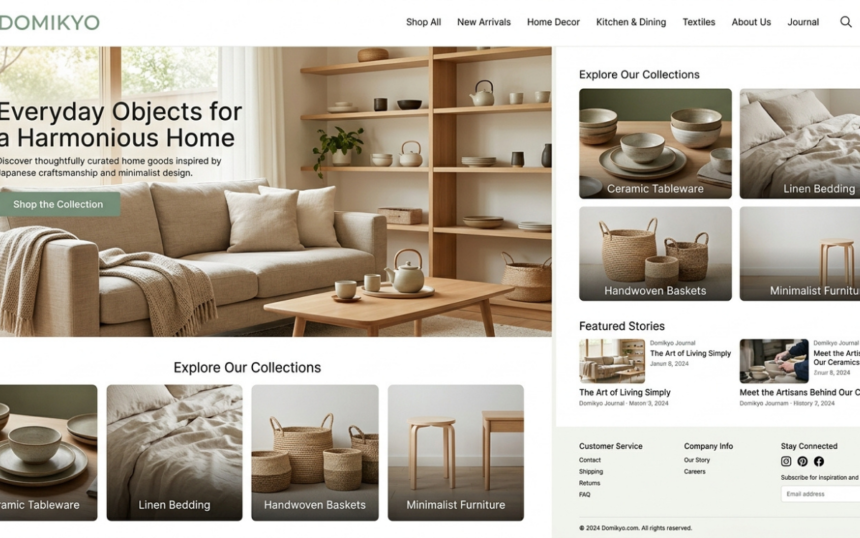
If you searched for Domikyo.com, you may have noticed something odd: the web cannot seem to agree on what the site actually is. Some recent pages describe it as a smart-home and Internet of Things resource. Another calls it an international real-estate marketplace. Other references portray it as a broad digital publication covering technology, business, finance, health, lifestyle, education, travel, and general trends.
That inconsistency matters. Instead of repeating the most confident description, this guide separates verifiable signals from unsupported claims so you can understand the domain, evaluate its content, and decide how much trust to place in any page you find there.
What Is Domikyo.com?
The strongest current evidence points to Domikyo.com as a general-purpose content website rather than a single-purpose smart-home product, real-estate marketplace, or software platform. A Crunchbase profile describes the domain as an information destination spanning technology, business, finance, health, lifestyle, education, travel, and digital trends. A publisher marketplace also categorizes the site under finance, health, and technology.
That broader description fits the available commercial and technical footprint better than the narrower claims found in several competing articles. It also explains why readers may encounter the name in very different topical contexts.
One caveat is important. At the time of this research on August 28, 2026, the live homepage returned a 403 response to automated retrieval. That does not mean the website is unsafe or offline; sites commonly restrict bots through firewalls, security plugins, or Cloudflare rules. It simply means the current homepage could not be independently inspected through the research crawler.
Why Are There So Many Conflicting Descriptions of Domikyo.com?
Search results around the domain are a textbook example of why web research should not rely on repetition alone. Multiple 2026 articles describe the domain as a resource for smart homes, Wi-Fi, IoT security, Matter, Thread, mesh networking, and connected devices. One competitor even frames it as a hub for international property listings, developer reviews, residency programs, and real-estate transactions.
Those descriptions cannot all be equally accurate.
The more plausible explanation is that some publishers are building keyword-targeted “what is” pages around the domain and filling informational gaps with inferred or unverified positioning. A recent analysis from The Blogs Magazine explicitly argues that the site is a multi-topic WordPress publication rather than the specialized smart-home platform described elsewhere.
The Smart-Home Narrative Around Domikyo.com
Several high-ranking articles associate the site with home networking and connected living. They discuss routers, smart locks, voice assistants, IoT devices, network segmentation, Matter compatibility, and Thread-based devices.
The problem is evidentiary. Much of this material explains smart-home concepts in general, but it does not demonstrate that the domain itself is dedicated to those subjects. When several pages repeat the same positioning without pointing to specific first-party sections, author biographies, editorial policies, or archived evidence, repetition becomes a weak substitute for proof.
That distinction is easy to miss. A competitor can write 2,500 words about IoT, smart lighting, Alexa, HomeKit, Wi-Fi 7, or Matter and still provide very little evidence about the website named in its headline.
The Real-Estate Narrative
One July 2026 article goes in a completely different direction, presenting the domain as an international property marketplace serving Georgia, Turkey, Cyprus, the UAE, and other investment destinations. It attributes features such as developer profiles, client ratings, property filters, legal support, floor plans, and transaction assistance to the site.
That claim deserves caution because it conflicts sharply with broader company descriptions and with the smart-home narrative. Before relying on any property-related claim, users should look for live listings, identifiable agencies, company registration information, terms of service, and jurisdiction-specific legal disclosures on the first-party domain itself.
This is a critical lesson for anyone researching unfamiliar websites: specificity does not equal accuracy. An article can sound remarkably detailed while still lacking primary evidence.
What Topics Does Domikyo.com Appear to Cover?
Based on the broader third-party company description, the site appears to operate as a multi-category publishing property. The reported subject areas include:
- Technology and digital trends, including software, online tools, innovation, cybersecurity, artificial intelligence, and emerging technology.
- Business and finance, potentially covering entrepreneurship, markets, money topics, professional growth, and commercial guidance.
- Health and lifestyle, where accuracy and sourcing become especially important because poor information can affect real-world decisions.
- Education and travel, ranging from general explainers to learning resources, destination content, and practical guides.
- General informational articles, reflecting the wide-topic model used by many digital magazines and contributor-driven websites.
This breadth is not automatically a quality problem. Major media organizations successfully publish across dozens of verticals.
The real issue is article-level expertise. A publication covering finance, health, software, travel, and consumer products needs appropriate sourcing and subject knowledge for each topic rather than relying on the authority of the domain as a whole.
Is Domikyo.com a Guest-Post or Advertorial Website?
There is meaningful evidence of commercial publishing activity connected with the domain, but the wording needs to remain precise. Adoovy, a third-party publisher marketplace, currently lists the domain as a destination where buyers can purchase an advertorial. The listing advertises permanent publication, dofollow links, relatively rapid turnaround, and a stated price of $120 at the time it was crawled.
That does not prove every article on the site is sponsored. It also does not prove that the website owner personally created or approved the marketplace listing.
It does, however, create an important trust consideration. Readers should check whether individual pages disclose sponsorship, paid placement, affiliate relationships, contributor status, or commercial partnerships.
For SEO professionals, the distinction is equally important. A link sold primarily to manipulate search rankings can create search-policy risk depending on how the placement is structured, tagged, and disclosed.
For normal readers, the question is simpler: Is this page informing me, selling to me, or doing both?
Commercial content can still be genuinely useful. It just should not masquerade as independent editorial analysis.
Technical Trust Signals: What Can Be Verified?
The domain has an active technical footprint. DNS records show Cloudflare nameservers and Cloudflare-routed IP addresses, along with mail-routing records and a Google site-verification TXT record. These are ordinary signs of an actively configured web property.
But technical legitimacy and editorial trust are separate questions.
A domain can use Cloudflare, HTTPS, authenticated email, Google verification, and professional hosting while publishing low-quality information. Conversely, a small legitimate website can have a relatively basic technical stack.
Infrastructure proves infrastructure. It does not independently validate a medical claim, financial recommendation, product review, legal explanation, or investment opportunity.
What the 403 Response Does—and Does Not—Mean
Because the domain blocked automated homepage retrieval during this research, some first-party elements could not be inspected directly. A 403 Forbidden response frequently reflects anti-bot protection, firewall settings, security rules, rate limiting, or access-control policies. It is not proof of malware, fraud, or a scam.
The correct takeaway is narrower.
When direct inspection is unavailable, researchers should not pretend they verified a current homepage, navigation menu, author directory, ownership page, editorial policy, or category taxonomy that they could not actually access.
That transparency is part of trustworthy content too.
Is Domikyo.com Safe to Visit?
There is not enough evidence to label the entire domain simply “safe” or “unsafe.” A more useful assessment separates technical security, content reliability, privacy risk, and transaction risk.
For ordinary browsing, use the safeguards you would apply to any unfamiliar information website:
- Keep your browser, operating system, and security software updated.
- Avoid unexpected executable downloads or browser-extension installation prompts.
- Check the destination URL before opening unfamiliar outbound links.
- Do not provide passwords, payment details, identity documents, or sensitive financial information without understanding exactly why they are needed.
- Verify high-stakes information—particularly health, finance, law, cybersecurity, investments, and property transactions—through primary or authoritative sources.
If a page on the site recommends a product, service, investment, treatment, software download, or financial decision, look beyond polished writing.
Ask who wrote it. Check the evidence. Look for conflicts of interest. Determine whether a commercial relationship is disclosed.
Those checks matter more than whether the article has an attractive design or appears near the top of Google.
How to Evaluate Domikyo.com Using E-E-A-T Principles
Google’s E-E-A-T concept—Experience, Expertise, Authoritativeness, and Trust—is useful for readers as well as content teams. The central question is straightforward:
Why should this particular page be trusted for this particular subject?
Experience
Look for evidence of first-hand involvement.
A credible product review may include original photographs, benchmarks, screenshots, testing methodology, drawbacks, comparisons, and a description of how the reviewer actually used the product.
A travel article should ideally include destination-specific observations rather than generic descriptions available on hundreds of tourism sites.
First-hand experience adds information that cannot be reproduced simply by paraphrasing competing pages.
Expertise
Expertise should match the topic.
A cybersecurity article should demonstrate technically correct understanding of authentication, encryption, vulnerabilities, network architecture, and threat models. A financial article needs credible sourcing and responsible treatment of risk.
Health content requires an even higher standard. Medical claims should be supported by recognized clinical or institutional sources rather than anonymous opinions.
Breadth of publication does not eliminate the need for niche expertise.
Authoritativeness
Authority develops through consistent quality, credible citations, transparent ownership, recognized expertise, and references from reputable external sources.
Metrics such as Domain Authority, Domain Rating, backlink counts, or traffic estimates should not be mistaken for editorial authority. Those are SEO measurements, not certificates of factual accuracy.
The same logic applies to company-directory profiles. A Crunchbase page may provide useful organizational context, but its existence alone does not establish expertise in every category a publication covers.
Trust
Trust is the most important layer.
When assessing the publication, look for:
- Named authors and meaningful biographies.
- Publication and update dates.
- Primary-source links.
- An editorial or corrections policy.
- Clear ownership and contact information.
- Privacy and terms pages.
- Sponsorship and affiliate disclosures.
- Separation between reporting and promotion.
- Corrections when previous information becomes inaccurate.
A well-sourced individual article can be useful even when the parent site publishes across many unrelated categories.
A page that hides authorship, makes extraordinary claims without evidence, or presents promotional content as independent analysis deserves more skepticism.
Domikyo.com vs. the Articles Written About It
The biggest information gain comes from comparing claims instead of counting how many websites repeat them.
| Claim Found Online | Evidence Strength | Best Interpretation |
|---|---|---|
| Smart-home and IoT specialist | Moderate to weak | Repeated by several 2026 articles, but not independently verified from the live site during this research |
| International real-estate marketplace | Weak and conflicted | Detailed claim from one competitor, but inconsistent with broader descriptions |
| Multi-topic information publication | Stronger | Supported by Crunchbase’s description, marketplace categorization, and independent critical coverage |
| Active web domain | Strong | Current DNS and Cloudflare records are visible |
| Paid advertorial availability | Moderate | Listed by a third-party publishing marketplace; direct first-party confirmation was unavailable |
This comparison shows why Domikyo.com should be evaluated page by page.
Treating every third-party description as interchangeable creates false certainty. More importantly, it can lead readers to search for services or features that may not exist at all.
Who Might Find Domikyo.com Useful?
A broad informational publication can be valuable for readers who want quick introductions to unfamiliar subjects. If its individual articles are well sourced, clearly written, current, and transparent, the site may provide useful starting points across technology, business, lifestyle, finance, education, travel, and other general-interest areas.
The key phrase is starting point.
For decisions involving money, medical care, legal rights, cybersecurity settings, property purchases, or substantial product spending, use any general information site as one input rather than the final authority.
Cross-check consequential claims with government agencies, manufacturers, established research organizations, professional bodies, original documentation, or qualified experts where appropriate.
What SEO Professionals Should Check
SEO specialists may encounter the domain while researching publisher inventories or backlink opportunities. In that context, evaluating only DA, DR, or advertised traffic is insufficient.
A stronger due-diligence process examines:
- Topical relevance between the publication, page, and target website.
- Organic keyword visibility rather than a single third-party authority score.
- Indexed-page quality and whether ranking pages receive meaningful traffic.
- Outbound-link patterns, including potentially unnatural commercial linking.
- Anchor-text distribution and whether paid posts use aggressive exact-match anchors.
- Sponsored-content disclosures and appropriate link attributes.
- Audience alignment, not just theoretical link equity.
- Historical traffic trends, which can reveal instability that one snapshot hides.
Third-party marketplaces may advertise attractive metrics, but those figures can change quickly and should always be independently verified before money changes hands.
A Practical Checklist Before Trusting Any Domikyo.com Article
Before acting on a claim, spend two minutes examining the page itself.
That tiny amount of due diligence catches a surprising number of quality problems.
- Identify the author. Is there a real biography, relevant expertise, and a visible publication history?
- Inspect the evidence. Are factual claims linked to primary sources or credible institutions?
- Check the publication date. Software, regulations, financial data, health guidance, and product specifications age quickly.
- Look for disclosures. Is the article sponsored, contributed, affiliate-supported, or promotional?
- Compare independent sources. Do credible sources support the central claim?
- Distinguish fact from inference. Confident wording is not verification.
- Watch for category mismatch. A site publishing in unrelated niches needs strong article-level expertise.
- Inspect outbound links. Do they support the argument, or are they primarily commercial?
- Look for original information. Unique testing, data, screenshots, interviews, calculations, or first-hand observations indicate genuine information gain.
This process is especially valuable because search results surrounding Domikyo.com show how easily a particular description can spread from one article into several others.
Why Information Gain Matters So Much Here
Most competing pages follow a predictable template.
They define the website. List supposed features. Add benefits. Produce a generic pros-and-cons section. Then repeat the same claims in an FAQ.
What often goes missing is proof.
A genuinely helpful article does something different. It identifies contradictions, verifies technical signals, distinguishes third-party claims from first-party evidence, explains what cannot be confirmed, and gives the reader a repeatable evaluation framework.
That is information gain.
It also makes the content more resilient. If the site’s positioning changes, an evidence-based article can be updated without having to defend an invented narrative.
What Makes Domikyo.com Worth Watching in Search?
Current search interest appears to be driven partly by ambiguity. Users are not only looking for the domain name; they also want to know what it is, whether it is legitimate, whether it is safe, what it publishes, and why different websites describe it differently.
That produces an unusual SERP.
Instead of established brand pages dominating every query, there are numerous third-party explainers competing to define the entity itself. Some lean heavily into connected-home technology. Others broaden the subject considerably.
For search engines, that means entity clarity is weak. For publishers, it creates an opportunity.
Pages that carefully distinguish observed facts from assumptions—and update those facts as the site evolves—can satisfy search intent better than generic “complete guides” built mainly around semantic keywords.
FAQ About Domikyo.com
What is Domikyo.com used for?
Current evidence most strongly suggests that Domikyo.com is a multi-topic informational publishing website. Third-party descriptions associate it with technology, business, finance, health, lifestyle, education, travel, and digital trends, although competing articles sometimes portray it as a specialized smart-home resource.
Its usefulness therefore depends largely on the individual article. Readers should examine the author, sourcing, date, and purpose of a page instead of assuming every topic on the domain carries equal expertise.
Is Domikyo.com a smart-home and IoT website?
Several recent articles say so, associating the domain with Wi-Fi, IoT security, home automation, Matter, Thread, networking, and connected devices. However, that specialization could not be independently confirmed from the live homepage during this research, while broader references describe a multi-category publication.
The safest description is therefore that smart-home content is strongly associated with the domain in current third-party search results, not that the entire site has been verified as a dedicated IoT platform.
Is Domikyo.com a real-estate marketplace?
One competitor claims it provides international property listings, developer reviews, transaction assistance, and coverage of markets including Turkey, Georgia, Cyprus, and the UAE. Because that description conflicts with several other sources, readers should not assume those services exist without verifying them directly on the live website.
For any property transaction, also verify developers, ownership rules, licensing, contracts, and payment instructions independently. Real-estate decisions are too consequential to base on one online article.
Is Domikyo.com legit and safe?
The domain is actively configured and uses Cloudflare-backed DNS infrastructure, but those signals do not guarantee the accuracy of every article or the safety of every external destination. There is no responsible basis in the evidence reviewed here for applying a blanket scam label.
Use ordinary browsing precautions, inspect unfamiliar links, and independently verify high-stakes information before acting on it.
Does Domikyo.com accept paid guest posts?
A third-party publishing marketplace currently advertises paid advertorial placement associated with the domain, including permanent dofollow links. That provides evidence of a commercial publishing offer, although it is not equivalent to direct first-party confirmation that every article, contributor, or placement is sponsored.
Readers should therefore look for disclosure on the specific article they are viewing. SEO buyers should independently verify publisher terms, link attributes, indexing, relevance, and current organic performance before purchasing any placement.
Final Verdict: How to Use Domikyo.com Wisely
The most defensible view of Domikyo.com in 2026 is not the most dramatic one. Available evidence points toward a broad informational publication with an active technical footprint and at least one third-party commercial publishing listing, while competing search results have attached sharply different identities to the domain.
That uncertainty is exactly why careful verification matters.
Read useful explainers, but verify consequential claims. Check authorship. Inspect citations. Look for commercial disclosures. Treat health, financial, real-estate, cybersecurity, and other high-impact subjects according to the evidence presented on the specific page—not according to how authoritative a website name sounds.
If you are researching Domikyo.com right now, your next step is simple: open the exact article you intend to rely on, inspect its author, sources, date, and disclosures, then cross-check the central claim against a primary or authoritative source.
Five minutes of verification can tell you more than another generic “complete guide” ever will.